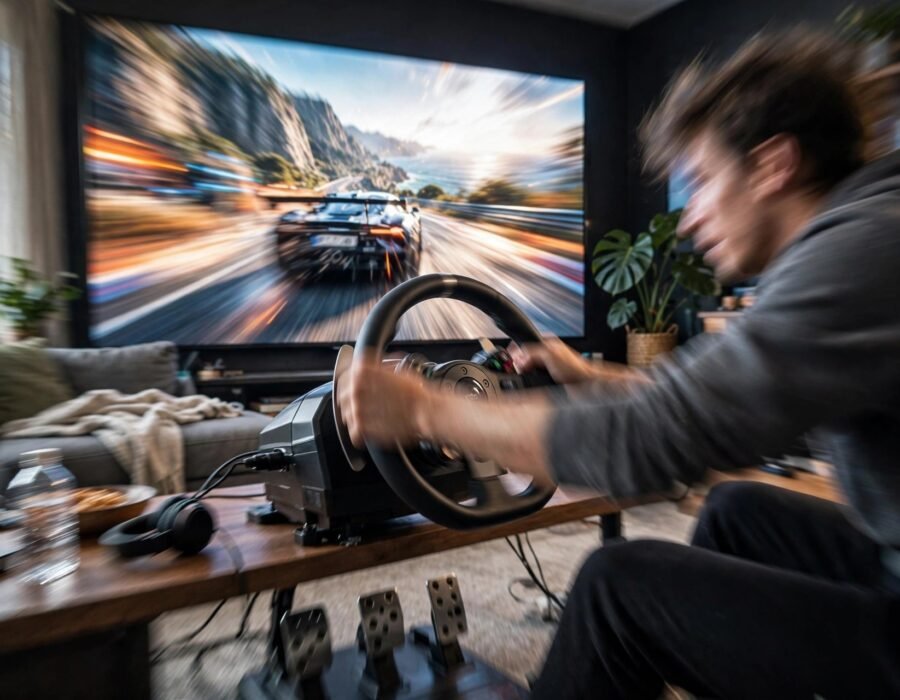
You want to get faster at racing games — not eventually, but now. Maybe a friend humiliated you last weekend, or you watched a world-record run that looked like sorcery. The good news: racing games reward structured practice more than almost any genre, and rapid improvement is genuinely possible. If you are asking where is the cheapest place to get better at racing games quickly in New York — or anywhere, since the cheapest place is your own setup — this guide covers the free and nearly-free methods that actually work, and the expensive traps that do not.
The uncomfortable truth first: there is no cheap shortcut past the fundamentals. Wheel or controller, the fast drivers are fast because of racing lines, braking points, and throttle control — skills, not gear. Money helps at the margins; understanding helps everywhere. Let us start with what costs nothing.
The Free Stuff: Lines, Braking, and Ghosts
The racing line — the fastest path through a corner — is the foundation of all speed. The classic line: brake in a straight line before the turn, turn in late, clip the apex, and unwind the steering while accelerating out. Beginners do the opposite: they brake during the turn (which destabilizes the car), turn in too early, and crawl out of corners. Learning one proper line is worth more than any setup tweak. Watch the racing line assist in-game, then turn it off once the shapes are in your muscle memory — dependence on the assist caps your growth.
Ghost racing is the best free coach ever invented. Download a ghost slightly faster than you — not the world record, which will just demoralize — and chase it. You will see exactly where it brakes later, carries more speed, and exits faster. Time trials with ghosts are how every fast driver trained, and they cost nothing but focused repetition. The ESRB’s game guides will not teach you this, but the in-game leaderboards will: study replays of the top times on your track and steal their braking points shamelessly. The best video games for casual players include several arcade racers where these fundamentals transfer directly once you step up to sims.
Braking: Where Races Are Won
Amateurs lose most of their time under braking — braking too early, too gently, or while turning. The technique: brake hard and late in a straight line, then trail off the brake as you turn in (trail braking), keeping the car’s weight balanced. ABS assists mask bad habits; turning assists down as you improve builds real skill. Practice one corner repeatedly in time trial until the braking point is automatic, then move on. Ten focused minutes on one corner beats an hour of racing badly.
Throttle control is the mirror skill: smooth application on exit, no wheelspin. In powerful cars, the temptation is to floor it; the fast move is progressive squeeze. If the game shows tire telemetry, watch it — red tires mean you are asking for more grip than exists. These are the unglamorous fundamentals that separate fast from slow, and they are 100% free. New York’s sim-racing community — meetups, leagues, and arcade lounges across the boroughs — is full of drivers who will happily critique your lines; the best time of year to visit New York City for gaming events tends to be the winter indoor season, when sim competitions peak.
Assists: Training Wheels With an Expiry Date
Driving assists (traction control, stability management, auto-braking) make you faster immediately and slower ultimately — they cap your potential by intervening before you learn car control. The progression: start with assists on, turn them off one at a time as each becomes a limitation rather than a help. The moment an assist is slowing you down, it has taught you everything it can. This staged approach builds skill faster than either extreme.
What About Gear? The Honest Cost-Benefit
The cheapest fast setup is the controller you own — top esports drivers compete on controllers, so do not let gear be an excuse. If you buy anything, buy it in this order: a wheel with force feedback (used Logitech G29/G920 wheels sell for $150–200 and transform the experience), then a stable mount or stand (a wobbling wheel is worse than a controller), then load-cell pedals (the single biggest hardware upgrade for consistency — braking by pressure rather than travel distance).
Skip: direct-drive wheels ($1,000+) until you are genuinely fast, motion rigs (fun, not fast), and triple screens before you have the fundamentals (a single screen is fine for learning). The FTC’s advice on avoiding online shopping scams is worth reading before buying used sim gear — the secondhand market has great deals and occasional frauds. Total honest budget for a transformative setup: $200–400 used. Everything beyond that is luxury, and luxury does not make you faster — practice does.
Learning From the Fast: Telemetry and Coaching
Once fundamentals are solid, the next leap comes from data. Most sims offer telemetry — throttle, brake, steering, and speed traces you can overlay against faster drivers’. The traces reveal brutal truths: you are braking 50 meters too early, your throttle application looks like a staircase, your steering saws at the wheel. Watching your inputs graphed against a pro’s is humbling and incredibly effective. Paid coaching (many fast drivers offer it for $20–50/hour) compresses months of trial and error into a few sessions — the cheapest money in sim racing if you have already maxed free resources.
The Bottom Line
Getting better at racing games quickly and cheaply means: learn the racing line, brake later and trail off, chase ghosts slightly faster than you, turn off assists progressively, and practice one corner at a time. The cheapest place to improve is your current setup with structured practice — not a store. Spend money only on a used force-feedback wheel once fundamentals are solid. Speed is a skill, and skills are free to build — one corner, one ghost, one session at a time. The stopwatch does not lie.
Frequently Asked Questions
Do I need a steering wheel to be fast?
No — many top competitive drivers use controllers. A wheel improves immersion and fine control, and force feedback teaches car feel faster, but it is not a prerequisite for speed. Master the fundamentals on whatever you have first.
What is trail braking?
Gradually releasing the brake as you turn into a corner, rather than finishing all braking in a straight line. It keeps weight on the front tires for grip while rotating the car. It is the single most important advanced technique in racing games and real racing alike.
How long does it take to get good at racing games?
Noticeable improvement in 2–4 weeks of focused practice (30 minutes daily on fundamentals); genuinely competitive in 3–6 months. The learning curve is steepest at the start — beginners gain seconds per lap quickly, then fight for tenths.
Are driving assists cheating?
No — they are learning tools. Use them while they help, disable them as they limit you. The only “wrong” approach is leaving assists on forever and wondering why you plateaued, or turning them all off immediately and learning nothing from the frustration.