Winter tires in Arizona sounds like a contradiction — until you’re driving up I-17 toward Flagstaff in January and the temperature drops 30 degrees in an hour while snow starts sticking to the Mogollon Rim. Arizona is the only state where you can golf in shorts in the morning and need chains on your tires by afternoon. Choosing winter tires for icy roads here isn’t about surviving a Minnesota winter; it’s about a specific, sneaky hazard: desert drivers encountering real winter conditions a few times a year, often with zero preparation.
Here’s how to think about winter rubber when you live in the Valley but drive in the high country.
Do You Actually Need Winter Tires in Arizona?
Start with geography, not marketing. If your driving never leaves the Phoenix or Tucson metro areas, the honest answer is no — dedicated winter tires are overkill. Valley winter lows hover in the 40s, and all-season tires handle that fine. But if you regularly drive to Flagstaff, the White Mountains, Prescott, or northern Arizona between November and March — or you ski at Snowbowl — you’re driving into genuine winter: Flagstaff averages over 100 inches of snow a year, and I-17, I-40, and SR-89A ice over regularly.
The middle ground most Arizonans actually need: a quality all-terrain or severe-snow-rated all-season tire, kept year-round, rather than a dedicated winter set. Dedicated winters make sense only if you’re doing weekly high-country trips all winter or you keep a cabin up north.
Winter vs. All-Season vs. All-Weather: Know the Difference
All-season tires are the default on most cars. They’re a compromise — fine in light cold, mediocre on ice. Their rubber compounds harden below about 45°F, losing grip even on dry pavement.
All-weather tires (note the different name) carry the three-peak mountain snowflake (3PMSF) symbol, meaning they passed an actual snow-traction test. They’re the sweet spot for Arizona: genuine snow capability you can run year-round without the rapid warm-weather wear of true winter tires. Models in this category have become excellent in recent years.
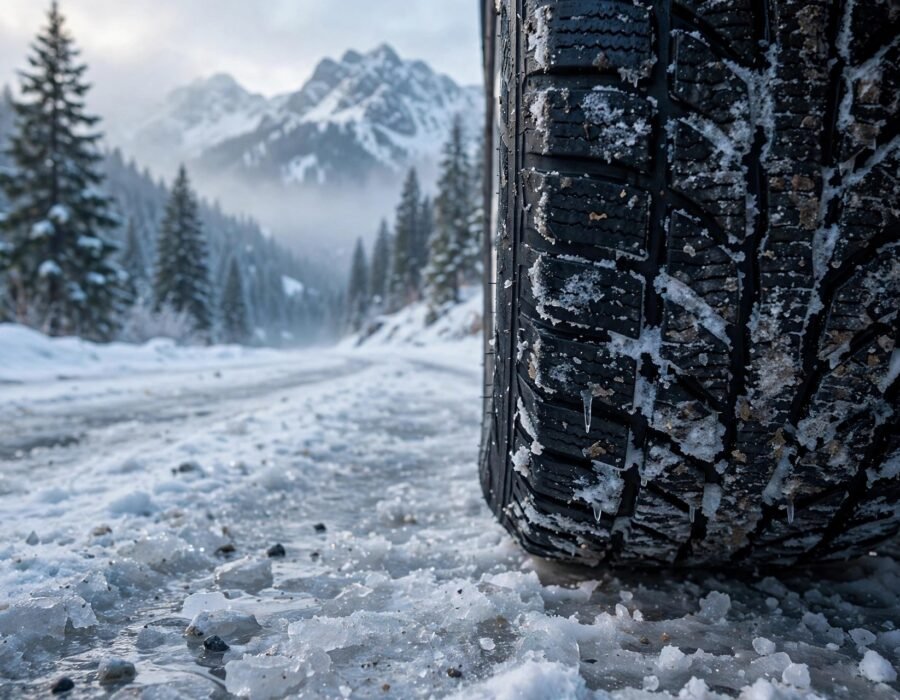
Dedicated winter tires use soft compounds that stay pliable below freezing and aggressive tread patterns that bite into snow and ice. On ice, the difference is dramatic — stopping distances can be 30–40% shorter than all-seasons. But that soft compound wears fast on hot pavement, which is most of the year in Phoenix. Running them year-round in the Valley will chew through a set in one summer.
What to Look For on the Sidewall
The single most important thing: the three-peak mountain snowflake (3PMSF) symbol. This isn’t marketing — it’s an ASTM-tested standard (F1805) proving the tire achieves at least 110% of the snow traction of a reference tire. The older “M+S” (mud and snow) marking is essentially meaningless by comparison; it’s a tread-pattern designation with no performance test behind it.
Beyond the symbol, check:
- Compound: silica-rich compounds stay flexible in cold. This is the invisible tech that separates real winter performers from pretenders.
- Siping: the tiny slits cut into tread blocks. More siping equals more biting edges on ice. Look for dense, interlocking sipe patterns.
- Tread depth: winter performance falls off a cliff below 6/32 inch. If you’re buying used winter tires, measure — half-worn “winter” tires are barely better than all-seasons.
- Studs: legal in Arizona (with restrictions on timing in some jurisdictions), but noisy and damaging to dry pavement. Modern studless winter tires have largely closed the gap on ice; studs only win on glare ice.
Sizing Strategy for Arizona Drivers
Here’s a trick from mountain-state drivers: minus-sizing. A narrower tire on a smaller wheel (e.g., dropping from 19″ to 17″ wheels) cuts through snow to the pavement instead of floating on top, and the taller sidewall absorbs potholes hidden under snow. It’s also cheaper — smaller tires cost less. If you run a dedicated winter set, buy a second set of inexpensive steel or basic alloy wheels in the smaller size and swap the whole wheel, not just the tire. Swapping wheels in your driveway takes 30 minutes; mounting and balancing tires twice a year costs $80–$120 each time.
Keep the overall diameter within 3% of stock so your speedometer, ABS, and traction control stay calibrated. Any reputable tire shop will confirm fitment.
The Arizona-Specific Playbook
For the typical Phoenix driver who heads north 5–15 times a winter:
- Best overall answer: a 3PMSF-rated all-weather tire, run year-round. You get legitimate snow and ice capability for the Flagstaff trips without swapping sets or melting soft compounds in August.
- Maximum safety answer: a dedicated winter wheel-and-tire set, swapped on for December–March if you’re north of the Mogollon Rim regularly. Store the set properly — cool, dark, sealed in bags, stacked or hung.
- Don’t forget: tire pressure drops about 1 PSI per 10°F of temperature change. The drive from 75°F Phoenix to 25°F Flagstaff can cost you 5 PSI — enough to meaningfully hurt grip and trigger the TPMS light. Check pressures before mountain trips.
- Carry chains anyway. ADOT can require chains or 4WD during storms regardless of your tires, and rental cars won’t have winter rubber. Practice installing chains once in your driveway, not on an icy shoulder at midnight.
Drivers who log serious highway miles should also think about fuel stops on mountain routes — apps that find the cheapest gas on road trips are handy when stations thin out north of Camp Verde.
What About AWD and 4WD?
The most dangerous myth in Arizona winter driving: “I have AWD, I don’t need winter tires.” All-wheel drive helps you go; it does nothing to help you stop or turn on ice. Braking and cornering are entirely the tire’s job. An AWD SUV on worn all-seasons will slide through an icy Flagstaff intersection just as helplessly as a front-drive sedan. Tires first, drivetrain second — always.
Costs and Timing
A set of four quality all-weather tires runs $600–$1,000 installed for most crossovers and sedans; dedicated winter sets with spare wheels run $900–$1,600. Buy in October — prices and selection are best before the first storms, and shops get slammed after the first I-17 closure. If you’re budgeting the whole trip, remember that renting a car for a week with proper tires can be cheaper than outfitting a car you rarely take north — though rentals almost never come with winter rubber, so verify before a ski trip.
Conclusion
The best way to choose winter tires for icy Arizona roads is to match the tire to your actual geography: 3PMSF-rated all-weather tires run year-round cover 90% of desert drivers who venture north, while a dedicated minus-sized winter set is the answer for true high-country regulars. Either way, remember that tires — not AWD — are what stop you on ice, check your pressures before climbing to Flagstaff, and carry chains for the storms that close I-17.
Frequently Asked Questions
Do I need winter tires if I live in Phoenix?
Not for Valley driving. But if you regularly drive to Flagstaff, Prescott, or the White Mountains from November to March, a 3PMSF-rated all-weather tire (run year-round) is a smart upgrade over standard all-seasons.
What does the three-peak mountain snowflake symbol mean?
It’s an ASTM-tested certification that the tire delivers at least 110% of the snow traction of a reference tire. It’s a real performance standard — unlike the older “M+S” marking, which only describes tread pattern.
Can I run winter tires year-round in Arizona?
You can, but you’ll destroy them. Winter compounds are designed for cold and wear rapidly on hot pavement — a Phoenix summer can consume a set of winter tires in a single season. All-weather tires are the year-round alternative.
Are studded tires legal in Arizona?
Yes, with some seasonal and local restrictions. However, modern studless winter tires perform nearly as well on ice and far better on dry pavement, so studs are rarely the best choice for Arizona’s intermittent winter conditions.
Does AWD replace the need for winter tires?
No. AWD helps with acceleration but does nothing for braking or cornering on ice — those depend entirely on your tires. A two-wheel-drive car on winter tires out-brakes an AWD vehicle on all-seasons on icy roads.
Authority sources: NHTSA tire safety guidance and Tire Rack’s winter tire testing data.