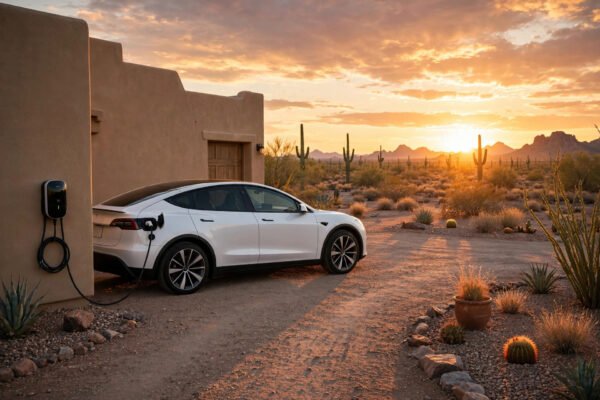
Phoenix in July. It’s 115°F outside, your EV’s dashboard is warning about battery temperature, and you’re wondering if the desert sun is quietly killing the most expensive component you own. It’s a fair worry — an EV battery pack can cost $10,000–$20,000 to replace, and Arizona’s extreme heat is genuinely harder on batteries than milder climates. But modern electric cars are far tougher than early models, and a few smart habits make a massive difference. This guide gives Arizona beginners the safest way to maintain an electric car battery properly.
You’ll learn how heat actually affects EV batteries, the charging habits that maximize lifespan, thermal management features to use, what to do during extreme heat waves, and how to read your battery’s health over time.
How Heat Affects Your Battery (and Why It’s Manageable)
Lithium-ion batteries degrade through two mechanisms: calendar aging (slow chemical breakdown over time, accelerated by heat) and cycle aging (wear from charging and discharging). High temperatures accelerate both — parked at 115°F with a full charge, a battery degrades measurably faster than one parked at 75°F. This is physics, not a defect.
But context matters. Modern EVs have active thermal management systems — liquid cooling circuits that keep the battery near its happy zone (roughly 60–95°F) even when ambient temperatures soar. A 2026 EV parked in Phoenix heat is actively protecting itself, running coolant pumps and sometimes the AC compressor to cool the pack. This is why battery degradation in hot climates, while real, is far less dramatic than early Nissan Leaf owners experienced — those cars had air-cooled batteries with no active thermal management, and Arizona heat famously degraded them.
Real-world data is reassuring: fleet studies show modern liquid-cooled EVs losing roughly 1–2% of capacity per year in hot climates versus under 1% in temperate ones. Over 8–10 years, that’s the difference between 85% and 90% remaining capacity — noticeable, not catastrophic. And federal law requires 8-year/100,000-mile battery warranties (California-emission states get 10-year/150,000-mile coverage), so premature failure is the manufacturer’s problem, not yours. The Department of Energy’s EV resources confirm these durability trends across tested fleets, and FuelEconomy.gov’s EV charging guide compares home, public, and fast-charging costs.
The Charging Habits That Matter Most
The 20–80 rule: For daily driving, keep your battery between 20% and 80% charge. Lithium-ion chemistry degrades fastest at the extremes — sitting at 100% or draining to near-zero stresses the cells. Most EVs let you set a charge limit in the app or infotainment system; set it to 80% and forget it. Charge to 100% only before long road trips, and try to time it so the car doesn’t sit full for hours.
DC fast charging: Fast charging generates significant heat and stresses batteries more than Level 2 charging. It’s fine when needed — that’s what it’s for — but don’t fast-charge daily if you have home charging available. In Arizona summers, try to fast-charge during cooler hours (early morning) when possible; the battery starts cooler and the thermal system works less hard.
Charging in extreme heat: If your garage hits 120°F, the car will run its cooling system while charging, which is normal — you’ll hear fans and pumps. Park in shade or a garage rather than direct sun whenever possible. Precondition the cabin while still plugged in before driving; this uses grid power instead of battery for the initial cooldown, preserving range and reducing battery thermal load.
Don’t let it sit at low charge in heat. A battery baking at 5% charge in 115°F heat is the worst-case scenario — low voltage plus high temperature accelerates degradation fastest. If you’re leaving the car parked for days in summer, leave it at 50–60% charge, plugged in if possible (most EVs have a “storage” or vacation mode).
Using Your Car’s Thermal Management Features
Every modern EV has battery preconditioning — learn yours. Preconditioning warms or cools the battery to optimal temperature before DC fast charging, which dramatically improves charging speed and reduces stress. Most cars do this automatically when you navigate to a charger; the key beginner mistake is driving to a fast charger without navigation active, then wondering why charging is slow.
Cabin overheat protection (Tesla) or similar features in other brands keep the interior from reaching destructive temperatures — use it, but understand it consumes battery. In extreme heat, the tradeoff is worth it: a cooler cabin means less AC blast needed when you return, and less thermal shock to interior components.
Scheduled charging is your friend in Arizona: set charging for overnight hours when it’s cooler and electricity is cheaper (many Arizona utilities offer time-of-use EV rates — APS and SRP both have plans that cut overnight charging costs significantly). Cooler charging is gentler on the battery and cheaper for your wallet. For trip planning, trip cost planning tools have EV equivalents — apps like A Better Routeplanner optimize charging stops for battery health and speed. For budgeting those trips, US road trip cost breakdowns help you compare charging costs against gas.
Reading Battery Health and Knowing What’s Normal
Some range loss is normal and not a defect. Expect 2–5% in the first year (initial settling), then ~1% annually. What matters is the trend: steady, gradual decline is normal; sudden drops warrant a service visit. Most EVs show battery health in a service menu or app; third-party tools (like Recurrent reports) provide independent health scores useful for resale.
Don’t obsess over daily range fluctuations — displayed range varies with temperature, driving speed, AC use, and recent driving history. A “loss” of 15 miles on a 115°F day with the AC blasting is physics, not degradation. Compare same-condition range over months, not day to day.
Keep software updated: manufacturers continuously improve battery management via over-the-air updates, including better thermal strategies for hot climates. And maintain your 12V auxiliary battery too — ironically, the little 12V battery causes more EV roadside failures than the big traction battery, and Arizona heat kills 12V batteries in 2–3 years. Replace proactively.
Frequently Asked Questions
Will Arizona heat destroy my EV battery?
No — modern liquid-cooled batteries handle Arizona heat well, degrading only slightly faster than in temperate climates (roughly 1–2% per year versus under 1%). Early air-cooled EVs suffered badly, but current thermal management has largely solved the problem.
Should I charge to 100% every night?
No. Set a daily limit of 80% for regular use. Charge to 100% only before long trips, and avoid letting the car sit at full charge in extreme heat for extended periods.
Is it bad to fast-charge in 115°F weather?
It’s harder on the battery than Level 2 charging, but the car’s thermal management handles it — that’s what it’s designed for. When possible, fast-charge during cooler hours and navigate to the charger so preconditioning activates.
How long will my EV battery last in Arizona?
Most data suggests 12–15+ years to 70–80% capacity in hot climates with good habits — well beyond the 8-year/100,000-mile federal warranty. The battery will likely outlast your ownership of the car.
The Bottom Line
Maintaining your EV battery in Arizona comes down to five habits: charge to 80% daily, use Level 2 charging as your default, park in shade and stay plugged in during heat waves, precondition before fast charging, and keep software updated. Do that, and the desert sun becomes a minor footnote in your battery’s long life rather than its tragic ending. The technology has matured — now the maintenance just needs to match it.