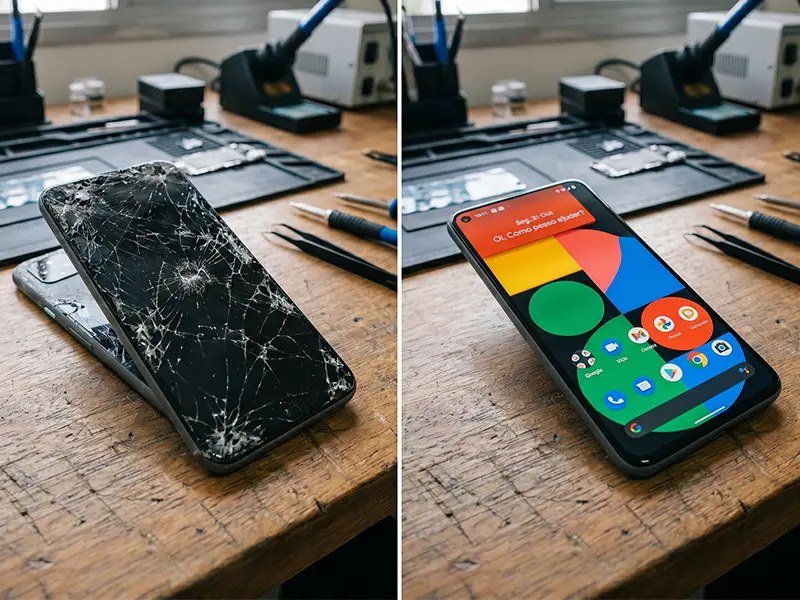
The screen is cracked, the battery dies by lunch, and the repair shop just quoted you $220. A new phone costs $800. How do I know when it is time to replace my phone instead of repairing it? This decision has a clear framework — and most people either replace too early (wasting money) or repair too long (throwing good money after bad).
Here’s how to make the call with confidence.
The 50% Rule (Your Starting Point)
The simplest framework: if the repair costs more than 50% of the phone’s current used value, replace it. A $200 screen repair on a phone worth $250 used? Borderline. A $200 repair on a phone worth $120? You’re paying more than the phone is worth.
Check your phone’s current value on Swappa or carrier trade-in estimators — not what you paid for it. Sunk cost doesn’t count; only current value matters.
Refine with the total investment test: add up everything you’ve spent on repairs in the last year. If repairs are approaching the cost of a refurbished replacement (often $300–$500 for a 1–2 year old flagship), stop repairing and redirect that money.
The Age Test: Software Support Matters Most
Hardware age is less important than software support age:
- iPhones: ~6–7 years of iOS updates. An iPhone 11 (2019) still getting updates in 2026 is viable; once updates stop, security risks accumulate.
- Samsung/Google flagships: 4–7 years depending on model (newer models promise longer).
- Budget Androids: often 2–3 years — after that, you’re exposed.
If your phone no longer receives security updates, replace it — regardless of repair costs. An unpatched phone handling your banking and email is a risk no screen repair justifies. The CISA is blunt about this: unsupported devices shouldn’t handle sensitive data.
Signs Repair Is Throwing Good Money After Bad
Replace rather than repair when you see multiple of these:
- Cascading failures: you fixed the screen, now the battery’s dying, and the charging port is loose. One repair is maintenance; three is a retirement plan.
- Performance can’t keep up: apps you need require newer OS versions; the phone stutters through basic tasks. Battery age compounds this — old batteries throttle performance.
- Repair costs stack: screen ($180) + battery ($70) + charging port ($60) = $310 on a phone worth $200.
- Missing features you actually need: 5G for your work hotspot, a camera good enough for your side business, storage you can’t expand. When storage can’t be expanded, that alone can force the decision.
- Repair parts are scarce: shops can’t get quality screens for 5+ year old models — you’ll get junk parts at premium prices.
Signs Repair Is the Smart Move
Repair wins when:
- The phone is under 3 years old and everything else works — a $150 screen replacement or $70 battery swap buys years.
- It’s a single isolated issue — cracked screen on an otherwise perfect phone is the textbook repair case.
- You’re happy with the phone. Underrated factor: if it does everything you need, there’s no reason to spend $800 for novelty.
- Budget is tight: a $100 repair that buys 18 more months is excellent value — that’s $5.50/month for a working phone.
- Environmental preference: keeping a phone 4 years instead of 2 roughly halves its lifetime carbon footprint.
And when you do replace, sell the old phone properly — even a damaged phone has value for parts or refurbishment. A phone with a cracked screen still fetches $50–$150.
The Environmental Case for Repairing Your Phone
Manufacturing a single smartphone generates roughly 85–95% of its lifetime carbon emissions — mining rare earths, refining metals, assembling components, shipping globally. Using the phone accounts for a tiny fraction. Every year you extend a phone’s life through repair avoids a significant chunk of manufacturing emissions.
The e-waste dimension is equally stark: over 50 million metric tons of e-waste are generated annually, with phones a meaningful share. A repaired phone is a phone that doesn’t enter that stream — and repair also recovers the economic value embedded in the device rather than shredding it.
This doesn’t mean repairing at any cost — a $300 repair on a $150 phone is still bad economics. But when the math is close, the environmental tiebreaker favors repair. And the most sustainable phone is the one you already own, maintained well: a quality case, screen protector, and battery replacement at year 2–3 can realistically stretch a phone to 5–6 years.
Frequently Asked Questions
Is it really better for the environment to repair?
Yes, overwhelmingly — manufacturing dominates a phone’s footprint, so extending life avoids the largest emissions source. Studies (including EU research) confirm repair beats replacement environmentally in nearly all scenarios where the repair is technically viable.
What should I do with a phone that’s not worth repairing?
Recycle it properly — never trash it. Apple, Samsung, Best Buy, and carriers all take old phones free; many give trade-in credit even for dead devices. Recycling recovers gold, copper, cobalt, and rare earths. Donation programs refurbish working phones for people in need.
Are refurbished phones environmentally friendly?
Very — buying refurbished extends a device’s useful life without new manufacturing, typically at 40–60% of the carbon footprint of new. It’s the second-best option after repairing your current phone.
What is the right-to-repair movement?
A consumer and legislative push requiring manufacturers to provide parts, tools, and repair documentation to owners and independent shops. The EU and several US states have passed right-to-repair laws — gradually making repairs cheaper and more available.
Do phone manufacturers recycle old phones?
Apple (Daisy robot), Samsung, and Google all operate recycling programs recovering materials from returned devices. Apple’s stated goal is a closed-loop supply chain. Trade-in programs feed these systems — another reason to trade in rather than drawer-store old phones.
How long should a phone last?
With a battery replacement at year 2–3 and reasonable care, 5–6 years is realistic for iPhones and flagship Androids (software support is usually the limiting factor). Budget phones: 3–4 years. The ‘upgrade every 2 years’ cycle is marketing, not engineering.
The Bottom Line
Use the 50% rule (repair cost vs. current used value), check software support status (no security updates = replace, period), and count the problems — one isolated issue means repair, cascading failures mean replace. A $150 repair on a 2-year-old phone you like is smart money; a $250 repair on a 5-year-old phone with a dying battery is not.