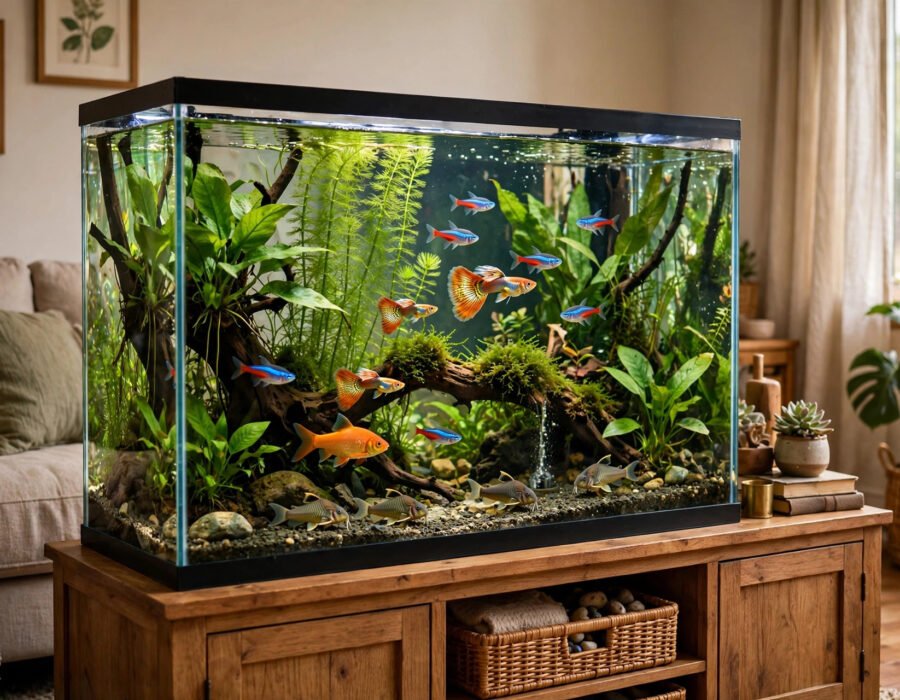
You’ve decided to get your first aquarium. Exciting! Then you visit the pet store, and the employee gestures at a wall of tanks — 5 gallons, 10, 20, 29, 55 — while a betta fish stares at you from a cup the size of a coffee mug. The paradox every beginner faces: smaller tanks seem easier, but they’re actually harder. This guide gives Midwest beginners the safest way to choose the right fish tank size — one that keeps fish healthy and doesn’t turn your new hobby into a chemistry nightmare.
You’ll learn why bigger is genuinely easier for beginners, the minimum sizes for popular starter fish, how to match tank size to your space and budget, the hidden costs of going too small, and a step-by-step setup plan.
The Counterintuitive Truth: Bigger Tanks Are Easier
This surprises everyone, but it’s the most important concept in the hobby: larger volumes of water are more chemically stable. In a 5-gallon tank, one overfeeding or one missed water change can spike ammonia to lethal levels in hours. In a 29-gallon tank, the same mistake dilutes across six times the water, giving you a comfortable margin to notice and fix it. Small tanks are unforgiving; large tanks are patient.
Temperature stability follows the same logic. A Midwest home might swing from 68°F at night to 76°F during the day in shoulder seasons — a 5-gallon tank tracks those swings quickly, stressing fish, while a larger tank buffers them. More water also means more room for beneficial bacteria (the invisible workforce that processes fish waste), more swimming space (reducing aggression), and more forgiveness for the beginner mistakes you will absolutely make.
The experienced aquarist’s rule: buy the largest tank your space and budget allow, with 20 gallons as the practical beginner minimum for a community tank. The ASPCA’s pet care resources emphasize that adequate space is a core welfare requirement, not a luxury — cramped conditions cause chronic stress, disease, and shortened lifespans.
Minimum Sizes for Popular Beginner Fish
Betta fish: The pet-store cup is cruelty, not a recommendation. Minimum 5 gallons for a single betta — heated (78–80°F) and filtered. A 5-gallon betta setup is the one legitimate “small tank” in the hobby.
Small schooling fish (neon tetras, guppies, white cloud minnows): 10 gallons minimum, 20 gallons far better. These fish need groups (6+ of each species) and swimming room; a 10-gallon tank maxes out at about 8–10 small fish total.
Beginner community tank (mixed tetras, corydoras, a centerpiece fish): 20–29 gallons. This is the sweet spot — stable, versatile, and fits on a standard sturdy stand or dresser. A 29-gallon has the same footprint as a 20-gallon long but extra height, making it the best value in the hobby.
Goldfish: Here’s the shocker — those “beginner” goldfish need 40+ gallons for one fancy goldfish, 75+ for a pair. Goldfish grow to 8–12 inches and produce enormous waste. The classic goldfish bowl is arguably the cruelest common pet setup in America. If you want goldfish, commit to the big tank or choose a different fish.
The old “one inch of fish per gallon” rule is dangerously oversimplified — it ignores waste production, swimming needs, and territoriality. Instead, research each species’ adult size and temperament, then stock conservatively. Understocked tanks are healthy tanks; overstocked tanks are emergency rooms. When introducing any new pet to your home, the same principle applies: start with more space and resources than you think you need.
Matching Tank Size to Your Midwest Home
Space: Measure twice. A filled 29-gallon tank weighs ~330 pounds — it needs a dedicated aquarium stand or genuinely solid furniture, not a particle-board bookshelf. Also consider what’s underneath — water-resistant flooring options turn a potential leak from disaster into cleanup. Standard tank footprints: 10-gallon (20″x10″), 20-long (30″x12″), 29-gallon (30″x12″), 55-gallon (48″x13″). Apartments often restrict tanks above 20–30 gallons in leases — check before buying.
Budget: Realistic starter costs: 10-gallon kit ($80–$150), 20-gallon setup ($150–$250), 29-gallon setup ($200–$350). Kits bundle tank, filter, heater, and light — good value for beginners. Beyond the kit, budget for substrate, decorations, water conditioner, test kit ($25–$40, non-negotiable), and fish. The test kit is the most-skipped purchase and the most important: you cannot manage what you don’t measure.
Midwest climate specifics: Winter heating dries indoor air and can drop room temperatures near exterior walls — keep tanks away from windows and exterior doors, and size your heater generously (5 watts per gallon minimum; in drafty rooms, go higher). Summer heat waves can push small tanks above 85°F; larger tanks resist this better, and a $15 clip-on fan across the water surface provides effective evaporative cooling.
The Nitrogen Cycle: Why You Can’t Add Fish on Day One
The number-one beginner killer — of fish — is “new tank syndrome”: adding fish to an uncycled tank where ammonia from waste has no bacterial colony to process it. The nitrogen cycle takes 2–6 weeks to establish: beneficial bacteria colonize your filter media, converting toxic ammonia → nitrite (also toxic) → nitrate (tolerable, removed by water changes). Fish added before this completes suffer ammonia burns and often die within days.
Fishless cycling is the humane method: set up the complete tank, add an ammonia source (pure ammonia or fish food), and test daily until ammonia and nitrite read zero and nitrates appear. It requires patience but costs no fish lives. “Bacteria in a bottle” products can speed this up but don’t fully replace cycling — use them as a supplement, not a shortcut.
Once cycled, add fish gradually — a few at a time over weeks, not a full stocking on day one. Each addition increases the biological load; the bacterial colony needs time to grow into it. Test water weekly for the first two months. The American Veterinary Medical Association includes aquatic animals in its welfare guidance — fish feel stress and pain, and proper cycling is the foundation of ethical fishkeeping.
Frequently Asked Questions
What is the best fish tank size for a complete beginner?
A 20-gallon long or 29-gallon tank. They’re chemically stable enough to forgive beginner mistakes, affordable, fit most spaces, and accommodate a genuine community of fish. Avoid anything under 10 gallons except for a single betta.
How many fish can I put in a 20-gallon tank?
Conservatively, 12–18 inches of small, slim-bodied adult fish (e.g., 10 neon tetras + 6 corydoras + a honey gourami). Research each species — waste production and territorial needs matter more than length alone.
Do I need a heater in the Midwest?
Yes for tropical fish (tetras, bettas, guppies need 74–80°F). Midwest homes drop below that in winter, especially at night. Cold-water species like white cloud minnows can go heater-free in most heated homes.
How often should I change the water?
25–30% weekly for most beginner tanks, using dechlorinated water matched to tank temperature. Test first — if nitrates stay under 20 ppm, your schedule is working. Never change all the water at once; it crashes the bacterial colony.
The Bottom Line
Choose the largest tank your space and budget allow — 20 to 29 gallons is the beginner sweet spot — because bigger water volumes forgive the mistakes every beginner makes. Cycle the tank before adding fish, stock gradually, test your water, and respect the nitrogen cycle. Do that, and your first aquarium becomes a thriving ecosystem instead of an expensive lesson. The fish are counting on you to get this right.