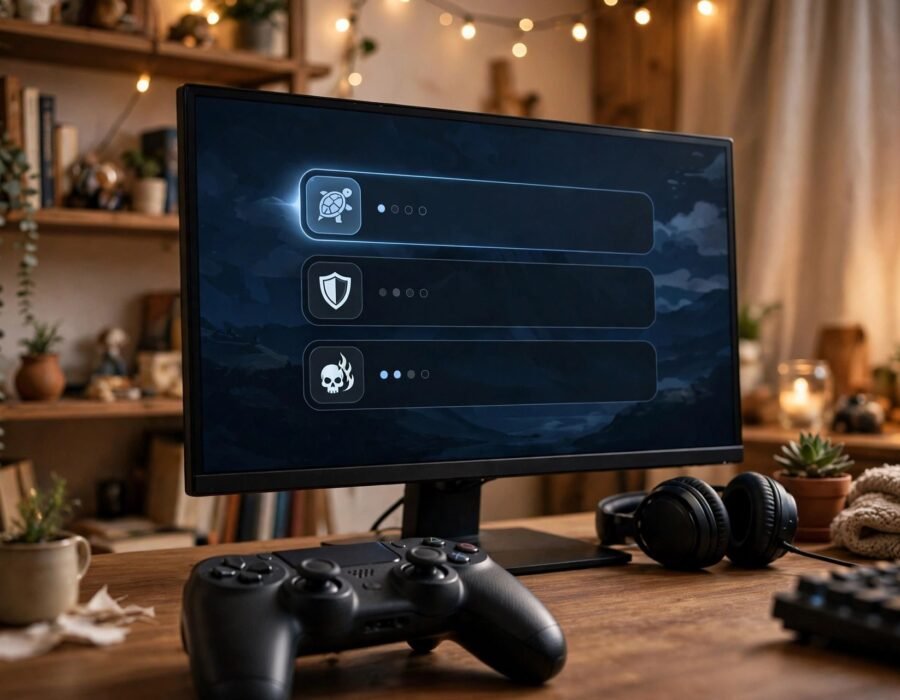
Easy, Normal, Hard, Nightmare. Story Mode, Survivor, “Give Me God of War.” Modern games offer a bewildering array of difficulty options, and choosing wrong can ruin a $70 purchase — too easy and you are bored, too hard and you are miserable. If you want to know what is the best way to understand game difficulty settings explained in the US — the labels are the same everywhere — this guide decodes what each setting actually changes, why developers design them the way they do, and how to pick the right one for you without shame.
First, the reframe: difficulty settings are accessibility features, not moral judgments. The idea that “real gamers” play on hard is gatekeeping nonsense that developers themselves reject — most designers want you to finish their game and have designed multiple difficulties precisely so different players can. Choosing the setting that gives you the best experience is the correct choice, full stop.
What Difficulty Actually Changes
It varies by game, but the common levers are: enemy health and damage (the bluntest instrument — hard modes often just inflate numbers), enemy aggression and AI behavior (smarter flanking, faster reactions), resource scarcity (less ammo, fewer heals), checkpoint frequency (harsher punishment for failure), and player assists (aim assist strength, puzzle hints). Some games change only numbers; the best-designed ones change behavior — enemies that were dumb become cunning, which feels fundamentally different from enemies that just take ten bullets.
Then there are the special cases. FromSoftware’s Souls games famously offer no difficulty slider — the difficulty is the design, with the community split on whether that is artistic integrity or accessibility failure. Adaptive difficulty (Resident Evil 4 pioneered it) quietly adjusts behind the scenes based on your performance. And “story mode” options increasingly strip combat challenge entirely for players there for the narrative. The ESRB’s rating summaries sometimes note difficulty-relevant content, but the real information is in reviews and community discussion. For players who just want a good time without friction, the best video games for casual players are curated for exactly that experience.
How to Choose: A Practical Framework
Start one notch below your instinct. Most players overestimate — the Dunning-Kruger effect applies to gaming too — and you can always raise the difficulty mid-game (most modern titles allow this; a few lock it). Consider your goals: there for the story? Pick easy/story and enjoy the ride. There for mastery? Start normal, graduate to hard. Returning to a genre after years away? Drop a level without shame; rust is real.
Consider your time, too. Higher difficulties demand more attempts, more learning, more hours — a hard-mode playthrough can take twice as long. If you have six gaming hours a week, “hard” might mean finishing one game a year. That is a legitimate factor, not a cop-out. And consider the specific game: a hard mode in a tactics game rewards thinking, while a hard mode in a reflex shooter just demands youth. Match the difficulty to the kind of challenge you actually enjoy.
The Achievement Question
Some achievements and trophies are difficulty-locked, which pressures players into settings they will not enjoy. Here is the healthy perspective: trophies are imaginary. If chasing a hard-mode achievement turns a beloved game into a chore, the achievement has negative value. The players with the most impressive trophy cabinets are often the ones having the least fun. Play for the experience; let achievements be a byproduct.
Why Difficulty Design Is Hard (for Developers)
Balancing difficulty is one of game design’s toughest problems. Developers playtest with limited pools, and what is “normal” for a developer with 2,000 hours in their own game is nightmare for a newcomer. This is why so many games ship with difficulty problems — too easy, too hard, or spikes that wall players mid-game. Playtesting can never cover the full skill distribution.
The industry is evolving toward better solutions: granular options (separate sliders for combat, puzzles, and exploration — as in recent AAA titles), assist modes (Celeste’s celebrated approach: tweak any parameter without judgment), and the aforementioned adaptive systems. The APA’s research on games and psychology supports what designers are learning: the optimal challenge zone — hard enough to engage, easy enough to progress — is deeply individual, and one-size-fits-all difficulty was always a fiction. The best board games for adults solved this centuries ago with handicaps and variable setups — video games are just catching up.
Difficulty and Accessibility: The Bigger Picture
The difficulty conversation is merging with the accessibility conversation — and that is progress. Features like Celeste’s assist mode, God of War’s granular sliders, and Forza’s auto-driving options recognize that barriers to enjoyment come in many forms: reflexes, vision, cognition, time. The old model asked “how hardcore are you?”; the new model asks “what do you need to have fun?” Developers who embrace this sell more games to happier players. The holdouts clinging to difficulty-as-identity are fighting a cultural shift they have already lost — the future is options, not gatekeeping.
The Psychology of Challenge
Why do we crave difficulty at all? Psychologists point to the concept of “flow” — the deeply satisfying state where challenge matches skill. Too easy produces boredom; too hard produces anxiety; the sweet spot produces engagement so complete that hours vanish. Good difficulty design is really flow design: a curve that rises with your growing competence. This is why the “right” difficulty is personal and dynamic — your flow zone today is not your flow zone after 50 hours. The best modern games understand this and offer granular control, trusting you to tune your own experience.
The Bottom Line
Difficulty settings adjust enemy strength, AI behavior, resources, and assists — and the right choice is the one that gives you the best experience, not the one that impresses strangers. Start a notch below your instinct, raise it if you are bored, and never apologize for story mode. Games are supposed to be fun; the setting that delivers fun is the correct setting. Everything else is noise from people who confuse suffering with skill. Play your way — the only wrong difficulty is the one that makes you quit playing entirely. The developers built these options for you; use them.
Frequently Asked Questions
Should I feel bad playing on easy?
No. Difficulty is an accessibility feature, and developers include easy modes specifically so more people can enjoy their work. The “real gamers play on hard” attitude is gatekeeping. Your enjoyment is the only metric that matters.
What is the hardest game difficulty ever?
Subjective, but commonly cited: “Give Me God of War” mode, Ninja Gaiden’s higher difficulties, and one-life modes in roguelikes. The Souls series’ base difficulty (with no easier option) remains the cultural benchmark for demanding design.
Can I change difficulty mid-game?
In most modern games, yes — check the options menu. A few titles lock difficulty at the start (some roguelikes, some FromSoftware games by design). When in doubt, assume you can change it; developers increasingly allow mid-game adjustment.
Do harder difficulties give better rewards?
Sometimes — certain games gate achievements, trophies, or endings behind higher difficulties. But the gameplay experience itself is the reward; if hard mode makes you miserable, no trophy compensates. Check what is locked before committing.