
Most wilderness emergencies look nothing like the movies. It’s a wrong turn, a dead phone, a twisted ankle, or a day hike that runs past sunset. That’s what wilderness survival usually means in real life: getting through a few bad hours or a couple of cold nights, calmly and sensibly, until you’re found or can walk out.
This survival guide shows you how to survive in the wild step by step. You’ll learn what your body actually needs, what to do in the first ten minutes, how to build shelter, get safe water, signal for help, and what to pack so you never have to test any of this.
This guide is for education. It doesn’t replace hands-on training, and if you can reach emergency services, call them first.
The Short Version: 7 Priorities
- Stay calm and stop moving. Panic makes bad decisions.
- Get out of wind, rain, and cold. Build shelter and insulate yourself.
- Signal for help early. Don’t wait until you’re desperate.
- Find and treat water.
- Make fire if you can do it safely.
- Stay put unless your spot is dangerous.
- Worry about food last.
What Do You Need to Survive? The Rule of 3s

Survivalists use a simple rule of thumb to rank what matters most. These numbers are rough, and real limits depend on weather, age, health, and effort.
| You need | Rough limit | What this means |
|---|---|---|
| Air (and staying out of icy water) | About 3 minutes | Get out of danger first |
| Shelter and warmth in harsh weather | About 3 hours | Cold, wet, and wind kill faster than hunger |
| Water | About 3 days | In extreme heat, much less |
| Food | About 3 weeks | The last thing to worry about |
The order can change with the environment. In the desert, water and shade come first. In freezing rain, warmth comes first. The point is to solve the fastest-killing problem first.
The Survival Mindset: Qualities That Help You Survive
Gear helps, but your head matters more. The people who do well in emergencies tend to share a few qualities:
- Calm. Fear is normal. Slow breathing and a clear plan keep it from taking over.
- Adaptability. Your plan will fall apart. Change it without wasting time on “what if.”
- Patience. Rescue and recovery often take longer than you’d like.
- Resourcefulness. Use what you have: a garbage bag becomes a poncho, a backpack becomes insulation for your feet.
- Humility. Admitting you’re lost early is the smart move, not the embarrassing one.
A trick that works: break everything into small jobs. “Survive the night” is too big. “Gather ten armfuls of dry leaves” is doable. Small wins keep your morale up.
Step One: STOP
The moment you realize you’re lost or hurt, use the STOP method:
- S – Stop. Don’t wander. Sit down, breathe, and drink some water if you have it.
- T – Think. How did you get here? What landmarks do you remember? How long until dark?
- O – Observe. Check your body for injuries. Check your gear. Check the weather and the terrain.
- P – Plan. Pick a simple plan, and act on it.
Stay or go? In most cases, staying put is the better choice. Search teams start looking at the last place you were seen, and a stationary person is much easier to find than a moving one. Move only if your spot is unsafe (flood risk, rockfall, wildfire) or you’re certain of a safe route out. The National Park Service hiking safety page covers this and the Ten Essentials in more detail.
7 Core Survival Skills
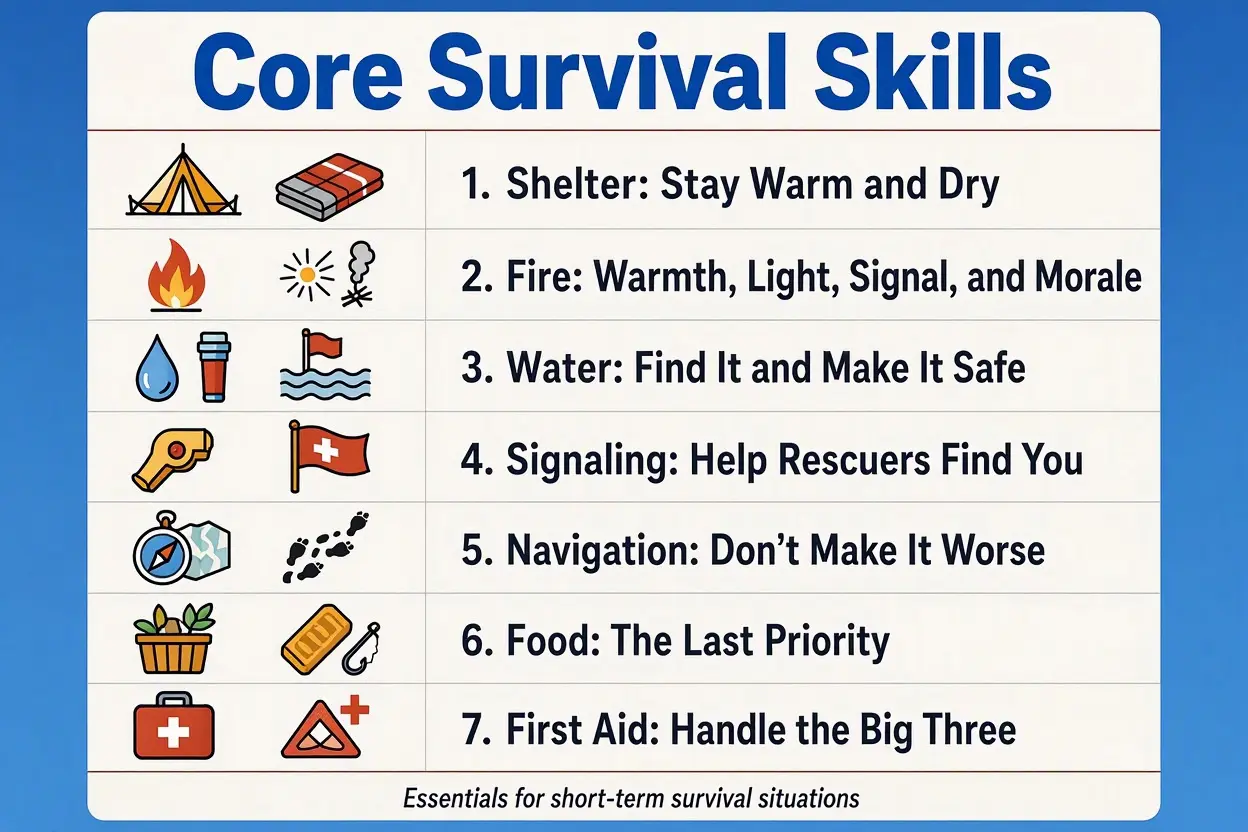
These are the survival skills worth learning first. Each one maps to a need from the rule of 3s.
1. Shelter: Stay Warm and Dry
Cold and wet weather kills more people than animals or hunger. Your goal is to stop heat loss.
- Get off the ground. The ground steals heat faster than the air. Pile up dry leaves, pine needles, or branches at least a foot deep and sit or lie on it.
- Block the wind. Use a rock face, fallen log, or thick brush. Make your shelter small, so your body heat can warm the space.
- Pick your spot carefully. Avoid the bottom of valleys (cold air pools there), dry riverbeds (flash floods), and areas under dead branches.
- Use what you carry. An emergency blanket, a tarp, or even a large garbage bag helps a lot.
- Keep your clothes dry. Wet cotton loses its warmth. Add layers before you get cold, and remove one before you sweat.
A simple debris shelter: lean a long branch against a stump or rock, add ribs along both sides, and cover it with a thick layer of leaves and branches. Stuff the inside with dry material. It takes a while, so start well before dark.
2. Fire: Warmth, Light, Signal, and Morale
Fire needs three things: tinder (dry, fine material like birch bark or dry grass), kindling (pencil-thin sticks), and fuel (wrist-thick wood and bigger).
- Collect everything before you strike a spark, and use twice as much as you think you need.
- Build on a dry base, such as bark, stones, or flat wood, and clear the area around it.
- Light the tinder, add kindling slowly, and only then add fuel.
- In wet weather, look for dead branches still on the tree, and split larger pieces to reach dry wood inside.
- Never leave a fire unattended, and put it out fully before you leave.
Carry two fire sources (a lighter plus a ferro rod or waterproof matches). Making fire by friction is a real skill, but it’s very hard when you’re cold, tired, and stressed, so don’t count on it. Also check local rules, since fire bans are common in dry seasons.
3. Water: Find It and Make It Safe
Water is your next priority after warmth. Even clear mountain streams can carry germs, so treat everything you drink.
Best methods, in order:
- Boil it. Bring water to a rolling boil for 1 minute (3 minutes above about 6,500 feet or 2,000 meters). This kills viruses, bacteria, and parasites. If the water is cloudy, filter it through a clean cloth first, or let it settle.
- Use chlorine dioxide tablets if you can’t boil. These also handle harder-to-kill parasites like Cryptosporidium.
- Use a filter, but check the label. Many portable filters don’t remove bacteria or viruses, so choose one made to remove parasites and follow the instructions.
The CDC’s guide on making water safe in an emergency has the full steps.
Where to look: running water is better than still water. Follow animal trails and low ground, and check the base of cliffs. Collect rain in a tarp, and gather dew with a clean cloth in the morning.
Never: drink water that smells of fuel or chemicals (boiling won’t fix it), drink urine, or drink seawater. Don’t rely on cactus juice either.
4. Signaling: Help Rescuers Find You
Being found is the goal, so make yourself easy to see and hear.
- Three of anything is a widely recognized distress signal: three whistle blasts, three fires, three flashes of a mirror.
- Use a whistle instead of shouting. It carries farther and doesn’t tire you out.
- Add color and contrast. Lay bright clothing or gear in an open area. Big shapes on the ground, like an X or SOS, are easy to spot from the air.
- Make smoke. Add green leaves to a fire for thick smoke during the day.
- Carry a personal locator beacon (PLB). A PLB sends your location to rescue services by satellite from anywhere with sky view. In the US, it must be registered with NOAA (see the FCC’s PLB page and NOAA SARSAT). Rules differ in other countries, so check yours.
5. Navigation: Don’t Make It Worse
A map and compass never run out of battery, but you need to know how to use them before you go. If you decide to move:
- Mark your route (broken branches, stacked stones, scratches on trees) so searchers can follow you.
- Avoid moving at night or in bad weather.
- Following a stream downhill often leads to people eventually, but it can also lead you through cliffs, waterfalls, and thick brush. Treat it as a last resort, not a default.
6. Food: The Last Priority
You can go without food for days, even weeks, so don’t risk your life for a meal. Don’t eat wild plants or mushrooms unless you’re absolutely sure what they are. Many are toxic, and vomiting or diarrhea will dehydrate you fast. Eat the food you carry, in small amounts. Stay warm, since your body burns extra energy trying to stay warm when it’s cold.
7. First Aid: Handle the Big Three
- Bleeding: apply firm, direct pressure with a clean cloth and don’t lift it to check.
- Hypothermia: watch for uncontrollable shivering, clumsiness, confusion, slurred speech, and drowsiness. It can happen even above freezing if you’re wet or chilled by wind. Get the person out of wet clothes, into shelter, and insulated from the ground. Warm the chest and core first, give warm drinks (never alcohol), and get medical help. See CDC guidance on hypothermia.
- Heat illness: stop, get into shade, loosen clothing, cool the body with water, and sip fluids.
A first aid or wilderness first aid course is one of the best investments you can make.
Bushcraft Survival Skills
Bushcraft is the practical skill set behind wilderness living: using a knife safely, making cordage, building shelters, and starting fires with natural materials. Some primitive survival skills, like bow-drill fire, are rewarding but slow to master. Learn them for confidence, not as your emergency plan.
Skills worth practicing at home or in a safe local park:
- Using a knife safely and carving fuzz sticks and kindling
- Lighting a fire in wet or windy conditions
- Tying a few reliable knots (bowline, taut-line hitch, clove hitch)
- Building a tarp shelter in ten minutes
- Reading a map and using a compass
- Improvising with what you carry
Practice where it’s legal. Don’t cut live trees or damage the landscape, and follow local fire rules.
How to Survive in the Woods
Forests offer plenty of materials for shelter, fire, and water, but they come with their own problems:
- You’re hard to see. Dense trees hide you from the air. If safe, move to a clearing or open ridge to signal.
- Watch for widowmakers. Dead branches can fall in wind. Never camp under them.
- Water is common but not safe. Treat everything you drink.
- It’s easy to lose direction. Trees block landmarks, so mark your path if you move.
- Nights can be cold and damp, even in summer. Insulate from the ground and stay dry.
Desert Survival Skills
In the desert, the enemy is heat, and water is everything. Survival time can be measured in hours, not days.
- Don’t ration water when you have it. The commonly taught rule is to ration your sweat, not your water. Drink when you need to, and cut your sweating instead.
- Rest in shade during the day. Save your movement for early morning or evening, and only if you must move.
- Cover up. Loose, light-colored clothing, a hat, and sunglasses protect you better than bare skin.
- Get off the hot ground. Sit on a pack or a pile of material, since sand can be much hotter than the air.
- Stay out of washes if rain is nearby. Flash floods can arrive with little warning.
- Prepare for the cold night. Desert temperatures can drop sharply after sunset.
- Signal early. Stay near your vehicle if you have one. It’s much easier to spot than a person.
Wildlife: Stay Calm, Stay Away
- Store food away from your sleeping area, and keep it sealed.
- Make noise when walking in areas with bears so you don’t surprise them.
- If you meet a large animal, stay calm, speak firmly, and back away slowly. Don’t run.
- Leave snakes alone. Most bites happen when people try to handle or kill them. If bitten, keep still, stay calm, and get help.
- Check yourself for ticks in tick country.
Behavior varies by animal and region, so learn the specifics for wherever you’re going.
Survival Skills for Kids
Kids get lost more easily than adults, and the best defense is a few simple rules they can remember. The Hug-a-Tree and Survive program teaches children aged about 5 to 11 four ideas:
- Tell an adult where you’re going before you go anywhere.
- If you’re lost, hug a tree and stay put. A tree, rock, or bench gives a fixed spot and some protection.
- Keep warm and dry. Put on extra layers, and use an emergency shelter or a large garbage bag with a hole cut for the face.
- Help searchers find you. Answer when they call, blow a whistle, and leave clues.
Give every child a whistle and a bright bag or jacket on any outing, and practice these rules as a game at home.
Wilderness Survival List: What to Pack

The classic Ten Essentials are the backbone of any wilderness survival list. Carry them even on short hikes.
| # | Essential | Examples |
|---|---|---|
| 1 | Navigation | Map, compass, GPS or offline maps |
| 2 | Sun protection | Sunscreen, hat, sunglasses |
| 3 | Insulation | Extra layers, rain jacket, warm hat |
| 4 | Illumination | Headlamp and spare batteries |
| 5 | First aid | Kit with bandages, tape, blister care |
| 6 | Fire | Lighter, waterproof matches, ferro rod |
| 7 | Repair kit and tools | Knife, duct tape, cord |
| 8 | Nutrition | Extra high-energy food |
| 9 | Hydration | Extra water and a way to treat more |
| 10 | Emergency shelter | Space blanket, bivy, tarp |
Basic survival tools worth adding: a whistle, paracord, a signal mirror, a metal water bottle or pot (for boiling), chlorine dioxide tablets, a large orange or bright garbage bag, and a PLB if you head into remote areas.
Before you go: tell someone your route and return time. This is the most effective survival tool there is.
10 Quick Survival Tips
- Tell someone where you’re going and when you’ll be back.
- Wear synthetic or wool, not cotton.
- Stop and think before you move.
- Stay put unless it’s unsafe.
- Insulate from the ground first.
- Treat all water.
- Keep your phone battery for emergencies. Airplane mode saves power.
- Signal in threes.
- Don’t eat unknown plants.
- Keep busy with small tasks to stay positive.
Common Mistakes That Make Things Worse
- Walking on after realizing you’re lost
- Ignoring the cold until it’s too late
- Drinking untreated water and getting sick
- Panicking and dropping gear
- Building a huge shelter that takes all day
- Eating wild plants without knowing them
- Not leaving a trip plan
Survival Books, Manuals, and Training
Reading helps, but skills only stick when you practice them. A few well-known starting points:
- The US Army Survival Manual (FM 21-76), since renumbered as FM 3-05.70, is a classic, detailed field guide covering shelter, water, fire, and navigation.
- SAS Survival Handbook by John “Lofty” Wiseman is a popular all-around reference.
- Outdoor Survival Skills by Larry Dean Olsen is a well-known introduction to primitive skills.
Pair the reading with real training: a wilderness first aid course, a local search and rescue safety class, or an outdoor skills course. No book replaces doing it in real conditions with an experienced person nearby.
Conclusion
Knowing how to survive in the wild comes down to a short list of habits. Stay calm and use STOP. Protect your body heat first. Treat your water. Signal early. Stay put unless you have to move. And carry the Ten Essentials so you rarely have to rely on improvised skills at all. Start small: pack the essentials this weekend, practice building a fire and a tarp shelter in a safe place, and tell someone your plans every single time. For more interesting news and daily updates visit the usamagazinewire.
Frequently Asked Questions
How long can you survive in the wild?
It depends on the conditions. The rule of 3s is a rough guide: about 3 hours in harsh weather without shelter, about 3 days without water, and about 3 weeks without food. Extreme heat or cold can shorten these a lot.
What should you do first if you’re lost in the wild?
Stop, stay calm, and use the STOP method: Stop, Think, Observe, Plan. Don’t keep walking, since that often makes you harder to find.
Should I stay put or walk out?
Usually stay put. Search teams begin at the last place you were seen. Walk out only if your location is unsafe or you’re sure of a safe route.
Can I drink water from a stream?
Not without treating it. Boil it for 1 minute (3 minutes at high elevation), or use chlorine dioxide tablets or a filter designed to remove parasites.
How do I stay warm without a fire?
Insulate from the ground, block the wind, keep your clothes dry, add layers, and shrink your shelter. A space blanket or large garbage bag makes a big difference.
Can I eat wild plants to survive?
Only if you’re 100% sure of the plant. Food is the lowest priority, and a wrong guess can leave you dehydrated or seriously ill.
What are the most important survival skills to learn first?
Shelter, fire, treating water, signaling, navigation, and basic first aid.
Should I follow a river to find help?
It can lead to people, but it can also lead through cliffs and heavy brush. Only do it if staying put isn’t an option.
How can I teach kids to stay safe in the wild?
Teach them the Hug-a-Tree rules: tell an adult where you’re going, stay put if lost, keep warm and dry, and help searchers find you. Give them a whistle.
What should I do if I meet a bear?
Stay calm, don’t run, speak firmly, and back away slowly. Since advice varies by species and region, check local guidance for your area.
