You are selling in Seattle, Portland, or Spokane, the market is competitive, and every agent says 'stage it' — while every stager quotes thousands. The question is whether budget staging actually moves the needle or just moves your money. The data gives a surprisingly clear answer: staging works, and expensive staging is not required for most of the benefit.
This guide breaks down the real return on staging investment, a room-by-room budget playbook that costs hundreds instead of thousands, and the Pacific Northwest specifics — from gray-sky lighting to muddy-paw realities — that generic staging advice misses.
The ROI Question: What Staging Actually Earns
The National Association of Realtors' staging reports consistently find that staged homes sell faster and that buyers are willing to offer more — with agents reporting price increases of 1–10% on staged versus unstaged comparable homes. On a $600,000 Pacific Northwest home, even a 2% lift is $12,000 — against a budget staging spend of $500–$1,500. That math is why the question is not really whether to stage, but how cheaply you can capture the effect.
The mechanism is psychological, not decorative. Staging reduces buyers' cognitive load: a defined dining space, clear traffic flow, and depersonalized rooms let buyers mentally move in instead of mentally renovating. Vacant homes feel smaller than furnished ones — a documented perception quirk — and cluttered homes make buyers doubt maintenance. Budget staging targets exactly these perceptions; it does not need designer furniture to work.
The Budget Playbook: Where Dollars Matter Most
Spend in this priority order. First, declutter and deep clean ($0–$100): remove half of everything visible, including personal photos, fridge magnets, and crowded shelves. Rent a storage unit for a month ($75–$150) if needed — it is the highest-ROI staging spend in existence. Second, lighting ($50–$150): replace dim bulbs with bright daylight LEDs, add floor lamps to dark corners. PNW buyers tour under gray skies; a bright home feels like a different property.
Third, paint touch-ups ($30–$80): one gallon of warm white for the worst walls transforms photos. Fourth, curb appeal ($50–$100): PNW moss, ferns, and rain-stained entries need pressure washing and fresh mulch — first impressions form before the door opens. Fifth, soft furnishings ($100–$300): new throw pillows, a neutral duvet cover, fresh towels and a shower curtain. Total: $300–$800 for a transformation that photographs like a $5,000 job.
For the authoritative take, visit National Association of Realtors.
Room by Room: The 80/20 of Staging
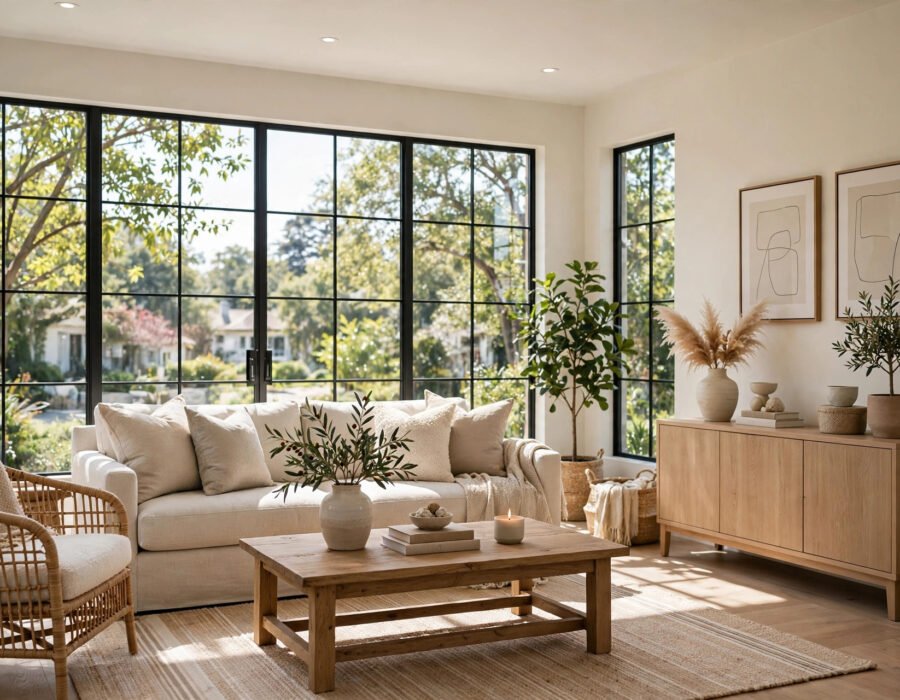
Living room: arrange furniture to define conversation areas and maximize the view — PNW buyers pay for windows and greenery views, so clear sightlines to them. Remove oversized pieces that shrink the room. Kitchen: clear counters to one or two items (a bowl of fruit, a plant), hide small appliances, and make sure it smells neutral — no cooking odors during showings. Bedrooms: neutral bedding, decluttered nightstands, closet doors that open freely.
Bathrooms: this is where budget staging shines or dies. New white towels, a clean shower curtain, empty counters, and ruthless grout cleaning. PNW moisture means checking for mildew — buyers here notice it instantly. Home office nooks (huge post-2020 selling point): a clean desk, a chair, good lighting, and nothing else. Photograph everything with your phone afterward; if a room looks bad in a photo, it looks bad in person.
Pacific Northwest Specifics
The PNW market has quirks. Light is the big one: from October to April, natural light is scarce, so staging must manufacture brightness — warm-white bulbs at 3000K–4000K, mirrors opposite windows, and sheer curtains instead of heavy drapes. Second, the outdoorsy buyer: highlight mudrooms, gear storage, and easy-clean entryways, because PNW buyers actually own the kayaks and hiking boots in the listing photos' implied lifestyle.
Third, moisture honesty: PNW inspectors and buyers are moisture-skeptics, so staging should never hide water issues — fresh paint over a stain reads as a cover-up and kills trust. Fourth, seasonality: spring listings can lean into gardens and patios (pressure-wash decks, stage outdoor seating), while winter listings should emphasize coziness — throws, warm lighting, a clean fireplace. Match the staging to the season buyers are experiencing.
When Budget Staging Is Not Enough
Be honest about the exceptions. Luxury listings ($1M+ in Seattle or Portland) face buyers who expect professional staging, and skimping there can cost more than it saves. Vacant homes are the other exception — empty rooms photograph small and cold, and virtual staging ($30–$75 per photo) is the budget answer, clearly disclosed as virtually staged per most MLS rules.
Also recognize when the house's problem is not presentation: major deferred maintenance, bad location factors, or overpricing cannot be staged away. If your agent's feedback after two weeks is about price or condition rather than presentation, redirect the budget there. But for the typical PNW home in average condition, budget staging captures the large majority of staging's value at a tenth of the cost — which is exactly why it is worth it.
You can verify the details at U.S. Dept. of Housing and Urban Development.
Photography: Staging for the Camera
In the Pacific Northwest market, most buyers meet your home through photos first — staging that does not photograph is half wasted. The photo rules: shoot in daylight with all lights on (PNW gray days need every lumen), declutter one level beyond what looks good in person (cameras amplify clutter), and remove small items that read as noise — refrigerator magnets, bathroom counter armies, pet bowls.
Hire a real-estate photographer (150 to 300 dollars in most PNW markets) rather than DIY-ing with a phone — professional wide-angle shots with proper exposure routinely generate measurably more showings, making it the best staging dollar after decluttering. Twilight shots work beautifully for PNW homes with views or nice exteriors. And stage with the lens in mind: arrange furniture for the camera angle, not just the walkthrough — the two perspectives differ, and the photos sell the showing.
The full background is available at Bankrate.
Keep exploring with decorating your home on a budget and increasing your home's value before selling.
Staging your Pacific Northwest home for open houses on a budget is worth it — the ROI math is compelling, with a few hundred dollars of decluttering, lighting, paint, and soft furnishings capturing most of staging's documented price and speed benefits. Prioritize storage-unit decluttering, brightness for gray-sky touring, honest moisture presentation, and season-matched coziness or outdoor living. Save professional staging for luxury or vacant listings. For everyone else, the budget playbook is not a compromise — it is the smart version of the same strategy.
Frequently Asked Questions
How much does home staging cost on average?
Professional staging averages $2,000–$5,000+ for a full home, but budget DIY staging runs $300–$800 using decluttering, lighting, paint touch-ups, and soft furnishings — capturing most of the benefit for typical homes.
Does staging really increase the sale price?
NAR data shows staged homes can command 1–10% more than comparable unstaged homes and tend to sell faster. Even a modest 2% lift on a $600,000 home is $12,000 against a few hundred in budget staging costs.
Should I stage a vacant home myself?
Vacant homes are hard to DIY-stage well since empty rooms look smaller. Use virtual staging ($30–$75 per photo, disclosed per MLS rules) or rent key furniture pieces rather than leaving rooms completely empty.
What is the single highest-ROI staging spend?
Decluttering — ideally via a one-month storage unit ($75–$150). Removing half your visible belongings makes every room look larger and better maintained, outperforming any decorative purchase.