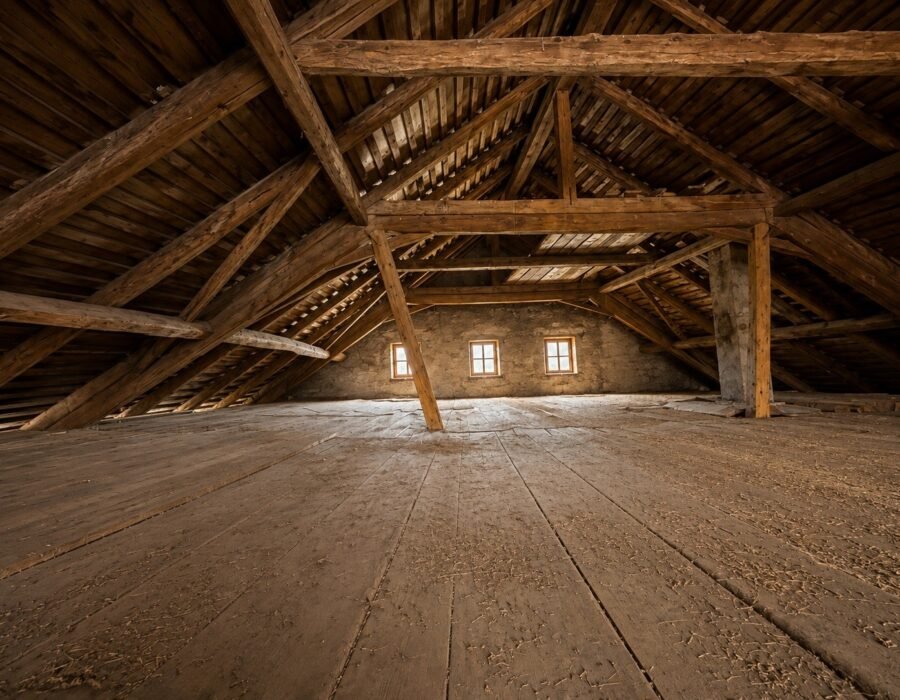
I’ve measured 150°F in my attic on a 95°F day — hot enough to be dangerous, and a massive burden on everything below it. The question why does my attic get so hot in the summer has a straightforward physics answer, but the solutions are where it gets interesting (and where the internet gives a lot of bad advice). Here’s what’s happening up there, what actually helps, and what’s a waste of money.
Why it matters beyond comfort: a superheated attic cooks your shingles from below (shortening roof life), radiates heat into your living space (raising cooling bills 10-30%), punishes ductwork (if ducts run through the attic, you’re cooling 150°F air — enormously wasteful), and creates a hazard for anyone who must enter.
Why Does My Attic Get So Hot in the Summer? The Physics
Three heat sources combine:
- Solar radiation on the roof: the big one. A dark asphalt shingle roof absorbs 85-95% of solar energy, reaching 160-190°F surface temperature. That heat conducts through the shingles and decking, radiating into the attic. This is 70-80% of attic heat.
- Poor ventilation: without airflow to carry heat away, the attic becomes a solar oven. Stagnant air just accumulates heat all day.
- Heat from below: the living space below (and especially unsealed air leaks) pumps warm air up. Minor compared to solar, but it adds up.
Attics don’t have to be this hot — a well-designed attic stays within 10-20°F of outside temperature. If yours is 40-50°F above ambient, something’s wrong with ventilation, roofing, or both.
What Actually Works (Ranked by Impact)
1. Ventilation: soffit + ridge (the foundation)
Proper passive ventilation is the #1 fix and the prerequisite for everything else:
- How it should work: cool air enters through soffit vents (under the eaves), hot air exits through the ridge vent (at the peak). Continuous airflow flushes heat constantly. No fans, no energy, silent.
- The common failure: insulation blocking the soffits (see my attic insulation guide — rafter baffles exist for exactly this reason).
- Sizing: building code calls for 1 sq ft of net free vent area per 150 sq ft of attic floor (1:300 with balanced soffit/ridge and vapor barrier). Most homes are under-vented.
- Cost: adding a ridge vent during re-roofing is $500-1,000. Retrofitting soffit vents: $50-100 each installed.
2. Radiant barrier
Reflective foil stapled under the rafters (or spray-applied) reflects radiant heat back toward the roof. Reduces attic temperatures 10-30°F in hot climates. Most effective in hot, sunny climates (zones 1-3); marginal benefit in the north. Cost: $1,500-3,000 pro-installed, or $500-1,000 DIY (foil rolls + staples — very DIY-able). Must face an air gap to work — don’t lay it on the attic floor over insulation (dust kills its reflectivity).
3. Roof color and material (at replacement time)
Light-colored “cool” shingles reflect significantly more solar energy — attic temperatures drop 10-20°F versus black shingles. When re-roofing, this is nearly free (cool-rated shingles cost about the same). Metal roofing in light colors is even better. Don’t replace a good roof just for color, but choose wisely when the time comes. (See roof replacement signs.)
4. Attic insulation (the floor, not the roof)
More insulation on the attic floor doesn’t cool the attic — it protects the living space from the hot attic. Still essential (it’s the thermal barrier), but understand what it does: your attic stays hot, your house stays cool. R-49 is the target (see insulation guide).
5. Ductwork: seal, insulate, or move
If ducts run through the attic (common in the South), they’re the biggest energy waste in the house — cooled air traveling through 150°F space. In order of effectiveness: move ducts into conditioned space (best, major renovation), seal with mastic + insulate to R-8 (practical, $1,000-3,000), or at minimum seal the leaks (DIY mastic, huge ROI).
What’s Overhyped or Wasteful
- Power attic ventilators (PAVs): controversial. They can depressurize the attic and pull conditioned air up from the house through ceiling leaks — increasing energy use. Building scientists generally recommend against them if the ceiling isn’t perfectly air-sealed. Passive ventilation is better.
- Solar attic fans: less bad than powered vents (no depressurization risk from house air? Actually they can still depressurize), but they move far less air than claimed. A ridge vent outperforms them silently and permanently.
- Spray foam on the roof deck (creating a conditioned attic): effective but $8,000-15,000+. Justified for new construction or when ducts must stay in the attic; overkill as a cooling-only retrofit.
- “Cool roof” coatings on old shingles: mixed results, can void shingle warranties. Fine as a stopgap, not a strategy.
The Practical Action Plan
- Verify ventilation: soffits clear? Ridge vent present and unblocked? This is step one, always.
- Air seal the attic floor (stops house heat from adding to the problem).
- Insulate to R-49 (protects the living space).
- Address ducts if present (seal + insulate minimum).
- Consider radiant barrier (hot climates, DIY-friendly).
- Choose cool roofing at replacement time.
The DOE’s attic guidance covers the ventilation and insulation specs authoritatively. And this connects to the whole cooling picture — my cooling without AC and summer electric bill guides complete the system.
The Ductwork Emergency
If your HVAC ducts run through the attic, stop everything and address them — they’re the single biggest energy waste in your home. Cooled air traveling through 150°F ductwork arrives at your rooms significantly warmer, forcing the AC to run longer and harder. The fix hierarchy: seal every joint with mastic (not duct tape — it fails in attic heat), insulate to R-8 minimum, and consider a radiant barrier above. I measured a 12-degree temperature gain in uninsulated attic ducts — the AC was essentially trying to cool the attic. Sealing and insulating ducts is the highest-ROI efficiency project most homeowners can do, full stop.
The Bottom Line
Why does my attic get so hot in the summer? Solar radiation baking the roof (70-80% of the heat) trapped by inadequate ventilation. Fix ventilation first (clear soffits + ridge vent — passive, permanent, cheap), then insulate the floor to R-49 to protect the living space, address ductwork if it’s up there, and choose cool roofing at replacement time. Skip the powered ventilators. A well-vented attic runs 10-20°F above ambient instead of 50°F above — and your AC, your shingles, and your electric bill all benefit.