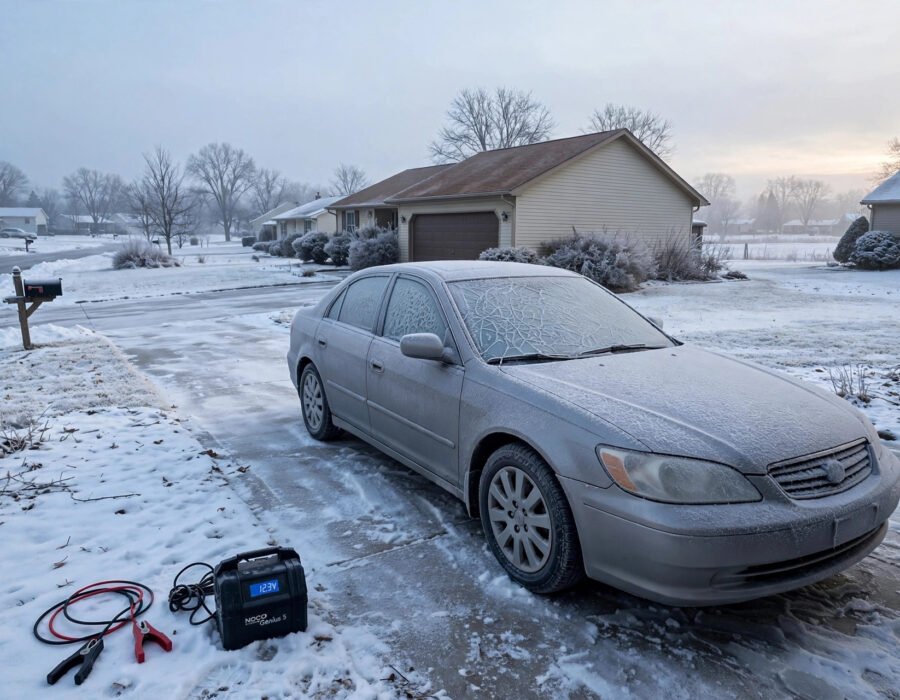
It’s 6:40 AM in January, negative 8 degrees in Minneapolis, and your car makes that sickening click-click-click instead of starting. Dead battery. Again. Cold is a car battery’s worst enemy — battery capacity drops about 20% at freezing and up to 50% at -22°F, right when your engine needs more power to turn over thick, cold oil. In the Midwest, where winters are long and brutal, keeping your battery alive isn’t luck — it’s a short list of habits and checks. Here’s the complete playbook.
Why Winter Kills Batteries (The Chemistry)
Car batteries generate power through chemical reactions, and cold slows chemistry down. At 32°F, a fully charged battery has about 80% of its normal cranking power; at 0°F, roughly 60%. Meanwhile, cold engine oil thickens, demanding more cranking amps to turn the engine. It’s a double squeeze: less power available, more power needed.
Age compounds everything. The average car battery lasts 3–5 years, and Midwest batteries skew toward the short end — summer heat actually does the hidden damage (evaporating electrolyte, corroding plates), and winter delivers the final blow. A battery that “seemed fine” in October can be dead by January. The Department of Energy’s vehicle maintenance guidance flags battery testing before winter as one of the highest-value preventive steps drivers can take.
The Pre-Winter Battery Checkup (Do This in October)
1. Test the battery — free at most auto parts stores
Don’t guess. Most auto parts chains test batteries free in the parking lot, measuring cold cranking amps against the battery’s rating. If it’s testing below 80% of rated capacity or is over 4 years old, replace it before winter, not during the first cold snap when everyone’s stranded and shops are slammed. A new battery costs $150–$250; a tow plus a missed workday costs more.
2. Clean the terminals
Corrosion — the white/green crust on terminals — adds resistance that mimics a dying battery. Disconnect (negative first), scrub with a wire brush and baking-soda solution, reconnect (positive first), and apply dielectric grease or anti-corrosion pads. Ten minutes, massive difference.
3. Check the cables and hold-down
Loose cables cause intermittent no-starts that feel like battery failure. The battery should be firmly clamped — vibration damages internal plates over time. If the hold-down is rusted out, replace it; it’s a $10 part protecting a $200 battery.
4. Know your battery’s age
The manufacture date is stamped on the battery case (often a code — ask the parts store to decode it). If you can’t remember when you bought it, assume it’s older than you think.
Daily Habits That Keep It Alive All Winter
- Drive long enough to recharge. Starting the engine is the battery’s biggest workout; short 5-minute trips never fully recharge what starting took. In winter, aim for at least 15–20 minutes of driving regularly. If your life is all short trips, take the long way home once a week — your battery will thank you. This matters even more on long road trips across the US, where the charging system gets the sustained runtime it needs.
- Turn off everything before you shut off the engine. Headlights, heated seats, defrosters, phone chargers — kill them all before turning the key off, and don’t turn them on until the engine’s running. Every accessory is a drain the alternator must overcome.
- Park in the garage if you have one. Even an unheated garage is 10–20 degrees warmer than outside — a meaningful difference in battery chemistry. No garage? Park facing east so morning sun hits the hood, or use a battery blanket/insulation wrap ($20–$40).
- Don’t idle to “warm up” for 20 minutes. Modern cars need 30–60 seconds of idle, then gentle driving. Extended idling wastes fuel, and the alternator charges poorly at idle anyway. The NHTSA’s winter driving guidance emphasizes getting moving (gently) over idling — better for the engine, the battery, and the air.
- Unplug parasitic drains. Dash cams, phone chargers, and aftermarket accessories left plugged in drain batteries overnight. In summer it’s harmless; in a cold snap it’s the difference between starting and clicking.
The Nuclear Options: For Extreme Cold and Long Sits
- Battery maintainer/trickle charger. If your car sits for days (second car, work-from-home life), a $40–$60 smart maintainer keeps the battery at full charge indefinitely. This single purchase prevents more dead batteries than everything else combined for infrequently-driven cars.
- Engine block heater. Common in Minnesota and the Dakotas, rare elsewhere. It keeps the engine (and oil) warm, dramatically reducing cranking demand. If your car has one, use a timer to run it 2–3 hours before departure — all night is wasteful.
- Portable jump starter. A $70–$100 lithium jump pack in the glove box means a dead battery is a 5-minute inconvenience instead of a crisis. Charge it every few months — they self-discharge in cold too.
- Know how to jump properly. Positive to positive, negative to engine ground (not the dead battery’s negative terminal), and let the good car run a few minutes first. Keep the best gas-finder app handy too — winter driving burns more fuel, and running low in a cold snap compounds every problem.
When to Replace vs. Nurse Along
Replace immediately if: the battery is 5+ years old, it needed a jump more than once this season, the case is swollen or cracked, or it tests below 70% capacity. Nurse along (with a maintainer and vigilance) if: it’s 3–4 years old, tests above 80%, and holds charge fine — but budget for replacement before next winter. Batteries don’t recover; they only decline. Hope is not a maintenance strategy.
Conclusion
Keeping your car battery alive through a Midwest winter comes down to an October checkup (test, clean, inspect), daily habits (drive long enough, kill accessories, garage it), and one smart purchase (a trickle charger or jump pack) for the hard cases. Winter doesn’t kill healthy batteries — it exposes weak ones. Test yours before the first freeze, and the only clicking you’ll hear in January is your turn signal.
Frequently Asked Questions
How long do car batteries last in the Midwest?
Typically 3–4 years — shorter than the national 3–5 year average. Summer heat does hidden internal damage, and brutal winters finish off weakened batteries. Test annually after year 3 and plan replacement proactively.
Will my car battery die if I don’t drive for a week in winter?
Possibly, especially if the battery is older or temperatures drop below zero. Modern cars have constant small drains (alarms, computers). For sits longer than a week in winter, connect a smart trickle charger or have someone drive the car for 20+ minutes.
Does idling charge a car battery?
Poorly. Alternators produce limited current at idle — it takes 15–20+ minutes of idling to meaningfully recharge, and it’s wasteful. Driving at normal speeds charges far more effectively. Don’t idle for 20 minutes thinking you’re helping the battery.
Should I disconnect my battery in winter?
Only for long-term storage (months). For daily drivers, disconnecting causes more problems (lost radio presets, computer relearn cycles, disabled alarms) than it solves. A trickle charger is the better solution for infrequent use.
Can cold permanently damage a car battery?
Yes — a fully discharged battery can freeze (the electrolyte becomes mostly water), and freezing can crack the case and warp plates permanently. Keeping the battery charged is what prevents freezing; a fully charged battery won’t freeze until around -76°F.