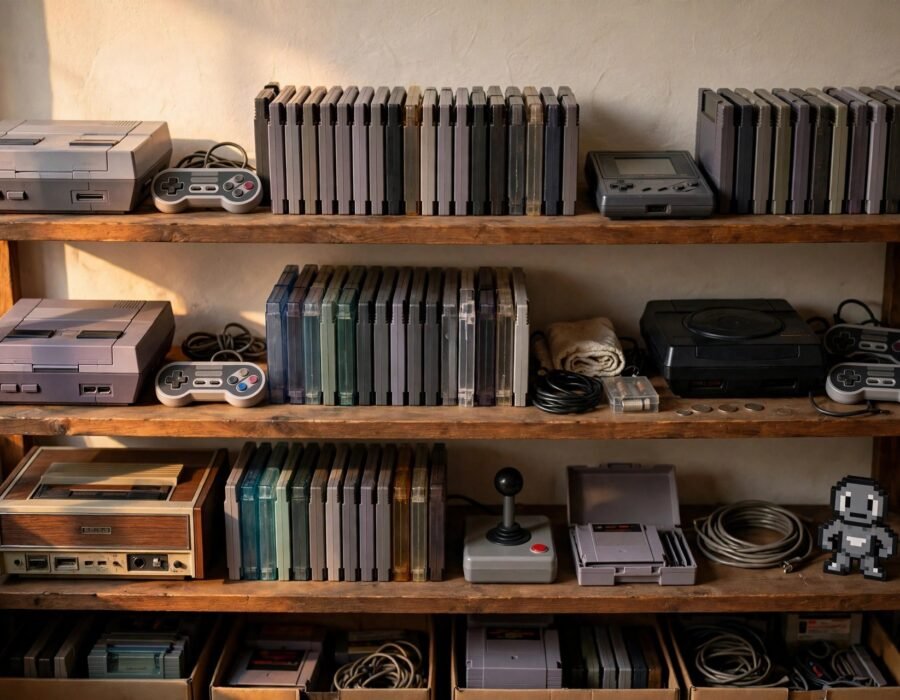
A sealed copy of Super Mario Bros. sold for $2 million. A garage-sale Atari cartridge turned out to be worth thousands. Retro game collecting has grown from nostalgic hobby into a serious market — part museum curation, part investment speculation, part treasure hunt. If you are asking why should I care about retro game collecting in the US, whether as a hobbyist, an investor, or just someone with an attic full of old cartridges, this guide covers what is worth collecting, what is hype, and how to avoid the pitfalls of a market with more fakes than most.
The appeal is deeper than money. Retro games are cultural artifacts — the medium’s history you can hold. Playing Chrono Trigger on original hardware, with a CRT’s glow and a controller’s click, is a different experience from emulation: it is time travel. Collectors preserve what companies abandoned; without them, vast swaths of gaming history would exist only as memories. That preservation mission is increasingly recognized by institutions — the Library of Congress maintains game preservation initiatives, treating classic games as the cultural heritage they are.
What Is Actually Worth Collecting
The market rewards rarity, condition, and cultural significance — in that order. Sealed, graded copies of landmark titles (Mario, Zelda, Pokémon) command the highest prices, but the graded-sealed market has also attracted speculation and controversy, with accusations of price manipulation. For most collectors, the sweet spot is complete-in-box copies of beloved games in good condition: valuable enough to appreciate, affordable enough to actually enjoy.
Undervalued areas: obscure systems with passionate communities (TurboGrafx-16, Sega Saturn), complete RPGs with maps and manuals, and arcade PCBs. Overhyped areas: common sports titles (millions printed, worth nothing), ungraded “sealed” games of dubious provenance, and anything bought at peak hype. The rule of collecting: buy what you love, in the best condition you can afford, and treat appreciation as a bonus — because markets correct, but a shelf of games you adore never disappoints. Why game consoles are sometimes hard to find explains the supply dynamics that also drive retro scarcity.
Avoiding Fakes and Scams
The retro market’s dark side is counterfeits. Reproduction cartridges — fake copies in authentic-looking shells — flood online marketplaces, and sophisticated fakes fool even experienced buyers. Protect yourself: learn the tell-tale signs for your system of interest (label print quality, cartridge shell details, board components visible through translucent shells), buy from reputable sellers with return policies, and be deeply suspicious of deals far below market price.
Grading adds another layer of controversy. Professional grading (WATA, VGA) authenticates and rates condition, and graded games fetch premiums — but the grading boom also inflated a speculative bubble, with critics alleging conflicts of interest. For a personal collection, grading is unnecessary expense; for investment-grade purchases, it is table stakes. The FTC’s guidance on avoiding online shopping fraud applies directly — document everything, use protected payment methods, and remember that “too good to be true” is the market’s most reliable signal. Fellow collectors gather for fun game nights with friends where showing off the collection is half the pleasure.
Preservation vs. Investment
A philosophical split divides the hobby: preservationists who play and share their collections versus investors who seal games in acrylic as assets. Both have merit — investors fund the market’s liquidity, preservationists keep the culture alive — but be honest about which you are. Sealed investing is speculation with extra steps; collecting to play and preserve is a hobby with benefits. The happiest collectors are the ones whose shelves get used.
Getting Started on a Budget
Start with what you owned: rebuilding your childhood collection is affordable (common titles are $10–30) and deeply satisfying. Thrift stores, flea markets, and estate sales remain the best hunting grounds — the thrill is in the find. Set a focus (one system, one genre, one series) to avoid drowning in randomness. Learn basic maintenance: cleaning cartridge contacts with isopropyl alcohol, replacing save batteries, recapping aging hardware.
Emulation and FPGA consoles (like Analogue’s products) deserve mention: they play original cartridges on modern displays with perfect accuracy, bridging collecting and playing. And flash carts let you play entire libraries on original hardware — controversial among purists, beloved by pragmatists. The goal is enjoying the games; the plastic is just the delivery mechanism.
The Emulation Question
No collecting guide can ignore emulation — software that mimics old hardware, letting you play entire libraries without owning cartridges. Legally, it is murky: emulators themselves are legal, but downloading ROMs of games you do not own generally is not (with narrow exceptions for archival and games you physically own, varying by jurisdiction). Ethically, the community is split: purists insist on original hardware, pragmatists note that emulation preserves games whose physical media is decaying — cartridge batteries die, discs rot, and hardware fails.
The preservation argument is strong and getting stronger. Magnetic and optical media degrade; without emulation, countless games would already be lost. Institutions now treat emulation as legitimate preservation, and several publishers have embraced it through official retro compilations and subscription libraries. For collectors, the sensible stance: collect the physical artifacts you love, emulate for convenience and preservation, and support official re-releases when they exist. The two practices complement rather than compete.
The Bottom Line
Retro game collecting is worth caring about as preservation, as hobby, and cautiously as investment: buy what you love in the best condition you can afford, learn to spot fakes, and treat speculation as speculation. The market will have its bubbles and corrections. But a shelf of games that shaped the medium — playable, shared, and loved — is valuable in the way that matters most: it keeps the history alive and the fun accessible.
Frequently Asked Questions
Are retro games a good investment?
Selectively. Landmark titles in excellent condition have appreciated strongly, but the market is volatile, illiquid, and rife with fakes and speculation. Treat it like art collecting: buy what you love, diversify, and never invest money you cannot afford to lose. Most collectors do better emotionally buying to play.
How do I spot fake retro cartridges?
Check label print quality (fakes often have slightly off colors or pixelation), cartridge shell details and screws, weight, and — for translucent shells — the board inside. Compare against verified authentic copies. When in doubt, buy graded or from highly reputable sellers, and avoid deals far below market price.
What is the most valuable retro game?
Sealed, high-grade copies of Super Mario Bros. (NES) hold the auction records, reaching $2 million. But “most valuable” depends on category — prototype cartridges, unreleased games, and arcade rarities each have their own record-holders. For attainable collecting, complete-in-box RPGs and first-party Nintendo titles are the blue chips.
Should I get my games graded?
Only for investment-grade sealed games where the grading premium exceeds the cost. For a personal played collection, grading is unnecessary — it encases the game, costs money, and adds nothing to your enjoyment. Grade assets, not hobbies. And never grade a game you intend to open and play; the slab defeats the purpose.
Where are the best places to hunt for retro games?
Thrift stores, flea markets, estate sales, and garage sales remain the best hunting grounds for deals — the thrill is in the find. Online, use reputable marketplaces with buyer protection and compare against price-charting sites before paying. Local game stores often have fairly priced inventory and the advantage of inspecting before buying.