
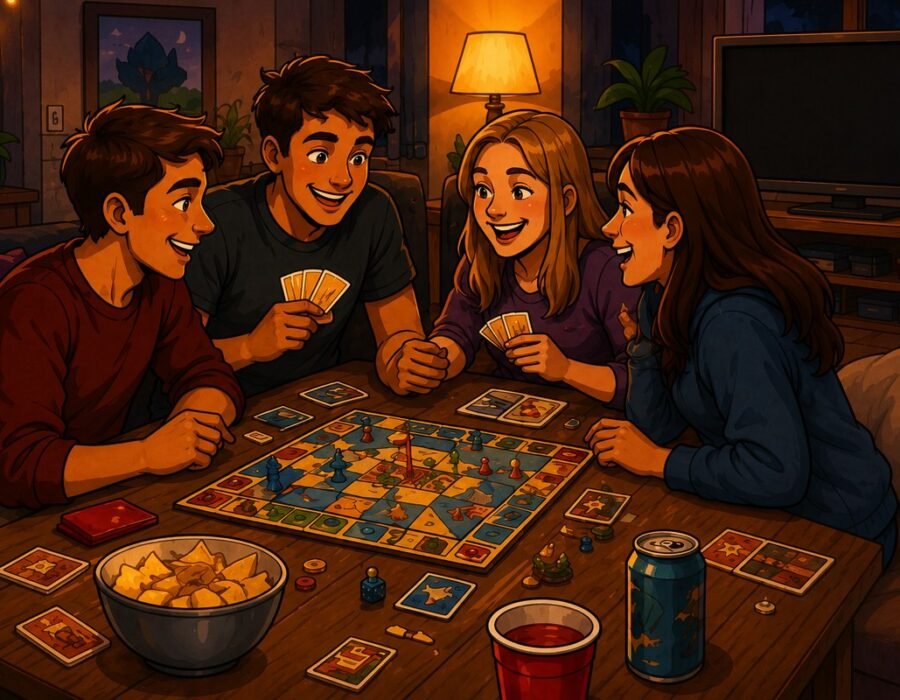
Game night sounds great in theory — friends, laughter, snacks — but so many game nights fizzle into awkward rule explanations, one person dominating, and half the group checking their phones. If you’re asking how do I plan a fun game night with friends, I’ve hosted dozens of game nights (brilliant ones and disastrous ones), and the difference is almost entirely in the planning. Great game nights feel effortless because someone did the effort beforehand. Here’s the complete playbook.
The core insight: a fun game night is 30% game selection, 30% group dynamics, 30% atmosphere, and 10% snacks (though nobody’s ever complained about better snacks). Most hosts obsess over which game to buy and ignore everything else. Don’t be that host. Let’s plan the whole evening.
How Do I Plan a Fun Game Night With Friends? Start With the Guest List
Four to six players is the sweet spot. Fewer than four limits your game options and energy; more than six makes most games drag (downtime between turns kills momentum) and splits the group into side conversations. Know your group’s competitive intensity — some friends love cutthroat strategy, others shut down if the game gets mean. The cardinal rule: invite people who like each other more than they like winning. One hyper-competitive player who sulks when losing can poison the whole evening.
Consider experience mix carefully. A table of all beginners needs simple, quick-to-learn games. One experienced gamer among beginners can teach — but only if they’re a good teacher (patient, concise, enthusiastic). The worst game-night dynamic is an expert who spends 30 minutes explaining rules while everyone else’s eyes glaze over. If you’re the experienced one, learn to teach in under 10 minutes or pick a simpler game.
Choosing Games: The Tier System
Openers: easy, funny, 20–30 minutes
Always start with something light while people arrive, settle in, and finish snacks. The opener sets the tone — it should generate laughter within five minutes and require almost no explanation. My go-to openers:
- Wavelength: a psychic-guessing party game — one player gives a clue on a spectrum (hot–cold, good movie–bad movie), the team guesses where the target sits. Generates hilarious debates, takes 2 minutes to teach.
- Codenames: the gold standard of party word games — give one-word clues to connect your team’s secret words. Brilliant, endlessly replayable, works for 4–10+ players.
- Just One: cooperative party game where everyone writes one-word clues — duplicates get canceled. Simple, funny, zero learning curve.
- Telestrations: telephone meets Pictionary — the drawings get progressively more absurd, and the reveals are comedy gold.
Main events: engaging, 45–90 minutes
After the opener, the group is warmed up and ready for something meatier. The key criteria: teachable in under 15 minutes, everyone’s engaged on every turn (no long downtime), and it ends before energy fades.
- Ticket to Ride: the perfect gateway strategy game — collect cards, claim train routes, block opponents. Simple rules, real decisions, 60 minutes. If your friends “don’t like board games,” start here.
- Catan: the classic for a reason — trading, building, just enough competition. Can run long with 5–6 players, so consider the 4-player game for pacing.
- Azul: beautiful tile-drafting game — simple to learn, surprisingly deep, 45 minutes. The tactile tiles and visual appeal win over skeptics.
- The Crew: cooperative trick-taking in space — small, cheap, brilliant. Perfect for groups that prefer teamwork over competition.
- Wits & Wagers: trivia where you bet on answers — you don’t need to know anything, just guess cleverly. Levels the playing field between trivia buffs and everyone else.
Closers: quick, high-energy, 15–20 minutes
End the night on a high — something fast and funny when energy is fading but nobody wants to leave. Cockroach Poker (bluffing, 15 minutes), Love Letter (deduction in a tiny package), or a second round of the opener if it was a hit. Never start a 2-hour epic at 10 PM — that’s how game nights end in exhaustion instead of “when are we doing this again?”
The Hosting Details That Matter
Learn the rules before guests arrive. This is non-negotiable. Watch a “how to play” video (YouTube has excellent 10-minute tutorials for every popular game), play a practice round solo if needed, and prepare a 5-minute explanation covering only what’s needed to start — teach the rest as it comes up. Nothing kills excitement like a 30-minute rules lecture. Start playing within 10 minutes of sitting down.
Set up the space. A table everyone can reach (dining table ideal — coffee tables are too low for most games), good lighting (you need to read cards), chairs that are actually comfortable for two hours, and phones face-down in a pile (make it a lighthearted rule, not a decree). Background music low enough to talk over — game nights need conversation, not concert volume.
Feed people strategically. Serve dinner before gaming or keep food completely separate from the game table (greasy fingers and $50 board games are enemies). Finger foods that aren’t messy: popcorn, pretzels, veggie trays, cheese and crackers. Avoid anything requiring utensils over the game, anything crumbly, and anything with strong smells. Drinks in cups with lids or away from the table edge — one spilled drink can end the night.
Manage the energy. Watch for the signs: someone’s quiet, turns are dragging, phones appearing. That’s your cue to wrap the current game (it’s okay to end early — “let’s call it here and play something quick” is always fine) and switch gears. The host’s job is reading the room, not winning. If you’re hosting, consider sitting out the most competitive games to focus on the group’s experience — the best hosts facilitate fun rather than dominate it.
Variations and Special Formats
Themed nights add excitement: murder mystery boxes (prepared kits, $25–30, genuinely fun), trivia night (one person hosts, teams compete), tournament brackets (single-elimination in a quick game like Love Letter or Cockroach Poker with a silly trophy). Virtual game nights work surprisingly well — Jackbox Party Packs (one person streams, everyone plays on phones), Board Game Arena (free, hundreds of games in browser), or virtual watch parties for a movie intermission.
For your game collection, start with 3–4 versatile titles rather than a shelf of shrink-wrapped boxes. And check out the best board games for adults for deeper recommendations. For the renaissance of tabletop gaming, the Wikipedia article on board games covers the modern golden age.
So how do you plan a fun game night with friends? Invite 4–6 people who like each other, start with a laugh-out-loud opener, feature one engaging main game, close with something quick, learn the rules in advance, feed people away from the games, and read the room on energy. Do this, and your game nights become the event friends ask about — “when’s the next one?” is the sound of a host who’s cracked the code.




3 Comments