
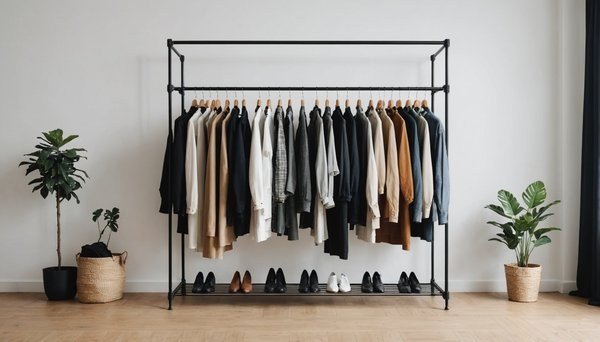
You open your closet and feel nothing. A hundred items, zero outfits. If you’re asking how to build a capsule wardrobe from scratch, here’s the promise: 25–35 versatile pieces that all work together, replacing the chaos with a closet where everything matches, getting dressed takes five minutes, and you actually wear everything you own. It takes one focused weekend to build. Here’s the system.
What a Capsule Wardrobe Actually Is
Not a uniform, not minimalism cosplay — a curated collection where every piece coordinates with most others. The classic formula: ~30 pieces (excluding underwear, workout gear, and occasion wear) in a cohesive color palette. The math: 30 pieces × coordination = 100+ outfits. Compare that to 100 random pieces yielding “nothing to wear” (see the full-closet paradox).
Step 1: Audit and Purge
Take everything out. Yes, everything. Sort into:
- Love + wear: keep — these are your foundation
- Like but don’t wear: why? Wrong size? Needs tailoring? Doesn’t match anything? Fix or release.
- Guilt pile: expensive mistakes, gifts, “someday” clothes — release with gratitude
- Worn out: donate/recycle responsibly (see donating clothes responsibly)
Be ruthless. If you haven’t worn it in a year (minus occasion/seasonal), it’s not “versatile” — it’s clutter.
Step 2: Define Your Palette and Lifestyle
Colors: pick 2–3 neutrals (navy, gray, white, black, tan) + 1–2 accents you love. Every new purchase must work with the palette. (Navy-based? See colors that pair with navy.)
Lifestyle ratio: honest assessment — what % is work, casual, active, evening? A remote worker needs a different capsule than a trial lawyer. Build for your actual life, not an aspirational one.
Step 3: The Core List (Template)
- Tops (8–10): tees, button-downs, sweaters, blouse — neutrals + accents
- Bottoms (5–6): jeans, chinos/trousers, skirt if worn — dark washes, neutral colors
- Layers (4–5): blazer, cardigan, jacket, trench coat
- Shoes (4–5): everyday pair, dress pair, boots, sneakers — see shoes that go with everything
- Dresses/jumpsuits (2–3) if worn
- Accessories: belt, watch, bag, scarves — the outfit multipliers
Step 4: Fill Gaps Strategically
List what’s missing, then shop the list — not the store. Prioritize: the piece that opens up the most outfits first (usually a neutral layer or shoe). Buy quality over quantity — 30 good pieces beat 60 mediocre ones. Thrift the expensive categories (blazers, coats).
Maintaining It: One In, One Out
The capsule only works if it stays curated. New purchase? Something leaves. Seasonal swap? Store off-season compactly (see space-saving folding). Review quarterly — your life changes; the capsule should too. For the movement’s principles, the capsule wardrobe concept covers the history and math.
Capsule Wardrobes by Lifestyle: Three Templates
The template shifts with your life. Here are three complete starting points.
The remote professional: polished on top, comfortable throughout. 8 tops (polos, henleys, casual button-downs, 2 blazers), 5 bottoms (dark jeans, chinos, joggers that look like pants), 4 shoes (sneakers, loafers, boots, slippers for the house — kidding, mostly). Palette: navy, gray, white, olive. The video-call rule: everything above the waist must be camera-ready.
The office professional: business casual core. 10 tops (button-downs, blouses, sweaters), 6 bottoms (dress pants, skirts, dark jeans for casual Friday), 4 layers (2 blazers, cardigan, coat), 5 shoes (dress shoes, loafers, boots, sneakers, heels/flats). Palette: navy, charcoal, white, plus one accent. Everything must pass the client-meeting test.
The creative/student: expressive but cohesive. 10 tops (tees, vintage finds, statement pieces), 6 bottoms (jeans in varied washes, cargo, skirts), 5 layers (denim jacket, leather jacket, oversized blazer, hoodies), 4 shoes (sneakers × 2, boots, sandals). Palette: black, white, denim blue, + bold accent. The rule: personality pieces anchored by neutrals.
Adapting any template: swap the formality level, keep the structure. The capsule math — 30 pieces, one palette, everything coordinates — works for every lifestyle. Build for the life you have, in the colors you love, at the formality you need.
Capsule Wardrobes by Lifestyle: Three Templates
The classic capsule assumes an office job. Here are templates for other lives.
The work-from-home capsule (25 pieces): 5 quality tops (visible on camera), 3 comfortable bottoms (real pants — the psychology matters), 2 layering pieces, 1 “meeting blazer,” plus off-duty basics. Fewer formal pieces, more comfort — but no pajamas-as-clothes. (See the WFH dressing guide.)
The creative/freelance capsule (30 pieces): more room for personality — statement pieces earn their place here. 8 tops with variety, 5 bottoms, 4 layers including the interesting jacket, 3 shoes. The formula still applies; the palette just gets wider.
The parent-on-the-go capsule (25 pieces): washability is the top criterion — everything machine-washable, stain-forgiving colors, no dry-clean-only. 6 tops, 4 bottoms, 3 layers, 2 pairs of indestructible shoes. Style within the constraint: dark colors, quality knits, one good bag.
The universal principles: every template keeps the tight palette, the 3-outfit rule per piece, and the seasonal review. The piece counts shift; the system doesn’t. Build for the life you actually live — the capsule that fits your Tuesday is the one you’ll keep.
Capsule Wardrobe Mistakes Beginners Make
Buying everything at once: the capsule is built, not bought — start with what you own, fill gaps gradually. A shopping spree defeats the purpose.
Too neutral, too boring: neutrals are the base, not the whole wardrobe. Without an accent color or a personality piece, the capsule feels like a uniform you resent.
Ignoring lifestyle: the 37-piece office capsule fails the work-from-home parent. Build for your actual week — count where your hours go, and allocate pieces proportionally.
Perfectionism: the capsule is a direction, not a destination. Pieces will miss; that’s data, not failure. Adjust seasonally and keep going.
Key Takeaways
- 30ish pieces, one palette, everything coordinates = 100+ outfits.
- Audit ruthlessly first — you can’t curate clutter.
- Build for your actual lifestyle ratio, not an aspirational one.
- Fill gaps from a list; prioritize hardworking versatile pieces.
- One in, one out — forever. That’s what keeps it a capsule.
The Bottom Line
Building a capsule wardrobe from scratch takes one weekend of honest auditing and strategic gap-filling. The payoff: five-minute mornings, everything matches, nothing unworn. It’s not about having less — it’s about everything you have actually working. Your closet becomes a tool instead of a source of stress.




1 Comment