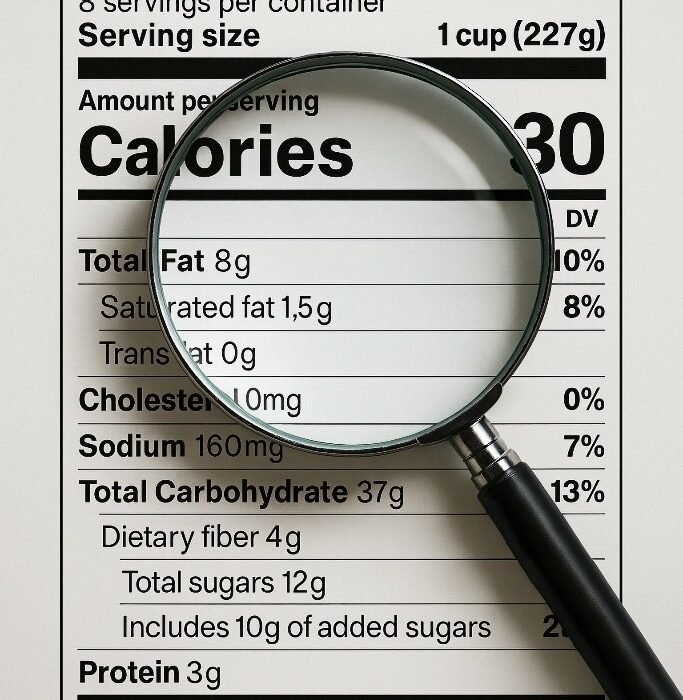
Serving size: 2/3 cup (55g). Servings per container: about 3.5. Total fat 8g (10% DV). Sodium 210mg (9% DV). Total carbohydrate 37g (13% DV), of which total sugars 12g, including 10g added sugars (20% DV)… If reading that made your eyes glaze over, you’re not alone. Learning how do I read nutrition labels without getting confused is genuinely empowering — the label is the most honest thing on the package, cutting through every marketing claim on the front. I’ve taught friends to read labels in five minutes, and it permanently changes how they shop.
Here’s the thing the food industry doesn’t want you to internalize: the front of the package is advertising; the back is data. “Natural,” “low-fat,” “made with real fruit,” “supports immunity” — these are marketing terms with loose or no legal definitions. The Nutrition Facts panel, by contrast, is federally regulated by the FDA and must follow strict formatting rules. Learn to read it, and you see through every trick. Let’s decode it step by step.
How Do I Read Nutrition Labels Without Getting Confused? Start at the Top
Serving size and servings per container
This is the foundation everything else rests on — and the industry’s favorite trick. All the numbers on the label describe one serving, not the whole package. That “150 calorie” bag of chips? Check the servings per container — if it says 2.5 and you eat the whole bag, you ate 375 calories. Cereal boxes are notorious: a serving might be 3/4 cup, but who eats 3/4 cup of cereal? I pour at least double.
The FDA updated serving sizes in 2016 to reflect what people actually eat (soda labels now use 12 oz instead of 8 oz, for example), but they still don’t always match your portion. The fix is simple math: compare the serving size to what you’ll actually eat, and scale the numbers. If you eat twice the serving, double everything. This one habit — always checking serving size first — eliminates the most common label confusion instantly.
Calories
Printed big and bold for a reason — it’s the headline number. But calories alone don’t tell you much without context. A 200-calorie snack of almonds and a 200-calorie snack of candy affect your body very differently (protein, fiber, and fat slow digestion and keep you full; sugar spikes and crashes). Use calories as a portion-awareness tool, not a quality judgment. The label can’t tell you if those calories nourish you — that’s what the rest of the panel is for.
The Nutrients: What to Limit and What to Seek
Limit these: saturated fat, sodium, added sugars
The FDA specifically flags these three because Americans overconsume all of them. Saturated fat: aim for less than 10% of daily calories (about 20g on a 2,000-calorie diet). Note that the label shows saturated fat separately from total fat — unsaturated fats (from nuts, olive oil, fish) are fine and healthy; it’s the saturated kind you watch. Sodium: the daily limit is 2,300mg, but the average American eats over 3,400mg. A single frozen meal can pack 1,500mg+. If a product has 20%+ DV sodium per serving, that’s high. Added sugars: the newest and most revealing line on the label (required since 2020). This separates naturally occurring sugars (in fruit, milk) from sugars added during processing. The daily limit is 50g — and you’d be shocked how fast flavored yogurt, granola bars, and pasta sauce get you there.
Get enough of these: fiber, vitamin D, calcium, iron, potassium
The FDA highlights these because Americans underconsume them. Fiber is the big one — most adults get about half the recommended 28g daily. A product with 3g+ fiber per serving is decent; 5g+ is excellent. Fiber is also my favorite label shortcut: high-fiber foods are usually less processed and more filling, whatever else the label says. Vitamin D, calcium, iron, and potassium are listed because deficiencies are common; the % DV tells you at a glance whether a food meaningfully contributes.
The % Daily Value: Your Quick-Scan Tool
The % DV column is the fastest way to evaluate a product — it tells you how much one serving contributes to a 2,000-calorie daily diet. The rule of thumb the FDA teaches: 5% DV or less is low, 20% DV or more is high. This works for every nutrient on the label. Low in something you want to limit (saturated fat, sodium, added sugar)? Good. High in something you need (fiber, iron)? Good. High in sodium? Bad. You can evaluate any product in seconds with just this rule.
One caveat: % DV is based on a 2,000-calorie diet, which may not match yours. If you eat 1,600 or 2,500 calories, scale accordingly. But for comparing products against each other — which is the main use — the absolute numbers matter less than the relative ones. The product with 5% DV sodium beats the one with 25%, regardless of your calorie needs.
The Ingredient List: The Other Half of the Story
Below the Nutrition Facts is the ingredient list, and it has its own rules worth knowing. Ingredients are listed in descending order by weight — the first ingredient is what the product contains most of. If sugar (or one of its 60+ aliases: corn syrup, dextrose, cane juice, maltodextrin…) appears in the first three ingredients, it’s a sugary product no matter what the front claims. “Made with whole grains” means nothing if enriched flour is first and whole wheat is fourth.
Shorter is generally better — not because long lists are inherently evil, but because each additional ingredient is another opportunity for added sugars, refined starches, and additives you don’t need. Compare two breads: one with 5 recognizable ingredients, one with 25 including dough conditioners and preservatives. The choice is usually clear. That said, don’t fear ingredients you simply don’t recognize — ascorbic acid is vitamin C, tocopherols are vitamin E. Unfamiliar isn’t automatically unhealthy.
Watch for serving-size games in the ingredient list too: “whole grain” claims, “no added sugar” (but loaded with fruit juice concentrate, which is… sugar), “fat-free” (usually means extra sugar to compensate for lost flavor). The ingredient list plus the added-sugars line together expose all of these. A “fat-free” dressing with 12g added sugar per serving isn’t health food — the label told you, if you knew where to look.
Smart label reading pairs well with smart cooking — use it alongside healthier desk snacks and budget potluck planning. For the official rules behind every label, the FDA’s Nutrition Facts label guide is the authoritative reference.
So how do you read nutrition labels without getting confused? Check serving size first and scale to your real portion. Use the 5%/20% DV rule to scan nutrients in seconds. Limit saturated fat, sodium, and added sugars; seek fiber and the flagged vitamins and minerals. Read the ingredient list in order — first ingredients matter most. Ignore the front of the package entirely. Five minutes of learning, and you’ll never grocery shop the same way again.