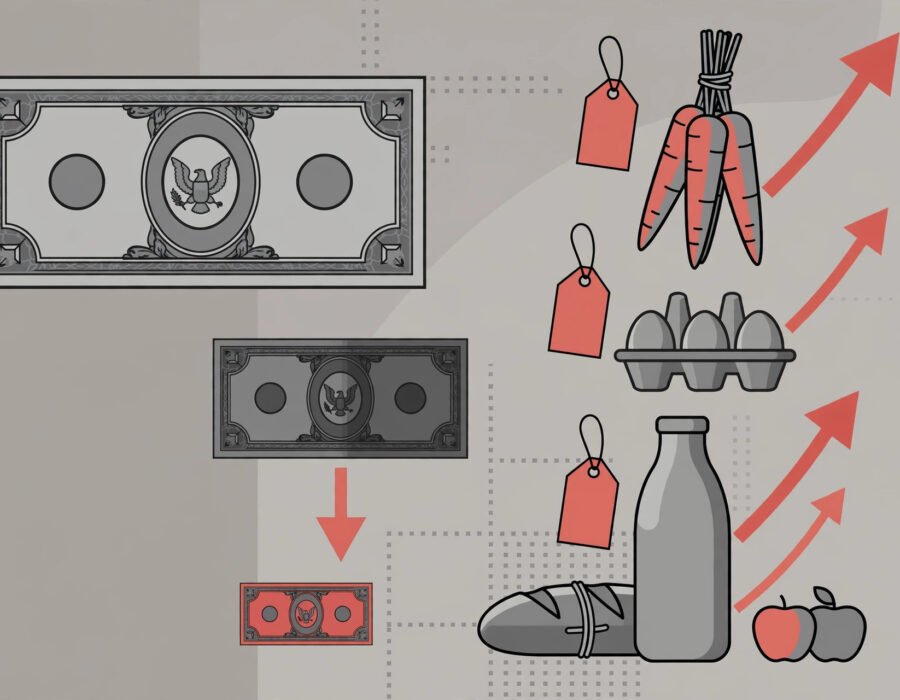
In 2020, $100 bought a full grocery cart. A few years later, the same $100 buys noticeably less — same cart, emptier bags, higher total. Everyone felt it, but few can explain it: what is inflation, exactly? Can someone explain inflation in simple terms? Here it is in one sentence: inflation is your money losing purchasing power over time — each dollar buys a little less than it did before.
That’s the core. Everything else — the CPI, the Fed, the interest rates — is detail around that one reality. Here’s the full simple-terms guide for Americans.
The Ice Cube Analogy
Think of your dollar as an ice cube. In a freezer (no inflation), it stays the same size forever. In a warm room (inflation), it slowly melts — still a dollar, but buying less each year. At 2% annual inflation, your ice cube loses about 2% of its purchasing power yearly — barely noticeable. At 8%, the melting is obvious within months: groceries, rent, gas all visibly pricier.
The critical insight: inflation doesn’t mean things got more valuable — it means money got less valuable. Your salary, savings, and debts are all denominated in melting ice cubes. That reframes every financial decision: cash sitting in a 0% account isn’t “safe” — it’s guaranteed to melt. This is why saving money on everyday expenses matters doubly during inflationary periods — you’re fighting both rising prices and shrinking dollars.
What Causes Inflation? (The Two Main Types)
Demand-pull inflation: too much money chasing too few goods. When the government stimulates heavily, or consumers all spend at once (post-pandemic reopening), demand outruns supply and sellers raise prices. Think of it as an auction where everyone suddenly has more cash to bid. Cost-push inflation: production gets more expensive — oil prices spike, supply chains break, wages rise — and businesses pass costs to consumers. The 2021–2023 inflation combined both: massive stimulus met broken supply chains, and prices surged on both fronts.
There’s also the money-supply dimension: when central banks expand the money supply faster than economic output grows, each existing dollar represents a smaller slice of the economy — the classic “printing money” effect. It’s not the whole story (velocity and expectations matter enormously), but it’s why Fed policy and inflation are permanently linked in every headline.
How Inflation Is Measured: The CPI
The Consumer Price Index (CPI) is America’s inflation thermometer, published monthly by the Bureau of Labor Statistics. It tracks price changes in a representative “basket” of goods and services — housing, food, transport, healthcare, and more — weighted by typical spending. When headlines say “inflation was 3.2%,” they mean the CPI basket costs 3.2% more than a year ago.
Know its limits: the CPI is an average — your personal inflation depends on your spending (renters felt housing inflation brutally; homeowners with fixed mortgages barely did). It also struggles with quality changes and substitution (when beef gets expensive and you switch to chicken, are you really experiencing the beef inflation?). “Core” CPI excludes volatile food and energy to show underlying trends — useful for policymakers, less relevant to your grocery bill. For food-specific pain, our guide to eating healthy on a budget has tactics calibrated for exactly these periods.
Who Wins and Who Loses From Inflation
Inflation redistributes wealth silently, creating winners and losers. Winners: borrowers with fixed-rate debt. A 30-year mortgage at 4% becomes cheaper in real terms every year inflation runs hot — you’re repaying with melting ice cubes. Losers: savers in cash. Money in a 0.5% savings account during 6% inflation loses ~5.5% of purchasing power yearly — a guaranteed loss mislabeled as safety. Mixed: workers. Wages often rise with inflation but usually lag — the 2021–2023 period saw real (inflation-adjusted) wages fall for many months before recovering.
Losers again: retirees on fixed incomes without inflation adjustments — Social Security has cost-of-living adjustments (COLAs), but private pensions often don’t. Understanding your position in this matrix determines your strategy: borrowers might welcome moderate inflation; cash-heavy savers should fear it.
How the Fed Fights Inflation (and Why It Hurts)
The Federal Reserve’s main weapon is interest rates. Raising rates makes borrowing expensive — mortgages, car loans, credit cards all cost more — which cools spending, which cools demand, which cools prices. It works, but the side effects are real: higher unemployment risk, stock market declines, and recession risk. The Fed is essentially prescribing economic pain as inflation medicine, calibrating the dose to kill inflation without killing the economy — the famous “soft landing” attempt.
This is why inflation dominates headlines: the cure affects every American with debt, investments, or a job. When you hear “the Fed raised rates again,” translate it to: “borrowing just got more expensive, saving just got more rewarding, and the economy just got cooler on purpose.” The Fed’s own communications at the Federal Reserve’s website explain policy in surprising plainness.
Protecting Yourself: The Personal Playbook
Don’t hold excess cash. Emergency fund in high-yield savings (which at least partially offsets inflation), but long-term money belongs in assets that historically outpace inflation — stocks, real estate, I-bonds. Consider I-bonds: U.S. Treasury Series I savings bonds adjust with inflation directly — among the purest inflation hedges available to ordinary Americans, purchasable at TreasuryDirect, the Treasury’s retail securities site. Lock fixed rates when borrowing: fixed-rate debt gets cheaper in real terms during inflation. Invest in your earning power: skills and career growth are the ultimate inflation hedge — wages are the one “asset” you control directly.
Budget dynamically: static budgets break under inflation — review and adjust quarterly, not yearly, using the frameworks in our monthly budgeting guide. And understand the tax dimension: inflation can push you into higher brackets (“bracket creep,” though brackets are now inflation-indexed federally) and erode deduction values — the IRS website publishes inflation-adjusted figures yearly.
Conclusion
Inflation, in simple terms, is money melting — each dollar buying less over time, driven by surging demand, rising costs, or expanding money supply, measured by the CPI’s basket, fought by the Fed’s interest-rate medicine. It silently transfers wealth from savers to borrowers, punishes idle cash, and rewards asset ownership and skill growth. You can’t control inflation, but you can refuse to be its victim: keep cash lean, own appreciating assets, consider I-bonds, borrow fixed when rates make sense, invest in yourself, and budget like prices move — because they do. The ice cube always melts. The question is whether your financial plan accounts for the puddle.
Frequently Asked Questions
What is a healthy inflation rate?
The Federal Reserve targets 2% annually — enough to encourage spending and investment (mild inflation punishes hoarding cash) without destabilizing prices. Sustained inflation above 3–4% starts causing real economic pain.
What’s the difference between inflation and hyperinflation?
Inflation is gradual purchasing-power erosion (single digits yearly); hyperinflation is currency collapse (50%+ monthly) — a different phenomenon driven by total loss of monetary confidence, as seen in Weimar Germany or modern Venezuela. The U.S. has never experienced hyperinflation.
Do wages keep up with inflation?
Eventually, usually — but with lags. Workers typically experience months or years of falling real wages during inflationary spikes before paychecks catch up. This lag is why inflation feels like a pay cut even when nominal wages rise.
Are I-bonds a good inflation hedge?
For the cash portion of your portfolio, yes — they’re U.S. government-backed, adjust directly with CPI inflation, and never lose nominal value. Limits ($10,000/year electronically per person) and early-withdrawal penalties constrain them, but they’re among the safest inflation hedges available. The Consumer Financial Protection Bureau’s Ask CFPB resources explain them clearly.