Your hands shake. Your throat closes. Twenty people in a Santa Monica coffee shop suddenly feel like twenty thousand, and the song you’ve played perfectly a hundred times at home evaporates from your brain. Stage fright — the fear of performing — hits beginners and pros alike; it’s the most democratic terror in music. In California, where performance opportunities are everywhere (open mics, beach bonfires, street fairs, actual stages), stage fright is also the most fixable barrier between you and the musician you want to be. Here’s the safe, proven path through it.
What Stage Fright Actually Is
Stage fright is your fight-or-flight system misfiring: adrenaline floods your body for a threat (social judgment) that isn’t physical danger. Symptoms — racing heart, shaking hands, dry mouth, blank mind, nausea — are the same physiology that would help you outrun a predator, applied to playing guitar at a brewery. Knowing this reframes everything: you’re not broken or uniquely cowardly. Your nervous system is doing its job on the wrong assignment.
The National Institute of Mental Health’s resources on performance anxiety classify it as a situational anxiety — highly treatable, highly common, and responsive to the same techniques that work for other performance anxieties. Which means: this is solvable, not a personality trait.
The Core Truth: Exposure, Not Avoidance
Every effective stage-fright treatment shares one mechanism: graduated exposure — performing in progressively scarier situations until your nervous system learns that audiences aren’t predators. Avoidance feels safe but teaches your brain that performing is indeed dangerous, making the next attempt worse. The path through is a ladder, not a leap:
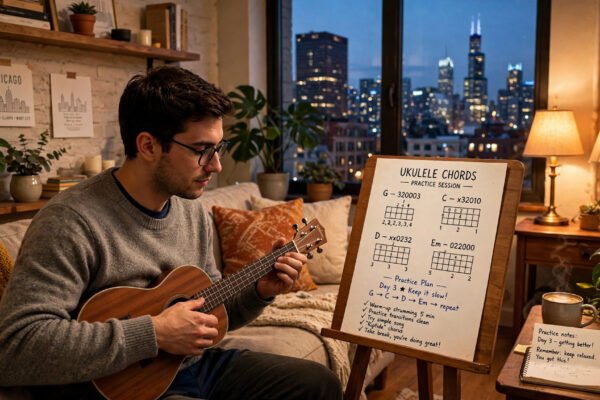
- Perform for your phone. Record yourself playing start to finish, no stops. The camera creates low-grade pressure — enough to reveal where your playing wobbles under observation.
- Perform for one trusted person. A friend, a partner, a fellow student. Announce it: “I’m going to play this through.” The formality matters — it simulates performance conditions.
- Perform for a small group. Three to five people. A living room concert. Notice: the fear spikes, then fades mid-song. That fade is your nervous system learning.
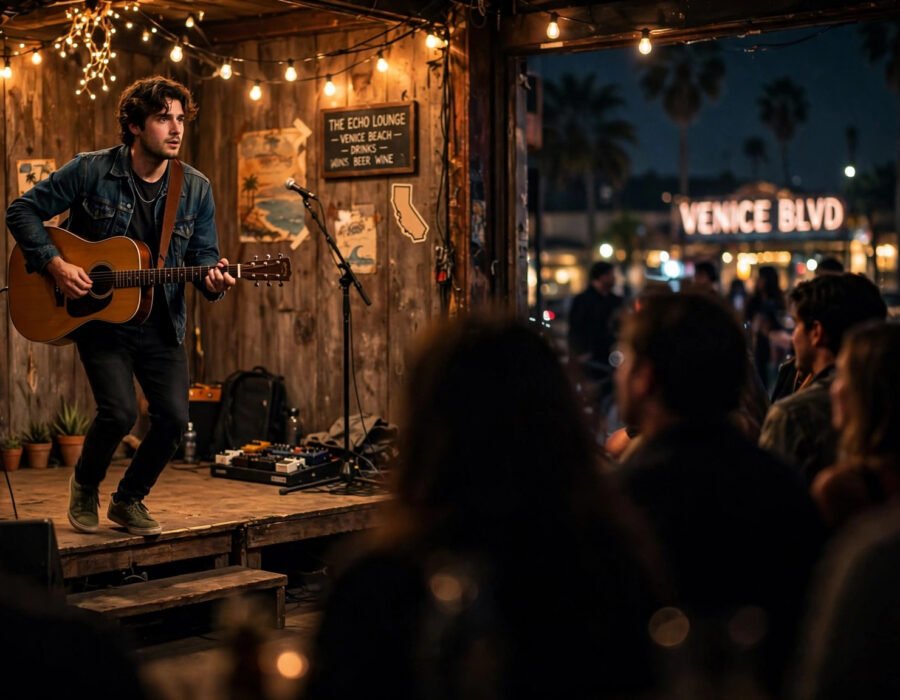
- Open mics (California’s gift). The state’s absurd density of open mics — every city has several weekly — is the perfect exposure gym: low stakes, supportive crowds, three-song slots. Finding open mic nights in your city is step one; going monthly is the training program.
- Real gigs. By the time paid or formal performances arrive, you’ve logged dozens of low-stakes reps. The fear never fully vanishes — pros still feel it — but it transforms from paralysis to energy.
Techniques That Work Before and During Performance
Preparation (the week before)
- Over-prepare the openings. Anxiety peaks in the first 30 seconds. If your song’s opening is automatic — muscle memory, not thought — you survive the spike and settle in. Practice starting cold, repeatedly.
- Simulate performance conditions. Play standing if you’ll stand. Play without stopping for mistakes (the #1 performance skill — audiences forgive wrong notes, not train wrecks). Play for the camera. Practice the situation, not just the song.
- Prepare your recovery. Decide in advance: when (not if) you flub a note, you smile and keep going. Having the recovery pre-decided prevents the freeze.
Day-of regulation
- Physical discharge. Adrenaline wants movement. A brisk 15-minute walk, jumping jacks, or shaking out your limbs before performing burns off the excess chemistry. Musicians who arrive and sit still marinate in adrenaline; those who move metabolize it.
- Breathing protocol. Slow exhale-focused breathing (in 4 counts, out 6–8) directly downregulates the sympathetic nervous system. Two minutes of this backstage measurably reduces shaking.
- Reframe the arousal. Research shows that interpreting nerves as excitement (“I’m excited”) rather than fear (“I’m terrified”) improves performance — same physiology, different story. Tell yourself the useful story.
- Beta-blockers: the honest note. Many professional musicians use doctor-prescribed propranolol for performance anxiety — it blocks the physical symptoms (shaking, racing heart) without sedation. It’s worth a conversation with your doctor if anxiety is severe; it’s also not a substitute for exposure work. The American Psychological Association’s performance anxiety resources discuss both behavioral and medical approaches without stigma.
On stage
- Arrive early, touch the space. Walk the stage, test the mic, play a few notes. Familiarity dissolves the unknown that feeds fear.
- Have a pre-performance ritual. Three deep breaths, a specific warm-up phrase, adjusting your strap the same way — rituals signal safety to your nervous system.
- Connect with one friendly face. Find the person smiling and play to them for the first song. An audience of allies beats an audience of judges.
- Accept the first-song tax. Your first song will be your worst — shaky, tight, imperfect. Plan for it: make it your easiest, most automatic piece. Song two is where you actually perform.
The Mindset Shifts That Last
- The audience wants you to succeed. This is the big one. Audiences — especially at open mics and local shows — are rooting for you. They’re not judges; they’re supporters who paid (or showed up) hoping for a good time. Performing for them rather than at them changes everything.
- Mistakes are invisible to audiences. They don’t know your arrangement. A wrong chord you sail past is forgotten instantly; the grimace and apology afterward is what they remember. Keep going and they keep enjoying.
- Competence precedes confidence. You don’t think your way to confidence and then perform well — you perform repeatedly (imperfectly) and confidence accrues. The order matters: action first, feeling second.
- Record your wins. After each performance, write down what went well. Anxious brains edit memories toward failure; a written record corrects the bias.
Building the underlying musicianship helps too — learning an instrument as an adult covers the practice side, and the same exposure principles apply to anxiety before big presentations — performance is performance, whatever the stage.
Conclusion
Getting over stage fright as a beginner performer in California comes down to graduated exposure (phone → friend → small group → open mic → stage), over-prepared openings, physical anxiety regulation, and the mindset shift that audiences are allies, not judges. California’s endless low-stakes performance opportunities make it the best place in America to climb this ladder. The fear doesn’t disappear — it converts to fuel. Start with the phone camera this week; the stage is closer than it feels.
Frequently Asked Questions
How long does it take to get over stage fright?
With regular graduated exposure (performing 2–4 times monthly at increasing stakes), most beginners feel major improvement within 3–6 months. The acute panic typically fades first; residual nerves become manageable energy. Complete fearlessness is rare even among pros — the goal is functional courage, not zero fear.
What’s the best first performance opportunity for beginners?
Open mic nights — they’re explicitly beginner-friendly, low-stakes (short sets, supportive crowds), and abundant in California. Go as an audience member first to see the vibe, then sign up. The supportive open-mic culture is the ideal training ground.
Should I use beta-blockers for stage fright?
It’s a legitimate option worth discussing with your doctor — propranolol is widely used by professional musicians for performance anxiety and blocks physical symptoms without cognitive effects. It’s most effective combined with exposure practice, not as a replacement for it.
Why do I play perfectly at home but badly on stage?
Adrenaline degrades fine motor control and working memory — the exact systems music performance needs. Home practice doesn’t trigger adrenaline, so it doesn’t train you to play through it. The fix is practicing under simulated pressure (recording, small audiences) so your playing becomes robust to the chemistry.
How do I recover when I make a mistake on stage?
Keep going — no grimace, no apology, no restarting. Audiences don’t know your arrangement and forget unacknowledged mistakes instantly. Decide your recovery strategy in advance (smile and continue), because in-the-moment decisions under adrenaline are unreliable.