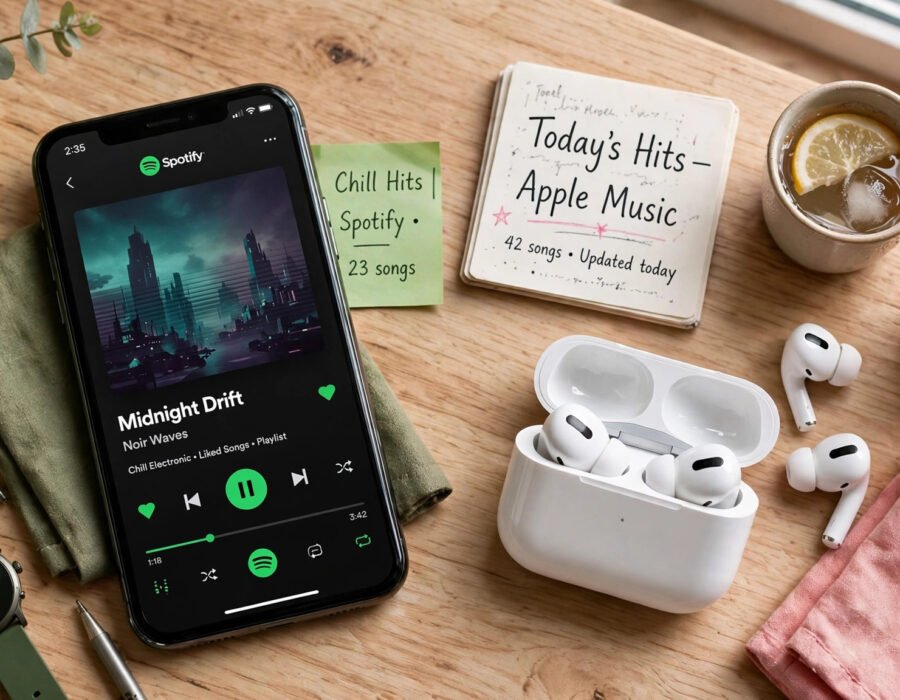
It’s 2026, you’re paying for a music streaming service, and a nagging question won’t die: did you pick the right one? Spotify vs. Apple Music is the streaming era’s great low-stakes dilemma — low-stakes because both are excellent, great because you’ll use the winner for thousands of hours. Do you need a professional (or a 40-tab research spiral) to decide? No. You need fifteen minutes and an honest assessment of how you actually listen. Here’s the decision framework.
The Short Answer: It’s About Your Ecosystem, Not “Quality”
Let’s clear the audiophile debate first: both services stream in high-quality formats in 2026 (lossless tiers are standard), both have 100M+ song catalogs with near-identical coverage, and both cost ~$11/month for individuals (~$17 family). The catalogs differ at the margins — occasional exclusives, slightly different podcast/video strategies — but no honest listener switches over library size anymore.
What actually differs: ecosystem integration, discovery philosophy, and artist economics. That’s the whole decision, and none of it requires professional help — just self-knowledge.
Round 1: Ecosystem Fit (Usually Decisive)
- Deep in Apple everything (iPhone, Mac, HomePod, Apple Watch, CarPlay)? Apple Music integrates seamlessly — Siri voice control, offline Apple Watch playback, spatial audio tuned for AirPods, and library syncing across devices that just works. The friction of using Spotify inside Apple’s walls (no HomePod native support, no Siri) is a daily paper cut.
- Android, Windows, Alexa, multi-platform life? Spotify is the universal citizen — native apps everywhere, Spotify Connect (seamless handoff between devices), and the best third-party integrations (Discord, gaming consoles, smart speakers of all brands).
- Switch platforms often? Spotify’s platform agnosticism is insurance against ecosystem changes. Your playlists and algorithms survive any hardware switch.
This round alone decides it for most people. The “best” service you fight with daily loses to the good-enough service that disappears into your life.
Round 2: Discovery Philosophy
This is the real personality split:
- Spotify: algorithmic discovery. Discover Weekly, Release Radar, Daylist, and the Wrapped phenomenon — Spotify’s recommendation engine remains the industry’s best at surfacing music you’ll love but haven’t heard. If discovering new music you like is a priority, Spotify’s edge here is genuine and widely acknowledged.
- Apple Music: human curation. Editorial playlists, artist interviews, radio shows with real DJs (Apple Music 1), and a more album-oriented presentation. If you prefer trusted human taste over algorithmic feeds — and value the editorial context around music — Apple Music’s approach resonates.
Neither is objectively better; they’re different relationships with music. Algorithm people feel Apple Music is static; curation people feel Spotify is noisy. Know which one you are — your current listening habits already tell you.
Round 3: The Details That Actually Matter Day-to-Day
- Audio quality: Both offer lossless. Spotify’s rollout completed; Apple Music includes spatial audio (Dolby Atmos) at no extra cost — genuinely impressive on AirPods, subtle elsewhere. Unless you’re listening on quality headphones in a quiet room, this round is a tie.
- Podcasts and non-music: Spotify invested heavily in podcasts and audiobooks (bundled listening hours); Apple keeps podcasts in a separate app. If you want one app for everything audio, Spotify. If you prefer separation, Apple.
- Social features: Spotify’s collaborative playlists, Blend (playlists merged with friends), and listening-party features are far ahead. Music as a social activity favors Spotify decisively.
- Library management: Apple Music (with its iTunes heritage) handles large owned-music libraries better — if you have thousands of ripped CDs or purchased tracks, Apple integrates them; Spotify largely doesn’t.
- Artist payouts: Both pay fractions of a cent per stream; Apple Music’s per-stream rate is somewhat higher. If supporting artists you love matters to you, the honest answer is that neither streaming service pays well — buying merch, concert tickets, and Bandcamp purchases move the needle far more than platform choice.
- Price and bundles: Compare student, family, and bundle pricing (Apple One vs. Spotify’s various partnerships). And audit the whole subscription stack — trimming streaming subscriptions without missing out applies to music too; many people pay for both services and use one.
The U.S. Copyright Office’s resources on music licensing offer fascinating background on how streaming royalties actually flow — useful context if the economics interest you beyond the consumer choice, and the RIAA’s annual revenue reports show where streaming money actually goes.
The 15-Minute Decision Method
- Check your ecosystem (2 min): All-Apple → lean Apple Music. Mixed → lean Spotify.
- Check your discovery style (2 min): Do you love algorithmic surprises or curated editorial? Your answer points clearly.
- Trial the other one (10 min + 1 week): Both offer free trials. Import your playlists (third-party playlist transfer tools make this painless), live with it for a week, and notice friction. The service you stop thinking about is the right one.
- Commit for a year. Annual plans (where offered) save ~15%. More importantly, committing stops the second-guessing — the differences are genuinely small, and the mental energy of perpetual comparison costs more than any feature gap.
Conclusion
You don’t need a professional to choose between Spotify and Apple Music in 2026 — you need to match the service to your ecosystem (Apple users → Apple Music; everyone else → Spotify), your discovery style (algorithms → Spotify; human curation → Apple Music), and your social listening habits. Trial the other for a week, commit for a year, and redirect the decision energy toward actually listening. The best streaming service is the one playing music while you get on with your life.
Frequently Asked Questions
Which has better sound quality, Spotify or Apple Music?
Both offer lossless streaming in 2026, making them effectively equivalent for most listeners and equipment. Apple Music includes spatial audio (Dolby Atmos) at no extra charge, which shines on AirPods. Audible differences require quality headphones and attentive listening.
Is Spotify or Apple Music cheaper?
Individual plans are priced nearly identically (~$11/month); family plans ~$17/month. The real savings come from bundles (Apple One, carrier deals) and annual plans. Check current promotions — they change frequently and often decide the value question.
Can I transfer my playlists between Spotify and Apple Music?
Yes — third-party playlist transfer tools move playlists, liked songs, and albums between services in minutes. Switching costs are low, which makes the free-trial comparison genuinely risk-free.
Which service is better for discovering new music?
Spotify’s algorithmic discovery (Discover Weekly, Release Radar, Daylists) is widely considered the industry’s best for personalized new-music surfacing. Apple Music counters with human-curated editorial playlists and radio. It depends whether you prefer algorithmic or human curation.
Do artists get paid more by Spotify or Apple Music?
Apple Music’s per-stream rate is somewhat higher, but both pay fractions of a cent per stream — neither is lucrative for artists at small scale. Direct support (merch, tickets, Bandcamp purchases) matters far more than which streaming platform you choose.
Which service is better for podcasts, Spotify or Apple Music?
Spotify, clearly — it invested heavily in podcasting, with exclusive shows, video podcasts, and audiobooks bundled into the same app and subscription. Apple keeps podcasts in a separate app (Apple Podcasts), which is excellent on its own but means two apps and a mental split. If you want one subscription covering music, podcasts, and audiobooks, Spotify’s bundle is compelling. If you prefer your podcasts separate from your music — many listeners do, to keep algorithms clean — Apple’s separation is a feature, not a bug. Decide based on whether consolidation or separation suits your listening habits.