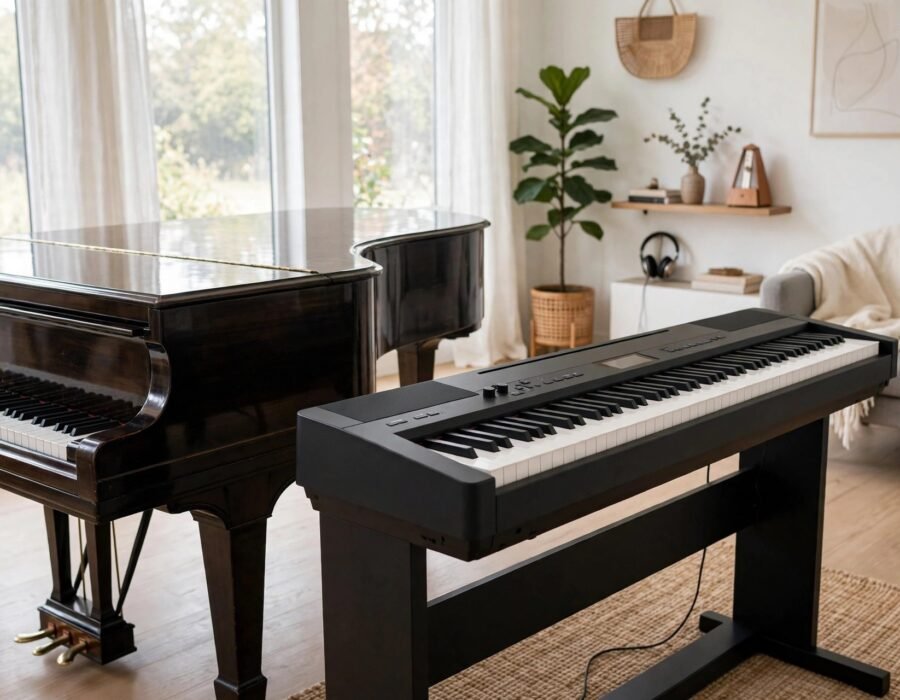
You want a piano. The acoustic upright costs $3,000 used and weighs 500 pounds; the digital keyboard costs $500, fits in a closet, and never needs tuning. The internet will tell you — passionately, on both sides — that one choice is obviously correct. If you are asking what should I know before I decide between digital and acoustic pianos, this guide gives you the honest comparison: what each does well, where each falls short, and how to choose based on your actual life rather than internet dogma.
The short version: modern digital pianos are astonishingly good and the right choice for most beginners; acoustic pianos remain unmatched for advanced players and specific contexts. The right answer depends on your level, space, budget, neighbors, and goals — not on which camp shouts loudest.
Sound and Feel: The Real Differences
Acoustic pianos produce sound physically: hammers strike strings, the soundboard resonates, and the entire instrument vibrates sympathetically. This creates tonal complexity — harmonics, resonance, the way notes interact — that even the best sampling cannot fully replicate. The touch is equally physical: graded hammer action, escapement (the subtle click as the hammer releases), and the way the keys respond to the vibrating instrument. Advanced players feel these differences profoundly; they shape interpretation.
Digital pianos simulate all of this. The best ones — with multi-gigabyte samples, modeled resonance, and high-end weighted actions — come remarkably close, close enough that blind tests fool many listeners on recordings. The gaps that remain: the sympathetic vibration of a real soundboard, the infinite dynamic subtlety of felt hammers, and the way an acoustic fills a room physically. For beginners through intermediates, these gaps are inaudible — technique limitations dwarf instrument limitations. NAMM’s piano buying guides detail the current state of digital action technology, which improves yearly. And if you are starting as an adult, learning an instrument as an adult pairs well with either choice — the practice matters more than the piano.
The Practical Comparison
Cost: digitals win decisively — $500–1,500 buys an excellent digital; comparable acoustic quality starts around $3,000 used, $8,000+ new, plus $150–300/year in tuning and maintenance. Space: digitals win — a slab piano fits anywhere; even “compact” acoustics dominate rooms and weigh hundreds of pounds. Neighbors: digitals win by knockout — volume control and headphone practice make 11 p.m. sessions possible; acoustics are heard through walls, floors, and sometimes streets.
Maintenance: digitals need none (dust it); acoustics need tuning twice yearly, humidity control, and eventual regulation and voicing — real ongoing costs in money and attention. Longevity: quality acoustics last generations and can appreciate; digitals depreciate like electronics and become obsolete as sampling improves. Resale: acoustic grands from respected makers hold value; digitals lose half their value quickly. Portability: digitals move in a car; acoustics require professional movers ($300–800) and sometimes crane removals. For gigging musicians, finding local live music events is easier with a digital you can actually transport.
The Hybrid Middle Ground
Hybrids — acoustic actions triggering digital sound (Yamaha AvantGrand, Kawai Novus) — offer real piano touch with digital convenience: headphones, no tuning, compact size. They cost $5,000–10,000, occupying the serious-enthusiast niche. For most buyers they are overkill, but they prove the categories are converging rather than competing.
How to Decide
Choose digital if: you are a beginner or intermediate, practice in shared walls, need headphones, move frequently, or want maximum piano for minimum money. The $800–1,200 range (Yamaha P-series, Roland FP-series, Kawai ES-series) buys instruments that satisfy players for years. Choose acoustic if: you are advanced enough to exploit the difference, own your space, have the budget for purchase plus maintenance, and value the instrument as furniture, heirloom, and acoustic experience.
Try before buying either way: play the specific instrument, not just the model — acoustics vary individually, and digital actions differ more than specs suggest. Buy used acoustics only with a technician’s inspection ($100–200 that saves thousands). And remember the Smithsonian’s piano history collections — the instrument you choose joins a 300-year lineage either way; the lineage does not mind which branch you sit on.
The Used Acoustic Market: Treasure and Traps
Used acoustics are where the value is — a $4,000 used Yamaha upright often outperforms a $6,000 new budget piano. But the market has traps: pianos that have not been tuned in a decade may never hold pitch again; cracked soundboards and pinblocks are fatal; and moving costs ($300–800) apply to every purchase. Always hire a piano technician ($100–200) to inspect before buying — they will check pinblock torque, soundboard condition, and action wear in under an hour. The best sources: estate sales, university surplus (music schools rotate instruments), and dealers’ trade-in inventories. Avoid free pianos unless a technician approves — “free” pianos are often free because moving them costs more than they are worth.
Digital Pianos: What the Specs Mean
Shopping digitals means decoding specs. Polyphony (notes the piano can sound simultaneously): 128 is minimum, 256 better — low polyphony drops notes in dense passages with the sustain pedal down. Action: graded hammer action is the baseline; wooden keys and escapement simulation mark the premium tier. Sound engine: longer, multi-velocity samples sound more realistic; modeling (Roland’s approach) offers infinite variation. Speakers: built-in speakers suffice for practice, but line-outs to external speakers transform the experience. Try before buying — two digitals with identical specs can feel completely different under your fingers.
The Bottom Line
Digital pianos offer unbeatable practicality — cost, silence, portability, zero maintenance — and satisfy everyone through intermediate level and beyond. Acoustic pianos offer irreplaceable tonal depth and physical presence for those who can house, afford, and exploit them. Match the instrument to your life, not to internet arguments: the best piano is the one you will play daily, in the space you have, at the hours you keep.
Frequently Asked Questions
Can you learn piano properly on a digital?
Yes, absolutely — provided it has 88 weighted keys. Millions of pianists learned on digitals, and graded exams accept them. The technique transfers fully to acoustics. Just avoid unweighted keyboards for serious study; the finger strength does not develop.
How long do digital pianos last?
10–20 years for quality instruments, though technology marches on — a 15-year-old digital still plays fine but sounds dated next to current sampling. Acoustics last generations with maintenance. Factor obsolescence into the value calculation, not just the purchase price.
Do acoustic pianos need tuning often?
Twice a year minimum, more for new instruments or unstable climates. Neglect tuning and the piano drifts into unpleasantness; long-neglected pianos may need multiple pitch-raise tunings to recover. Budget $150–300/year.
What should I spend on a first piano?
$500–1,200 for a digital with 88 weighted keys covers beginners through intermediate comfortably. For acoustic, $3,000–5,000 buys a decent used upright (plus inspection and moving). Spend less only if you are testing commitment — and upgrade when practice outgrows the instrument.
Is a 61-key keyboard enough to learn piano?
For the first months, yes — most beginner pieces fit within 61 keys. But you will outgrow it within a year as repertoire expands. If you are serious, start with 88 weighted keys; if you are testing the waters, 61 keys is an acceptable trial that costs little.