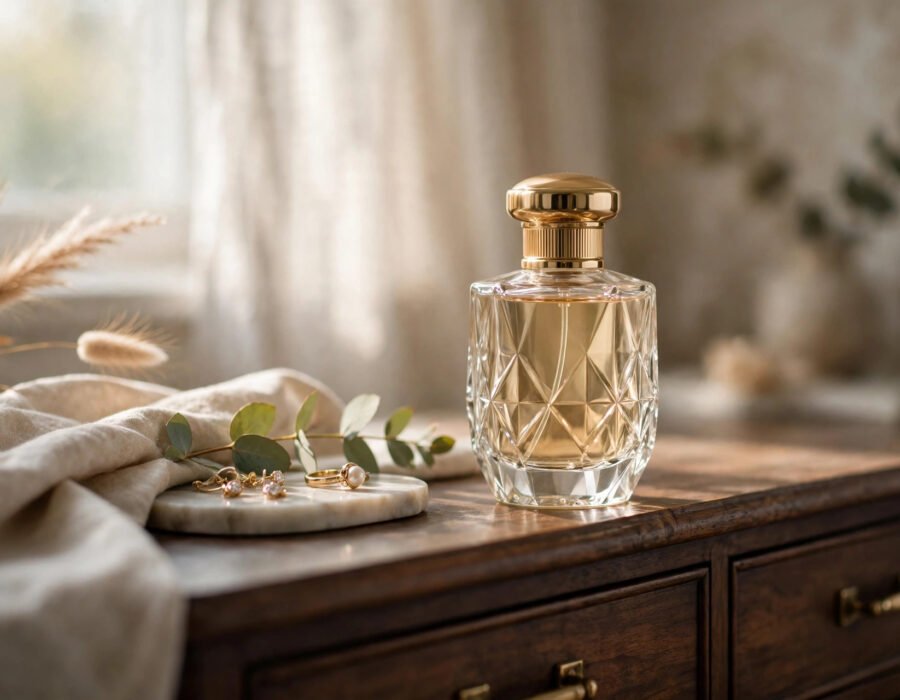
You spray perfume at 8 a.m. and by lunch it is gone — while your friend's scent lingers into the evening from the same number of sprays. Longevity feels like luck or money, but it is mostly chemistry and selection strategy: concentration levels, note types, and application technique determine wear time far more than price. Choosing a lasting perfume solo is entirely learnable.
Here is the longevity framework: what actually makes perfume last, how to read labels for wear time, the note families that endure, application tricks that double longevity, and a solo testing method that works without a sales associate.
Concentration: The Label Tells the Wear Time
Perfume longevity starts with concentration — the percentage of fragrance oils in the bottle. From lightest to strongest: eau de cologne (2 to 4%, lasts 2 hours), eau de toilette (5 to 15%, 3 to 5 hours), eau de parfum (15 to 20%, 5 to 8-plus hours), parfum/extrait (20 to 30%+, 8 to 12-plus hours). If your scent vanishes by lunch, check the label — you may be wearing an EDT and expecting EDP performance.
The solo buyer's rule: for all-day wear, default to eau de parfum or parfum concentrations. They cost more per bottle but less per wearing hour — a 120-dollar EDP worn 200 times costs 60 cents per wear. Note that concentration is not the whole story: a heavy-orental EDT can outlast a sheer EDP. But as a first filter, concentration is the most reliable longevity signal on the label, and it is printed on every box.
Notes: Which Scents Survive the Day
Fragrance notes evaporate in order: top notes (citrus, light florals — 15 minutes to an hour), heart notes (spices, heavier florals — hours), base notes (woods, amber, musk, vanilla, oud — the long haul). Longevity lives in the base: perfumes built on woods, resins, amber, and musk last; perfumes built on citrus and aquatic notes fade by design, however lovely the opening.
Read the note pyramid before buying — it is usually on the brand site or retailer page. For all-day wear, want a base with amber, sandalwood, cedar, vetiver, patchouli, or musk. Seasonal logic: heavier bases suit fall and winter; in summer heat, lighter EDPs with substantive hearts outperform heavy parfums that turn cloying. Your skin chemistry personalizes everything — the same perfume lasts 8 hours on oily skin and 4 on dry, because oils hold fragrance. Dry-skinned buyers should weight longevity even more heavily in selection.
For official guidance, see U.S. Food and Drug Administration.
Application: Doubling Wear Time for Free
Technique rivals selection. Apply to moisturized skin — fragrance lasts dramatically longer on lotioned skin than dry, so moisturize pulse points first (unscented lotion to avoid clashing). Target warm pulse points: wrists, neck, behind ears, inner elbows — heat diffuses scent. Do not rub wrists together — it crushes the top notes and shortens the scent's development.
Layer strategically: matching scented lotion or body oil underneath (same fragrance line, or unscented) creates a base that grips the perfume. Spray clothes and hair lightly — fabric holds scent far longer than skin (test for staining on delicates first). The right number of sprays: 2 to 4 for EDP — overspraying does not extend wear proportionally, it just announces you. Reapply once midday from a travel atomizer (decant, do not carry the full bottle) rather than drowning yourself at 8 a.m.
Solo Testing: The Method Without a Sales Associate
Test like a professional on your own. Rules: test on skin, never just paper strips (chemistry differs); test maximum three perfumes per outing (nose fatigue is real — coffee beans help marginally, fresh air helps more); spray one on each wrist and one on inner elbow, label them, and leave the store.
The critical step: evaluate over hours, not minutes. The opening lies — judge the dry-down at hour 3, hour 6, and hour 8. Does it survive? Does the base please you, since that is what you will smell most? Get samples or discovery sets before committing to full bottles — most brands and retailers sell them, and a 5-dollar sample prevents a 120-dollar mistake. Never buy on first sniff; the perfumes worth owning reveal themselves in the long dry-down, which is exactly what you are shopping for.
Budget Longevity: Price Is Not the Predictor
Some of the longest-wearing perfumes are cheap, and some expensive ones vanish — longevity correlates with concentration and composition, not price. The budget strategy: explore affordable EDPs with strong base notes, Middle Eastern fragrance houses known for potent long-wear formulas at low prices, and designer EDPs bought as testers or during sales.
Avoid the traps: celebrity EDTs marketed on fame rather than composition, 'fresh' summer flankers if longevity is the goal, and blind-buying full bottles based on influencer descriptions — skin chemistry makes this a lottery. Total cost of finding your all-day scent: a discovery set or two (20 to 40 dollars) plus the winning bottle. The expensive mistake is not the 100-dollar bottle — it is the five 60-dollar bottles bought wrong.
Learn more from Good Housekeeping.
Storing Perfume So It Lasts Years
Perfume degrades with heat, light, and air — the bathroom counter (humid, warm, bright) is the worst storage spot despite being the most common. Store bottles in a cool, dark place: a bedroom drawer, a closet shelf, away from windows. Original boxes add protection; keep them.
An unopened bottle stored well lasts 3 to 5-plus years; opened bottles last 1 to 3 years depending on the formula (citrus-heavy scents fade fastest, resinous bases endure). Signs of death: sour or vinegar-like off-notes, significant color darkening, weakened projection. Decant into small atomizers for daily use, keeping the main bottle sealed — every opening admits air. Your 120-dollar bottle deserves better than the bathroom windowsill; proper storage is free longevity.
For the authoritative take, visit Allure.
If this was helpful, keep reading: our guide to dressing well on a tight budget and making cheap clothes look expensive.
Yes, you can choose an all-day perfume on your own: default to eau de parfum or parfum concentrations, favor fragrances with substantive base notes (woods, amber, musk), apply to moisturized pulse points without rubbing, layer over unscented lotion, and test candidates over full 8-hour wear periods before buying. Longevity is chemistry and method, not luck or luxury pricing. The scent that survives the dry-down on your skin, tested solo over a real day, is the one — and now you know how to find it.
Frequently Asked Questions
What perfume concentration lasts longest?
Parfum/extrait (20 to 30%+ oils) lasts 8 to 12-plus hours, followed by eau de parfum (15 to 20%, 5 to 8-plus hours). For all-day wear, choose EDP or parfum over eau de toilette.
Why does my perfume fade so fast?
Common causes: low concentration (EDT), citrus/aquatic-dominated composition, dry skin, too few sprays, or rubbing wrists together. Switch to EDP, moisturize first, and apply to pulse points and clothing.
How many sprays of perfume should I use?
Two to four sprays of eau de parfum is standard. Overspraying does not extend wear proportionally — it intensifies projection. For all-day coverage, reapply once midday from a travel atomizer instead.
Do expensive perfumes last longer?
Not necessarily — longevity depends on concentration and note composition, not price. Many affordable EDPs with strong base notes outlast pricey sheer EDTs. Read the concentration and notes, not the price tag.