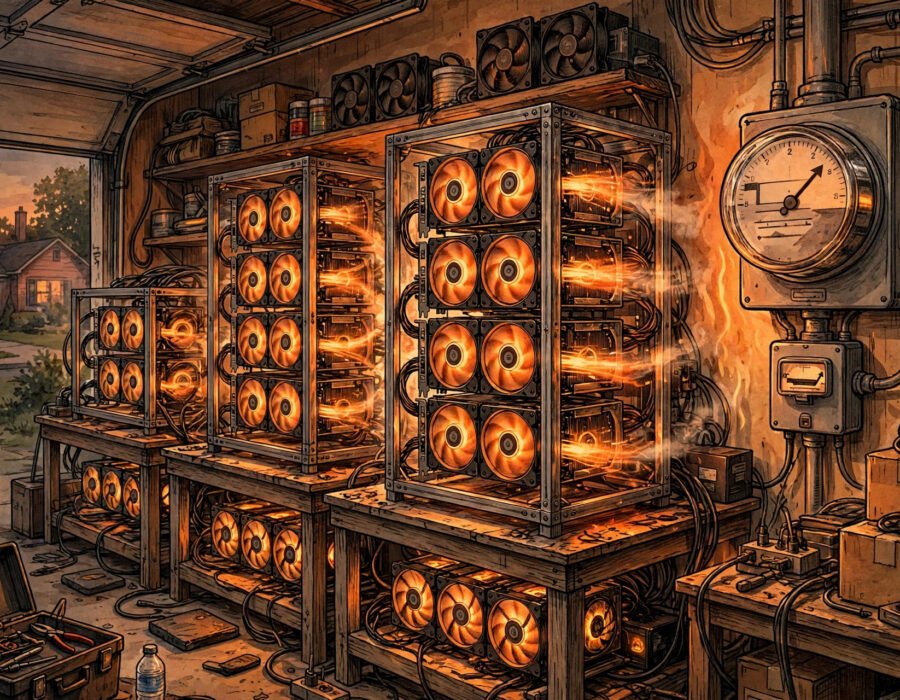
The dream is irresistible: a humming rig in the garage, quietly minting digital money while you sleep. YouTube thumbnails promise “$300 a month passive income!” with a graphics card and an extension cord. Then the electric bill arrives, the garage hits 110 degrees, the neighbors complain about the noise, and the math quietly collapses. What are the biggest mistakes people make when they start mining crypto at home in 2026? Nearly all of them trace back to one error: doing the math last instead of first.
Home mining isn’t dead — but in 2026 it’s a completely different game than the glory days, and the winners are the ones who treat it like an engineering project, not a lottery ticket.
Mistake 1: Mining Without Calculating Electricity Costs First
This is the mistake that kills most home operations. Mining profitability is brutally simple: revenue minus electricity minus hardware depreciation. And electricity is usually 60–80% of the cost. At the U.S. average of around $0.17–0.18 per kWh, most home mining setups lose money daily — the rig earns $2 in crypto while burning $3 in power.
Before buying anything, find your exact rate on your electric bill (not the advertised rate — the all-in per-kWh including delivery charges), estimate your rig’s wattage honestly, and run the numbers through a mining profitability calculator with current coin prices and network difficulty. If the math doesn’t work at today’s prices, it won’t magically work tomorrow — difficulty rises as more miners join, which is the market’s way of erasing easy profits. If your bill already makes you wonder why your electric bill is so high in the summer, adding a space heater that runs 24/7/365 will not improve the situation.
Mistake 2: Buying Hardware at the Wrong Time (or the Wrong Hardware)
Beginners buy GPUs at retail peaks — usually right after watching a “mining is profitable!” video — and then watch profitability crater as difficulty adjusts upward. Mining hardware is a commodity business: profits attract miners, miners raise difficulty, difficulty kills profits. Buying equipment at the top of that cycle means paying peak prices to earn trough rewards.
Worse, many buy the wrong hardware entirely. Bitcoin mining with GPUs has been obsolete for a decade — it requires specialized ASIC machines that cost thousands, sound like jet engines, and become doorstops when newer models release. GPU mining survives on smaller coins, but those markets are thin and volatile. And please: don’t mine on your gaming laptop. Sustained 100% load will cook components designed for bursts — if you’ve ever wondered why your laptop gets so hot watching videos, imagine that heat multiplied and sustained for months.
Mistake 3: Ignoring Heat, Noise, and Your Home
A mining rig is a 500–1,500-watt space heater that never turns off, plus fans running at full tilt around the clock. Beginners discover too late that: the spare bedroom becomes uninhabitable in summer, the noise carries through walls and annoys everyone in the house, and home insurance may not cover fire damage from modified electrical setups drawing continuous max loads.
Electrical safety is the non-negotiable part. Continuous high loads stress residential wiring, cheap power strips melt, and overloaded circuits start fires. If your setup trips breakers, that’s not an inconvenience — it’s a warning. Consult an electrician before scaling past a single modest rig, and never daisy-chain power strips. The crypto isn’t worth a house fire.
Mistake 4: Forgetting Taxes From Day One
In the U.S., mined crypto is taxable income valued in dollars the moment you receive it — every payout, every day, at that day’s price. Then when you sell, you owe capital gains on any appreciation since. A home miner receiving daily payouts generates hundreds of taxable events a year, each needing a dollar valuation. Start tracking from the first payout with mining-aware tax software, because reconstructing a year of daily payouts from pool records is miserable.
There’s a possible upside: home miners operating as a business may deduct electricity, hardware depreciation, and space costs. But “business” has IRS criteria — profit motive, regular activity, proper records — and hobby miners get fewer deductions. The IRS virtual currency FAQ covers mining specifically; read it before the rig, not after the audit notice.
Mistake 5: Joining the Wrong Pool (or Mining Solo)
Solo mining with home hardware is a lottery ticket — you might find a block in a decade, or never. Mining pools combine thousands of miners’ power and split rewards steadily, which is the only sane approach at home. But pools differ: fee structures (1–3% typically), payout schemes, minimum thresholds, and reliability all vary. Beginners also fall for “private pools” advertised in DMs — those are advance-fee scams, full stop.
Stick to established pools with public track records, understand the payout scheme (PPS pays steadily but takes a bigger cut; PPLNS pays more on average with more variance), and verify the pool’s stated fees against your actual payouts for the first month. If numbers don’t match, switch — loyalty to a pool is just another cost.
Mistake 6: Ignoring the Environmental and Neighborhood Math
Mining’s energy footprint is real, and in 2026 it’s a social and increasingly regulatory issue. Some utilities now offer time-of-use rates that make overnight mining cheaper — worth investigating — while some jurisdictions have considered restrictions on energy-intensive mining. Beyond politics, consider the straightforward question of whether burning hundreds of kilowatt-hours monthly aligns with your household’s values; many would-be miners find that reducing their home’s carbon footprint matters more to them than marginal mining revenue once they see the meter spin.
Noise deserves its own mention: ASIC miners run at 70–80 decibels continuously — louder than a vacuum cleaner, forever. Apartment miners have been evicted over it. Check your lease, your HOA rules, and your relationships before committing.
What Actually Works in 2026
The viable home-mining niches are narrow but real: miners with genuinely cheap electricity (under ~$0.10/kWh all-in, often via specific utility plans or regions), those heating spaces they’d heat anyway (a rig replacing a space heater is “free” mining in winter), and hobbyists who treat it as education with costs accepted upfront. Some also mine speculative small coins hoping for appreciation — honest gambling, but gambling nonetheless. The Consumer Financial Protection Bureau’s Ask CFPB resources on evaluating income opportunities apply a useful skepticism to every “passive income” pitch, mining included.
Conclusion
The biggest mistakes in home crypto mining all share a root cause: starting with the hardware instead of the spreadsheet. Calculate true electricity costs first, buy hardware only when the math survives difficulty increases, respect heat/noise/electrical reality, track taxes from payout one, join reputable pools, and be honest about whether the environmental cost fits your values. In 2026, home mining rewards engineers and punishes dreamers. Do the math first, and you’ll either build a genuinely profitable rig — or save yourself thousands by wisely deciding not to.
Frequently Asked Questions
Is home crypto mining still profitable in 2026?
Usually not at average U.S. electricity rates. It can work with cheap power (under ~$0.10/kWh), efficient hardware bought at good prices, and realistic expectations — but most beginners lose money. Run your exact numbers first.
Can I mine Bitcoin with my gaming PC?
Effectively no. Bitcoin mining requires specialized ASIC hardware; a GPU or CPU earns essentially nothing against industrial competition while wearing out your components.
How much electricity does a mining rig use?
A modest GPU rig draws 500–1,000 watts continuously — like running a space heater nonstop. That’s 360–720 kWh monthly, which at average rates adds $60–130 to your electric bill before earning a cent.
Do I owe taxes on mined crypto even if I don’t sell?
Yes. Mined coins are ordinary income at their dollar value when received, reported even if you never sell. Selling later triggers capital gains tax on top. Per SEC investor guidance, consult the IRS virtual currency FAQ for the federal rules.