There’s something unbeatable about movies under the stars in your own backyard — no crowds, no overpriced popcorn, pause button at your command, and the kids in pajamas. If you’re asking how do I make my backyard movie night amazing, I’ve hosted dozens of these (and attended enough mediocre ones to know what separates great from forgettable). The good news: a truly amazing backyard movie night costs less than one trip to the theater for a family, and the setup is simpler than you’d think. Let’s build it.
The core components are just four: picture, sound, seating, and atmosphere. Get all four right and it’s magic. Skimp on sound (the most common mistake) and it’s frustration. Here’s the complete guide, from budget basics to the details that make it unforgettable.
How Do I Make My Backyard Movie Night Amazing? The Picture
Projector options for every budget
Budget ($80–150): basic 1080p-support LED projectors from brands like Vankyo, Dr. J, or Yaber. Are they as good as $1,000 projectors? No. Are they plenty good for a backyard movie night? Absolutely — in the dark, on a decent screen, they look great. Key specs: “native” 720p minimum (ignore “supported 1080p” claims — check the native resolution), 5,000+ lumens claimed (manufacturer lumens are inflated; real brightness is lower, but it’s enough after dark), and HDMI input.
Mid-range ($300–500): name-brand portable projectors (Anker Nebula, BenQ GV series, XGIMI) with better brightness, auto-focus, and built-in streaming. The convenience upgrade is significant — auto-focus and keystone correction save 20 minutes of fiddling. If you’ll do this monthly, the upgrade pays for itself in reduced frustration.
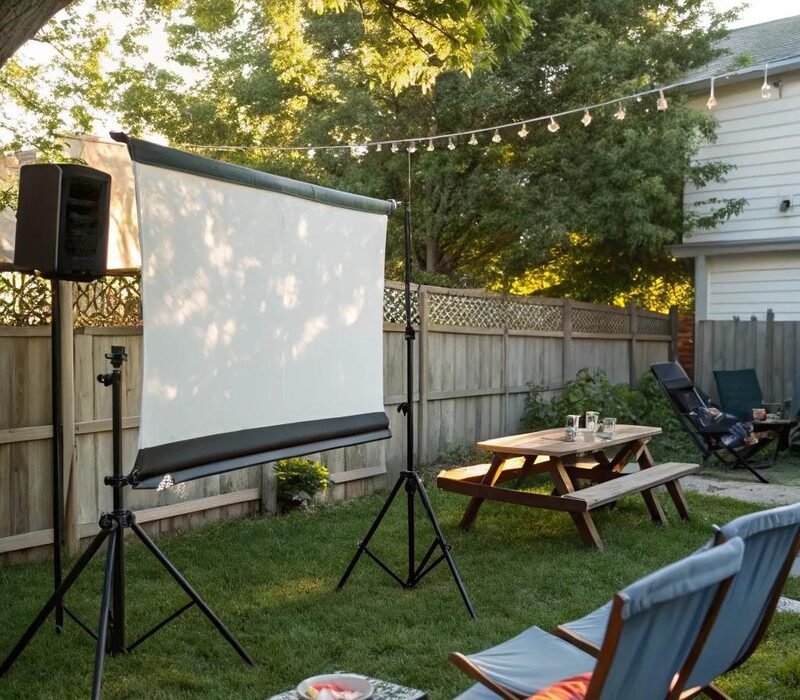
The screen: a white wall or light-colored garage door works surprisingly well (free!). For a dedicated screen: a white blackout-cloth ($20–30 for a 120″ sheet — the DIY secret; it’s designed to block light, so it’s perfectly opaque and wrinkle-resistant), stretched on a PVC frame or hung with grommets. Inflatable screens ($100–150) are the crowd-pleaser — huge, self-supporting, dramatic. Avoid bedsheets if you can — they’re translucent (light bleeds through) and wrinkle visibly. Blackout cloth is cheaper and dramatically better.
Placement: projector 10–15 feet from the screen (check your projector’s throw ratio), set on a table or tripod, centered. Run an extension cord before guests arrive. Test the full setup the day before — focus, alignment, and brightness all need darkness to evaluate, so test after sunset.
Sound: The Make-or-Break Element
I’m going to be blunt: projector built-in speakers are terrible. Tiny, tinny, drowned out by crickets and neighbors’ AC units. Bad sound ruins backyard movie nights more than any other factor. The fix is easy and cheap:
- Best budget option: a portable Bluetooth speaker ($30–60, JBL Flip or equivalent) placed near the seating. Dramatically better than projector speakers. Charge it fully beforehand.
- Better: a dedicated outdoor Bluetooth speaker with real bass (JBL Charge, Ultimate Ears Megaboom — $100–150). These fill a backyard with clear, full sound.
- Best: run the projector’s audio-out to a soundbar or stereo system via Bluetooth or aux cable. If you have a home theater soundbar, temporarily relocate it outside for movie night.
Connect via the projector’s Bluetooth or 3.5mm audio-out — test the sync (lip-sync delay plagues some Bluetooth setups; wired aux is more reliable). Set volume for the back of the seating area; it’ll be plenty loud up front. And check your local noise ordinances — most areas require quiet by 10–11 PM. Plan your start time accordingly (a 2-hour film starting at 8 PM ends at 10 — perfect).
Seating and Atmosphere
Seating tiers: blankets and pillows up front (kids’ zone), lawn chairs and bean bags in the middle, hammocks and lounge chairs at the back. The tiered arrangement means everyone sees. Provide more blankets and pillows than you think — backyard ground gets cold and hard after an hour, even in summer. A few cheap pool floats as loungers are a hit with kids.
Lighting: the magic is in the contrast — the screen bright, everything else softly dim. String lights ($15–25) overhead or along fences create the atmosphere; solar-powered ones need no wiring. Tiki torches or LED candles on tables. Avoid bright white lights anywhere near the screen — they wash out the picture. Pathway lights (solar stakes, $1 each) for safe bathroom trips.
Bug defense: citronella candles, a couple of oscillating fans (mosquitoes are weak flyers — moving air is the most effective repellent), and bug spray available for guests. Nothing ends a movie night faster than a mosquito swarm. Thermacell devices ($25) create a genuinely effective bug-free zone — worth it if mosquitoes are bad in your area.
Weather backup: check the forecast obsessively. Have a rain date announced upfront (“rain date: Saturday”). Wind is the other enemy — it flaps screens and drowns sound. A calm, clear night in the 65–75°F range is ideal. Fall movie nights (with blankets, hot cocoa, and horror films) are underrated — cooler air means fewer bugs and cozier vibes.
Food, Film Selection, and Hosting
Food: popcorn is mandatory (make it fresh — a $30 popcorn maker pays for itself in one summer of movie nights). Beyond that: a simple concession stand (candy, sodas in a cooler, hot dogs) lets kids feel like it’s a real theater. For adults: a themed cocktail or mocktail matching the film. Keep it simple — you’re hosting a movie, not a dinner party.
Film selection: crowd-pleasers with visual spectacle play best outdoors — the slight ambient light and casual atmosphere favor fun over subtle. Great backyard films: The Princess Bride, Jurassic Park, Back to the Future, The Greatest Showman, Coco, Top Gun: Maverick, Spider-Man: Into the Spider-Verse. Save the quiet character dramas for indoors. Let kids vote from a shortlist — investment in the choice means investment in the night. And check out family movie picks and free outdoor screenings for inspiration.
Hosting flow: invite for 30–45 minutes before showtime (setup buffer, socializing, snack distribution). Start the film at full dark (check sunset times — in midsummer, that’s 8:30–9 PM). One film per night — two sounds fun and ends at midnight with sleeping children on laps. Intermission halfway for bathroom, snack refills, and leg-stretching. Have the next movie night’s film vote before everyone leaves — momentum matters.
For the full outdoor cinema tradition, the Wikipedia article on inflatable screens covers the tech. For drive-in experiences, the principles overlap.
So how do you make your backyard movie night amazing? A decent budget projector on blackout cloth (not a bedsheet), real sound via Bluetooth speaker (never projector speakers), tiered comfortable seating with excess blankets, string-light atmosphere, bug defenses, popcorn and a simple concession stand, a crowd-pleasing film, and a start time at full dark. Total cost: $150–250 for a setup that pays for itself in two uses and creates summers your kids will remember forever. Roll credits.