
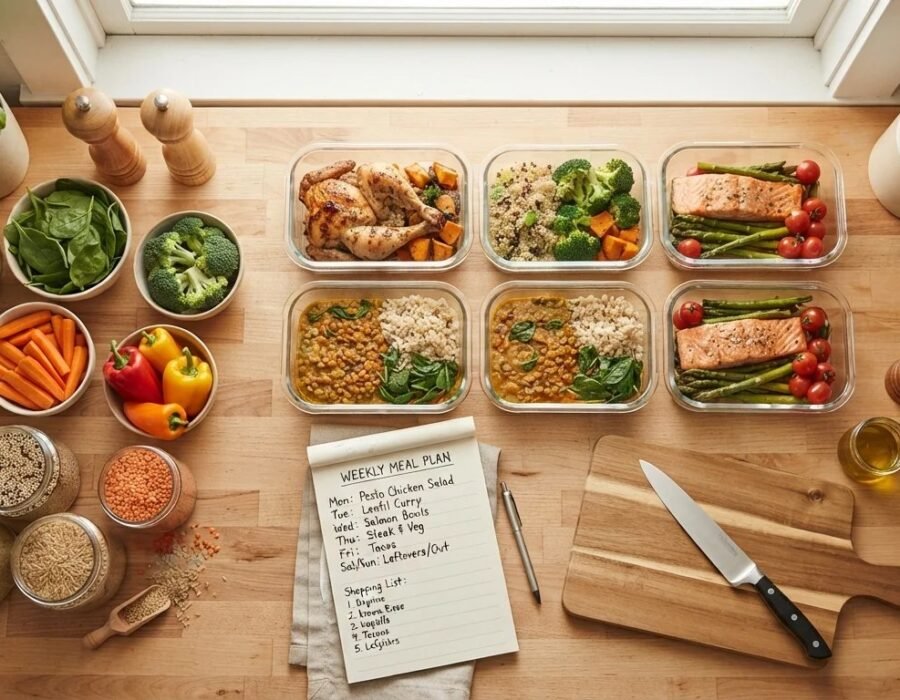
Sunday evening. You’re staring into the fridge, realizing you have no plan for the week, no groceries that make sense together, and approximately zero motivation to figure it out. So you order takeout — again — spending $60 on food you could have made for $20. If this is your weekly ritual, learning how to use AI to plan a weekly meal schedule might be the highest-ROI habit you adopt this year. It turns a dreaded hour-long chore into a five-minute conversation.
I’ll be upfront: I was skeptical that AI meal planning would be anything more than a gimmick. Then I tried it properly — with good prompts and my actual constraints — and it produced a better weekly plan in three minutes than I’d ever made myself. The grocery list was organized, the meals fit my schedule, and I actually stuck to it because I hadn’t burned an hour building it. Here’s the complete playbook.
How to Use AI to Plan a Weekly Meal Schedule: The Core Method
The basic approach is simple, but the prompt is everything. Don’t ask “plan my meals for the week” — that’s like asking a chef to “make food.” Instead, give AI the constraints that matter:
- Dietary needs: vegetarian, gluten-free, dairy-free, halal, kosher, low-sodium — whatever applies. Be specific about hard restrictions versus preferences.
- Household: “2 adults and a picky 7-year-old” produces very different plans than “single adult meal-prepping.”
- Cooking reality: “30 minutes max on weeknights, I can do longer Sunday cooking” / “I have an Instant Pot and air fryer but no oven” / “beginner cook, keep techniques simple.”
- Budget: “Keep groceries under $120/week” or “use affordable pantry staples.” AI is surprisingly good at budget-conscious planning when asked.
- Goals: high-protein, weight management, more vegetables, less food waste — name what you’re optimizing for.
- Schedule: “I need packed lunches Mon-Thu” / “Friday we eat out” / “Wednesday I get home at 8pm, need something instant.”
A prompt combining these looks like: “Create a 7-day dinner meal plan for 2 adults. One is vegetarian, both avoid dairy. Weeknight cooking max 25 minutes; I can batch-cook Sunday afternoon. Budget $100/week. Include a grocery list organized by store section, and make sure lunches use dinner leftovers where possible.” That single prompt replaces an hour of agonizing.
Getting More From AI Meal Planning
The first plan is just the start. Iterate conversationally: “swap Thursday’s meal, we had pasta last week,” “make Wednesday even simpler,” “add estimated prep times,” “what can I prep Sunday to make weeknights faster?” Each refinement takes seconds. Save the prompts that produce great results — build a personal template you reuse weekly with small tweaks.
Ask for the grocery list organized by store section (produce, meat, dairy, pantry, frozen) — this alone saves 15 minutes of wandering the store. Ask AI to check for ingredient overlap: the best meal plans reuse ingredients across days (that bunch of cilantro appears in three meals, not one), which cuts both cost and waste. The average American household wastes over $1,500 in food annually; planned overlap attacks this directly.
For nutrition grounding, ask AI to align plans with established guidance. The USDA’s MyPlate framework — half your plate fruits and vegetables, with whole grains and lean proteins — is the simplest healthy-eating standard. “Follow MyPlate proportions” in your prompt produces plans that are both convenient and nutritionally sound. For food safety questions that matter — safe temperatures, storage times, when leftovers expire — the FoodSafety.gov portal is the authoritative reference, and it’s worth AI-proofing your plan against it.
AI Meal Planning for Special Situations
Families with picky eaters: Ask for “deconstructed” meals — taco bars, pasta with sauce on the side, build-your-own bowls — where everyone assembles their own plate from shared components. One meal, zero short-order cooking. Ask AI specifically for kid-friendly adaptations of adult meals rather than separate kids’ menus.
Health goals: Whether it’s high-protein for training, lower-carb, heart-healthy, or managing a condition like diabetes, AI can build plans around nutritional targets — but verify important health-related plans with your doctor or a registered dietitian. AI is a planning assistant, not a medical professional. Our guide to healthy weight loss without dieting covers the sustainable nutrition principles worth building into your plans.
Tight budgets: AI excels at budget meal planning when given the constraint explicitly. Ask for plans built around affordable staples (rice, beans, lentils, eggs, seasonal produce, frozen vegetables), with cost estimates per meal. The USDA also publishes the Thrifty Food Plan showing nutritious eating is possible on tight budgets — a useful reality check.
Learning to cook: Pair meal planning with skill building — ask AI to explain techniques, suggest simpler substitutions for intimidating steps, and order the week’s meals by difficulty so you’re practicing progressively. Our guide to learning to cook new recipes with AI turns your meal plan into a cooking education.
Common Pitfalls (and How to Avoid Them)
A few things to watch. Verify unfamiliar ingredients and techniques — AI occasionally suggests odd combinations or assumes you know terms you don’t. Ask it to explain anything unclear. Check portion sanity — AI sometimes plans aspirational portions; adjust to your household’s actual appetites after week one. Don’t plan 7 ambitious dinners if your reality is 3 — plan for your real life, including the takeout night, and you’ll actually follow through. Seasonal awareness helps: asking for “seasonal produce” keeps costs down and quality up, though AI’s seasonal knowledge for your specific region may need a nudge.
And the meta-tip: review last week’s plan each Sunday before generating the new one. What worked? What went uneaten? What took too long? Feed that back into your prompt (“last week’s stir-fry was a hit, more like that; the fish tacos were too much work for a Tuesday”). Your meal planning gets smarter every week because you’re training it on your life.
The Bottom Line
Using AI to plan a weekly meal schedule: give it your dietary needs, household, cooking constraints, budget, and schedule in one detailed prompt; iterate conversationally; get an organized grocery list with ingredient overlap; ground nutrition in MyPlate guidance. The result is better eating, less waste, lower grocery bills, and the end of the Sunday-evening fridge stare. Start this week — one good prompt, five minutes, and you’ll wonder why you ever did it the hard way. Your wallet, your health, and your weeknight sanity will all thank you.




1 Comment