You can swim — you won’t drown, you can get across the pool — but after two laps you’re gasping while the 70-year-old in the next lane glides past like a seal. That’s not fitness; that’s technique. Swimming is the most technique-dependent sport there is: good form makes it feel effortless, bad form makes it feel like drowning in slow motion. The good news for adults in 2026: improving your swimming technique is absolutely worth it, it doesn’t require childhood lessons, and most adults see dramatic improvement within 6–8 weeks of focused work.
Why Technique Matters More Than Fitness in the Pool
On land, a fit beginner can muscle through bad running form. In water — 800 times denser than air — poor form is brutally punished. Drag increases exponentially with small errors: a dropped elbow, a head lifted to breathe, legs splayed like scissors. That’s why swimmers talk about “feel for the water” the way musicians talk about tone — it’s a skill, not a workout.
The payoff of better technique is enormous: you swim farther with less effort, your shoulders stop hurting, and swimming transforms from a suffer-fest into the low-impact, full-body, meditative exercise it’s supposed to be. The CDC’s physical activity guidelines highlight swimming as ideal moderate activity — but only if your form lets you sustain it.
The Four Fixes That Transform Adult Swimmers
Fix 1: Head position (the master key)
Where your head goes, your body follows — literally. Most adult beginners swim with their head lifted, eyes forward, which drops the hips and legs like an anchor. The fix: look straight down at the black line on the pool bottom. Your head should feel heavy and still, with water lapping at your hairline. This one change alone can cut your effort per lap by a third. It feels wrong for about two sessions, then it clicks.
Fix 2: The catch (stop pushing water down)
Beginners “swim” by pushing water downward with a straight arm — which mostly pushes their own body up and wastes energy. Efficient freestyle starts with the “catch”: fingertips enter the water, then the hand anchors while the forearm goes vertical, like pulling yourself along an invisible ladder rung. Think grip and pull past your body, not push down. Drills with a pull buoy (float between your thighs) isolate this beautifully.
Fix 3: Breathing without panic
Adult learners either hold their breath until they explode or lift their whole head to gasp. Both wreck your rhythm. The real technique: exhale continuously underwater (nose and mouth — a steady stream of bubbles), then rotate your head just enough for one quick inhale as your body rolls. Bilateral breathing (alternating sides every 3 strokes) keeps your stroke symmetrical and is worth learning early, even if it feels awkward.
Fix 4: Kick from the hips, not the knees
The classic beginner kick is a bicycle pedal from the knees — exhausting and nearly useless for propulsion. A proper flutter kick is small, quick, and driven from the hips with nearly straight legs and floppy ankles. Here’s the liberating truth: in distance freestyle, the kick is mostly for balance and body position, not speed. A relaxed two-beat kick (one kick per arm pull) is plenty for most adults. Stop kicking yourself into exhaustion.
The 6-Week Adult Technique Plan
Swim 2–3 times per week, 30–45 minutes. Every session follows the same structure:
- Warm-up (10 min): Easy swimming, any stroke. Get wet, get warm, stop thinking about your day.
- Drill set (15 min): Pick ONE fix per week and drill it. Week 1: head position (swim with a tennis ball tucked under your chin — drop it and you’re lifting your head). Week 2: catch (fist drill — swim with closed fists to feel the forearm). Week 3: breathing (kickboard side-kicking, rotating to breathe). Week 4: kick (vertical kicking, then whole-stroke with two-beat kick). Weeks 5–6: put it together.
- Swim set (10–15 min): Short repeats with rest — 4×50 yards with 20 seconds rest beats one exhausting 500. Focus on holding your one fix while slightly tired.
- Cool-down (5 min): Easy backstroke or breaststroke. Leave the pool feeling good.
If you’re rebuilding general fitness alongside swimming, starting exercise again after years of inactivity covers the dry-land side of the same journey.
Should You Take Adult Lessons?
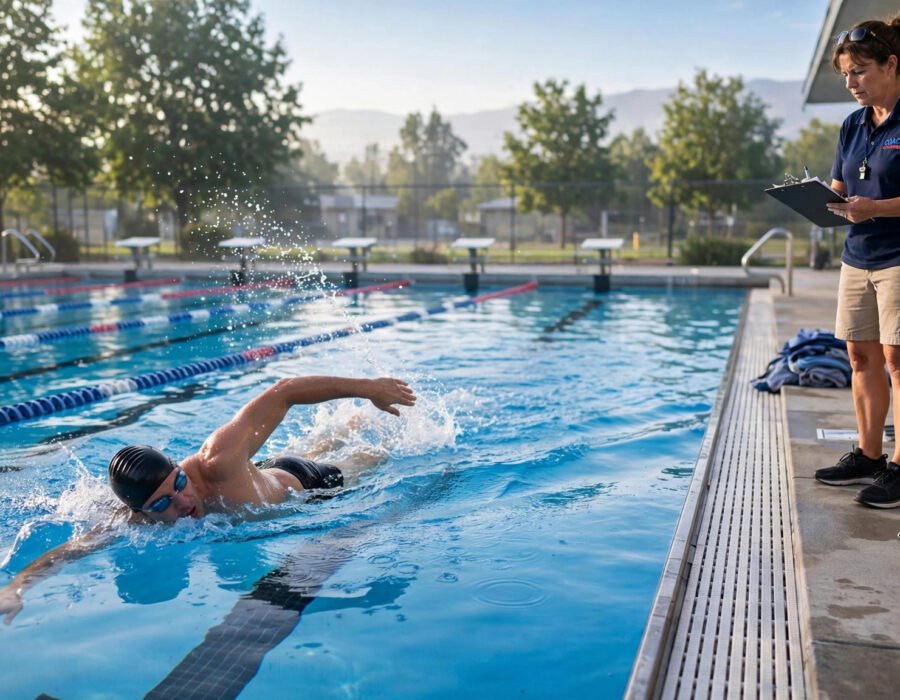
Yes — with a caveat. One private lesson or a 4-week adult stroke clinic (offered at most YMCAs and community pools for $80–$200) will correct in an hour what six months of solo swimming won’t. A coach sees what you can’t feel. The caveat: take lessons after 2–3 weeks of getting comfortable in the water, so lesson time goes to technique, not to overcoming water anxiety. Video analysis — many coaches now film your stroke on a phone — is worth its weight in gold; seeing your dropped elbow is believing it.
The National Institutes of Health research on motor learning in adults confirms what swim coaches know: adults learn technique slightly slower than kids but retain it better, because they understand why each movement matters. Your adult brain is an asset here, not a liability.
Common Adult Mistakes to Unlearn
- Swimming harder instead of smoother. Effort masks bad form. Slow down until the movement is right, then add speed.
- Skipping the drills as “boring.” Drills are the technique. The swimmers gliding past you did thousands of boring drill lengths.
- Comparing to childhood swimmers. The 70-year-old seal in the next lane has forty years of water feel. You’ll get there — on your timeline.
- Neglecting fuel and recovery. Swimming burns 400–600 calories an hour and dehydrates you invisibly (you’re in water; you don’t notice sweat). Eating properly before a morning workout applies double to pool sessions.
Conclusion
Improving your swimming technique as an adult in 2026 is one of the highest-ROI fitness investments you can make: a few weeks of focused work on head position, the catch, breathing, and kick transforms swimming from exhausting to effortless, unlocking a lifetime low-impact workout. Get comfortable, take one lesson or clinic, drill one fix at a time, and be patient with the water. The seal in the next lane started exactly where you are.
Frequently Asked Questions
How long does it take an adult to improve swimming technique?
Most adults see noticeable improvement within 6–8 weeks of swimming 2–3 times per week with focused drills. Major transformation — from struggling through laps to swimming smoothly for 30+ minutes — typically takes 3–6 months of consistent practice.
Can adults learn proper freestyle without childhood lessons?
Absolutely. Adults often learn technique more deliberately than children because they understand the biomechanics. A combination of drills, occasional coaching, and video feedback works at any age — many triathletes learn to swim well as adults.
What’s the single most important technique fix for beginners?
Head position. Looking down instead of forward lifts your hips and legs to the surface, reducing drag more than any other single change. It’s free, it’s immediate, and it makes everything else easier.
Should I use training aids like pull buoys and kickboards?
Yes, strategically. Pull buoys isolate your arm technique, kickboards isolate your kick, and fins help you feel proper body position. Use them as drill tools for part of each session, not as crutches for the whole workout.
Is swimming good exercise for adults over 40?
It’s among the best — full-body, zero-impact, excellent for cardiovascular health and joint-friendly. The CDC specifically highlights swimming for adults with arthritis or joint concerns. Good technique matters even more with age, since efficiency replaces brute force.