Florida weeds don’t mess around. Thanks to year-round warmth, abundant rain, and a growing season that never really stops, weeds here grow with an enthusiasm that feels personal. Crabgrass, dollarweed, nutsedge, Florida pusley — they’re not just unsightly; they steal water, nutrients, and sunlight from the plants you actually want. And if you’d rather not broadcast synthetic herbicides across your yard (for kids, pets, pollinators, or just principle), you need a real strategy. This guide tells Florida gardeners when and how to stop weeds without chemical sprays.
You’ll learn why Florida weeds are uniquely relentless, the timing that makes natural methods work, the most effective non-chemical techniques ranked, how to build weed-suppressive garden beds, and the long-term system that reduces weeding to minutes per week.
Why Florida Weeds Are a Special Problem
Three factors make Florida the major leagues of weed pressure. No winter kill: In northern states, winter resets the weed seed bank annually. In Florida, perennial weeds never die back and annuals seed year-round — the pressure never pauses. Disturbed sandy soils: Florida’s sandy soils are easily colonized; every new bed, trench, or bare patch is an open invitation. Prolific seeders: A single crabgrass plant produces up to 150,000 seeds; Florida pusley and chamberbitter are similarly prolific. Miss one plant and you’ve seeded next year’s problem.
The implication: reactive weeding (pulling what’s visible) loses to Florida weeds. You need systems — mulching, ground covers, and cultural practices that prevent germination in the first place. Every square inch of bare soil in Florida is a weed nursery; your job is to leave no vacancies.
Timing matters enormously. Weed seeds germinate in flushes triggered by rain and temperature — after every heavy summer rain, expect a new cohort within days. The gardeners who win are the ones who act in the 7–10 day window after germination, when weeds are thread-thin and effortless to remove, rather than waiting until they’re established. The Old Farmer’s Almanac weed guides help identify what’s sprouting so you target correctly, and the UF/IFAS Extension weed management guides identify Florida species specifically.
The Techniques, Ranked by Effectiveness
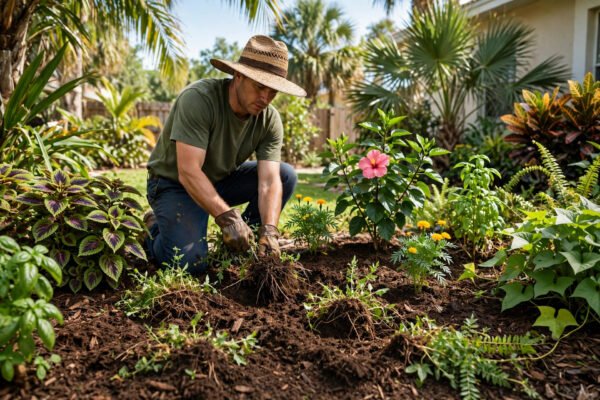
1. Deep mulching (the foundation). A 3–4 inch layer of mulch (pine bark, eucalyptus, melaleuca — all Florida-appropriate) blocks the light weed seeds need to germinate. This single practice eliminates 80–90% of weed pressure. Maintain depth — mulch decomposes fast in Florida heat, so top up twice yearly. Keep mulch pulled back from plant stems to prevent rot.
2. Hand-pulling at the right stage (essential backup). Pull when soil is moist (after rain or watering) — roots slide out of sandy soil easily. Grip at the base, pull slowly to get the root crown. For nutsedge and dollarweed (which spread by underground tubers/rhizomes), dig rather than pull — pulling snaps the top and leaves the spreading structures intact. Ten minutes weekly beats three hours monthly.
3. Hoeing and stirrup hoes (for beds and rows). A sharp stirrup (hula) hoe skims just under the soil surface, severing weed seedlings at the root. Use it weekly on a dry, sunny day — severed seedlings desiccate within hours. The key is shallow: deep hoeing brings buried seeds to the surface where they germinate.
4. Boiling water (for cracks and pavers). A kettle of boiling water poured on weeds in driveway cracks, paver joints, and sidewalk edges kills them to the root. Precise, chemical-free, and oddly satisfying. Don’t use near desirable plants — it’s non-selective.
5. Vinegar solutions (limited use). Horticultural vinegar (20% acetic acid — not kitchen vinegar, which is too weak) burns back top growth on young weeds. It doesn’t kill roots of perennials, requires careful handling (it burns skin and eyes), and acidifies soil with repeated use. Useful for spot-treating patio weeds; overhyped as a garden-wide solution.
6. Corn gluten meal (pre-emergent, modest). A natural pre-emergent that inhibits root formation in germinating seeds. It works — modestly — but requires precise timing (before weed germination), heavy application rates, and doesn’t affect established weeds. Better than nothing for lawns; underwhelming in beds.
Building Weed-Suppressive Beds
The permanent solution is designing beds weeds can’t colonize. Sheet mulching (lasagna gardening): To convert lawn or weedy areas, mow short, lay overlapping cardboard (tape removed), wet thoroughly, add 4–6 inches of mulch on top. Plant through the cardboard after 2–3 months. The cardboard smothers existing weeds while decomposing into soil organic matter — no digging, no herbicides, dramatically fewer weeds for years.
Dense planting: Nature abhors bare soil — fill every gap. Ground covers (sunshine mimosa, perennial peanut, beach sunflower — all Florida natives) carpet the ground so weeds can’t establish. In ornamental beds, plant at spacings that close canopy within one season. Every plant you add is square footage weeds lose.
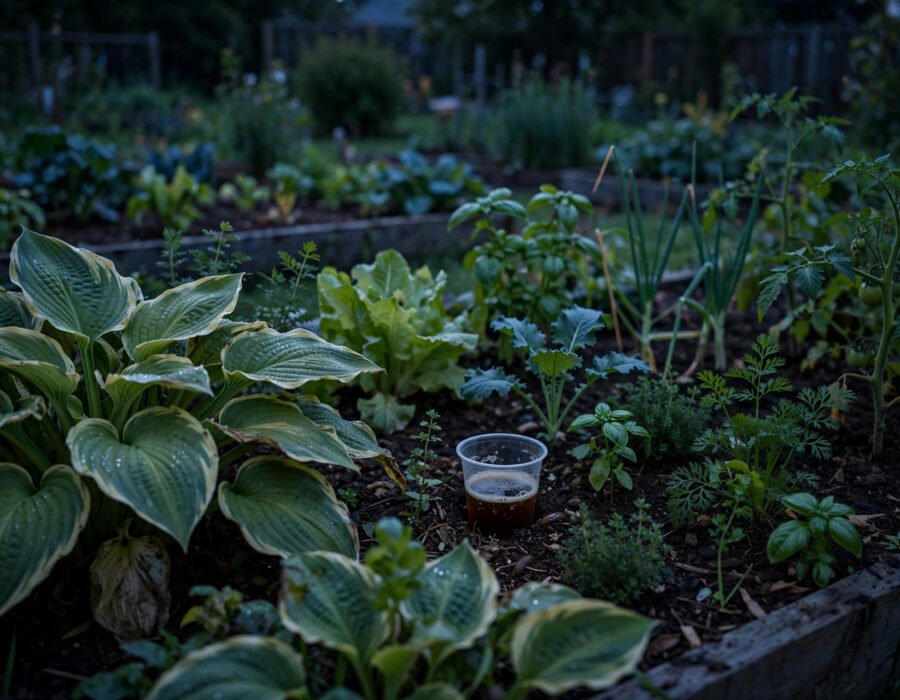
Living mulch in vegetable gardens: Underplant tall crops with low companions — sweet potato as living mulch under okra, for example. The companions shade soil, suppress weeds, and (in legume cases) fix nitrogen. It’s the polyculture principle: diverse, dense plantings outcompete weeds naturally.
Edging: Install physical barriers (steel, stone, or deep plastic edging buried 6 inches) between lawn and beds. Most bed weeds invade laterally from turfgrass — a clean edge cuts invasion by half. For lawn-specific strategies, growing grass in difficult spots covers the turf side of the equation.
The Florida Calendar for Weed Control
Late winter (Feb): Apply pre-emergent corn gluten to lawns before spring germination flush; refresh bed mulch before spring growth. Spring (Mar–May): Peak germination — hoe weekly, hand-pull after rains, sheet-mulch any new bed areas. Summer (Jun–Sep): Maintain mulch depth (heat accelerates decomposition); mow lawns high (3.5–4 inches shades weed seeds) with sharp blades — lawn mower maintenance directly affects cut quality and weed pressure; pull nutsedge diligently before it sets tubers. Fall (Oct–Nov): Second mulch refresh; plant cool-season cover crops in empty vegetable beds (they suppress winter weeds and feed soil). Winter (Dec–Jan): The breather — tackle perennial weeds (dig out dollarweed patches, solarize problem areas with clear plastic for 4–6 weeks).
Solarization deserves special mention for Florida: clear plastic over moist soil during summer’s peak heat (6–8 weeks) cooks weed seeds, soil pathogens, and nematodes in the top few inches. It’s the nuclear option without chemicals — perfect for resetting a hopelessly weedy bed before replanting.
Frequently Asked Questions
When should I start weed control in Florida?
February, before the spring germination flush. But the real answer is “continuously” — Florida’s year-round growing season means year-round vigilance, with heaviest effort March through September.
Does mulch really prevent weeds?
Yes — 3–4 inches of mulch blocks light to weed seeds, eliminating the vast majority of germination. It’s the highest-ROI weed control practice available. The failures come from too-thin application or never refreshing it.
How do I kill dollarweed without chemicals?
Dig out the entire patch including the underground rhizomes (pulling snaps them and spreads it), improve drainage (dollarweed loves wet soil), and mulch heavily. Persistent patches may need solarization. It’s a multi-season battle — consistency wins.
Is vinegar safe for organic gardens?
Horticultural vinegar is non-synthetic but still a strong acid — it kills soil microbes on contact and acidifies soil with repeated use. Use sparingly for spot treatment on hardscapes, not as a broadcast garden spray.
The Bottom Line
Stopping weeds without chemical sprays in Florida is a systems game, not a product game: mulch deeply and maintain it, design dense plantings that leave no bare soil, hoe and hand-pull on a weekly rhythm (catching weeds young), time pre-emergents for February, and use solarization to reset hopeless beds. Accept that Florida will always test you — but with these systems, weeding shrinks from a weekend war to a ten-minute weekly habit. The weeds never sleep here. Neither does good mulch.