It’s late March in the Midwest. Snow just melted, the garden catalogs are dog-eared, and you’re itching to plant — but the last frost date is still six weeks away, and every experienced gardener is warning you not to rush. Starting seeds indoors bridges that gap: you get a 6–8 week head start on the season while winter finishes outside. Done right, it’s the difference between harvesting tomatoes in July versus September. This guide gives Midwest beginners the safest way to start seeds indoors before the last frost.
You’ll learn exactly when to start (the date math that matters), the minimal setup that actually works, which seeds to start indoors versus direct-sow, the daily care routine, and how to harden off seedlings without killing them in week one outside.
The Date Math: When to Start What
Everything revolves around your average last frost date — find yours via the Old Farmer’s Almanac or your local extension office (Chicago: ~April 20; Minneapolis: ~May 10; Des Moines: ~April 25; Indianapolis: ~April 20 — but microclimates vary, so verify locally). Then count backward using each seed packet’s “start indoors X weeks before last frost” guidance:
10–12 weeks before: Onions, leeks, celery (slow germinators — start these first). 8–10 weeks: Peppers (they’re notoriously slow; super-hot varieties need the full 10). 6–8 weeks: Tomatoes, eggplant, brassicas (broccoli, cabbage, cauliflower). 4–6 weeks: Cucumbers, squash, melons, basil (fast growers — starting these too early produces leggy monsters). Direct sow only: Beans, corn, peas, carrots, radishes, lettuce (mostly) — these resent transplanting or germinate so fast indoors is pointless.
The classic beginner mistake is starting everything in February out of excitement. A tomato started 10 weeks early becomes a leggy, root-bound, stressed plant that a properly-timed 6-week seedling outperforms within a month outdoors. Timing precision beats enthusiasm. Pair your seed schedule with the best plants for beginner gardeners to avoid finicky varieties in year one. Mark your calendar with each crop’s start date the day you buy seeds — it’s a 10-minute planning session that determines your whole season.
The Minimal Setup That Actually Works
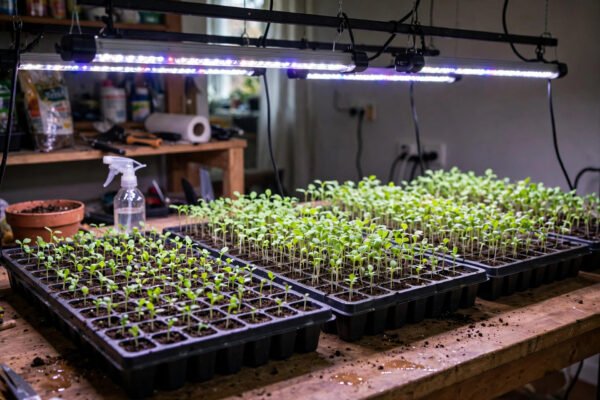
You don’t need a greenhouse — but you do need three things beginners try to skip. 1. Light: A sunny windowsill is almost never enough in the Midwest’s weak spring sun; seedlings stretch toward dim light and become leggy. A basic shop light with daylight (5000–6500K) LED or fluorescent tubes, hung 2–4 inches above the seedlings and raised as they grow, costs $25–$40 and is the single biggest success factor. Run it 14–16 hours daily on a timer.
2. Seed-starting mix: Not potting soil, not garden soil — sterile, fine-textured seed-starting mix. Garden soil harbors damping-off fungi that kill seedlings overnight; potting soil is too coarse for tiny seeds. A $8 bag starts hundreds of seedlings.
3. Bottom heat (for peppers especially): A heat mat ($20–$30) keeps soil at 75–85°F, which peppers and tomatoes need for germination. Midwest basements in March are 60°F — seeds sit dormant, rot, or germinate unevenly without warmth. Remove the mat once seedlings emerge (they prefer cooler air after sprouting).
Containers: anything with drainage holes works — recycled yogurt cups, nursery cell trays, soil blocks. Don’t start in peat pots for plants that hate root disturbance (they’re fine for most, but biodegradable pots can wick moisture away in dry indoor air — monitor closely). Label everything; all seedlings look identical at two weeks, and mystery plants are a rite of passage you only need once. For container inspiration, starting a small herb garden covers the container basics that apply here too.
Daily Care: The 10-Minute Routine
Water from the bottom: Set trays in a shallow water bath for 10–15 minutes; the mix wicks moisture up evenly. Top-watering disturbs seeds and encourages damping-off. Keep mix consistently moist (like a wrung-out sponge), never soggy or dry.
Air circulation: Run a small fan on low near (not directly on) seedlings for a few hours daily. The gentle movement triggers thigmomorphogenesis — plants grow stockier stems in response to mechanical stress. It also prevents the stagnant humid air where fungi thrive. This one trick produces visibly sturdier transplants.
Light height: Check daily — seedlings grow fast, and lights left too high cause legginess within 48 hours. Keep lights 2–4 inches above the tallest seedling tops.
Thin ruthlessly: The hardest beginner skill. When 5 seedlings emerge where you sowed thickly, keep the strongest one and snip the rest at soil level (don’t pull — it disturbs the survivor’s roots). Crowded seedlings compete, stretch, and all underperform; one strong seedling outperforms five weak ones every time.
Feed lightly: Seed-starting mix has minimal nutrients. Once seedlings have 2–3 sets of true leaves, feed weekly with half-strength liquid fertilizer. Pale, slow-growing seedlings are usually hungry, not dying.
Hardening Off: The Step That Kills Most Seedlings
Seedlings raised in pampered indoor conditions will sunburn, wind-whip, and temperature-shock to death if planted directly outside. Hardening off — gradual outdoor acclimation over 7–10 days — is non-negotiable.
The schedule: Days 1–2: 1–2 hours outdoors in shade, sheltered from wind; bring in overnight. Days 3–4: 3–4 hours with an hour of morning sun. Days 5–6: 5–6 hours, more direct sun, light breeze exposure. Days 7–8: Full day outside, in overnight if above 50°F. Days 9–10: Full days and nights outside (protect if frost threatens). Then transplant on a cloudy day or late afternoon, water deeply, and mulch.
Watch the forecast obsessively during this period — a surprise late frost (the Midwest specializes in these) kills unprotected seedlings overnight. Keep frost cloth or old bedsheets handy through Memorial Day in northern zones. The Old Farmer’s Almanac frost date tables are the authoritative reference; your local extension service’s planting calendars fine-tune these dates for your county; your county extension office can confirm local microclimate adjustments.
Frequently Asked Questions
Can I start seeds without grow lights?
A south-facing window plus supplemental light on cloudy days sometimes works for a few hardy seedlings, but most Midwest beginners get leggy, weak plants without dedicated lights. A $30 shop light is the cheapest garden investment with the highest return.
Why are my seedlings tall and floppy?
Insufficient light (the cause 90% of the time), excessive heat, or both. Lower the lights to 2 inches above seedlings, add the fan, and start over if they’re severely leggy — floppy seedlings rarely recover into strong plants.
When should I transplant seedlings outdoors?
After your last frost date for tender crops (tomatoes, peppers, basil), 2–4 weeks before for hardy crops (brassicas, onions, peas). Soil temperature matters too — peppers want 60°F+ soil, not just frost-free air.
What’s damping-off and how do I prevent it?
A fungal disease that kills seedlings at the soil line overnight. Prevent with sterile mix, bottom watering, air circulation, and not overcrowding. Cinnamon dusted on the soil surface is a folk remedy with modest antifungal effect — harmless to try.
The Bottom Line
Starting seeds indoors in the Midwest succeeds on: precise timing (count back from your real last frost date), adequate light (a $30 shop light beats any windowsill), bottom heat for warm-season crops, the daily 10-minute care routine (bottom water, fan, light height, thinning), and patient hardening off over 7–10 days. It’s a small indoor project that pays off in months of earlier, bigger harvests — and there’s nothing quite like eating a tomato in July that you started from a speck of a seed in March.