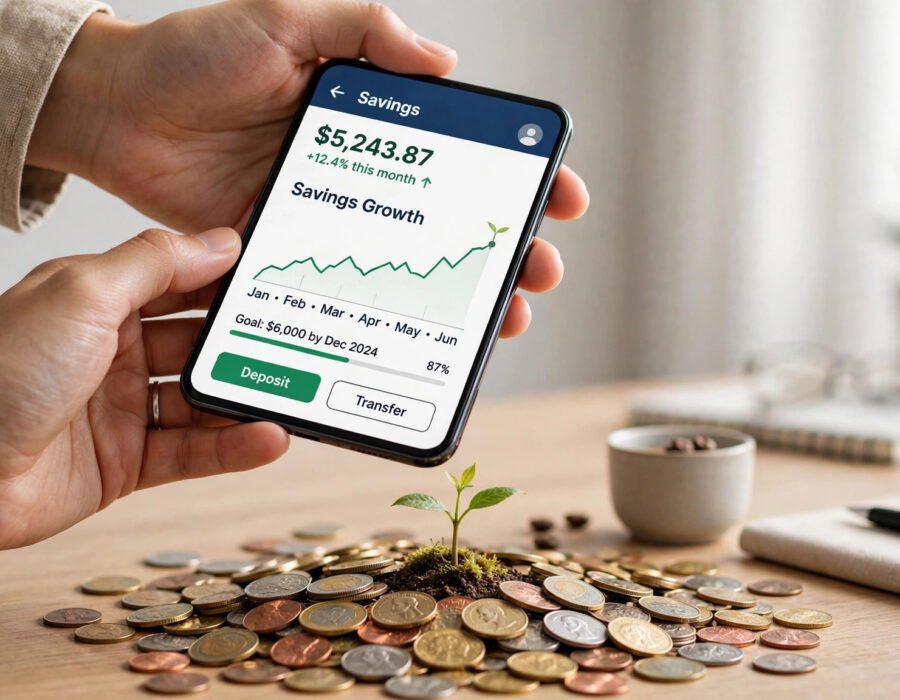
Your checking account pays 0.01% interest — functionally zero. Meanwhile, online high-yield savings accounts in 2026 are paying 4% or more, which turns a $10,000 emergency fund from a $1-a-year joke into $400+ a year of free money. Opening one takes about fifteen minutes. But before you chase the highest advertised rate, there are a few things worth knowing — because the difference between a great high-yield account and a mediocre one isn’t just the rate.
What “High-Yield” Actually Means in 2026
A high-yield savings account (HYSA) is simply a savings account paying a competitive, variable interest rate — typically 10 to 40 times the national average. Online banks can offer these rates because they skip the cost of physical branches and pass the savings to depositors.
Key context: HYSA rates are variable, not fixed. They move with the Federal Reserve’s benchmark rate. A 4.5% APY today could be 3.8% in six months if the Fed cuts. That’s normal and fine — even a “low” HYSA rate crushes traditional savings accounts. Just don’t pick a bank solely because it’s 0.15% higher this week; rates reshuffle constantly.
What to Check Before You Open an Account
1. FDIC insurance (non-negotiable)
Only open accounts at FDIC-insured institutions. This protects your deposits up to $250,000 per depositor, per bank. Every legitimate HYSA advertises this prominently — if you can’t find the FDIC language, walk away. You can verify any bank at the FDIC’s BankFind tool. Note that some fintech “savings” products sweep funds to partner banks; that’s fine as long as the underlying banks are FDIC-insured, but confirm the arrangement in writing.
2. The real rate vs. the teaser rate
Some banks advertise a headline APY that requires meeting conditions (direct deposit, debit transactions, balance tiers) or that applies only for a promotional period. Read the fine print: what’s the ongoing, unconditional rate? A steady 4.2% with no hoops beats a 5.0% teaser that drops to 3.5% after three months.
3. Fees and minimums
The best HYSAs have no monthly fees and no (or very low) minimum balance requirements. Watch for: monthly maintenance fees, minimum balance fees, excessive withdrawal fees, and wire transfer charges. A “high yield” account with a $12 monthly fee on a small balance can easily go negative in spirit.
4. Access and transfer speed
Online banks have no branches, so understand the plumbing: how do you deposit (mobile check deposit, ACH from your checking), how fast are outbound transfers (1–3 business days is typical; some offer instant), and is there an ATM network or debit card for emergencies? Your HYSA is for savings, not daily spending — but you need to reach the money within a few days when it counts.
5. Compounding and extras
Daily compounding beats monthly compounding by a hair — worth knowing, not worth obsessing over. More meaningful extras: savings “buckets” or sub-accounts for goals (emergency fund, vacation, car), automatic transfer rules, and round-up features. The CFPB’s savings account guidance is a solid neutral checklist for comparing these features.
The Smart Way to Use a High-Yield Account
- Emergency fund first. Park 3–6 months of expenses here — it’s liquid, safe, and now actually earning. This is the account’s highest and best use.
- Sinking funds second. Create buckets for predictable big expenses: annual insurance premiums, holiday spending, car maintenance. Monthly auto-transfers into buckets mean December never ambushes you again.
- Keep checking separate. Don’t pay bills directly from the HYSA — federal rules and bank policies limit certain withdrawals, and mixing purposes defeats the psychology. Checking for flow, HYSA for stockpiles.
- Automate on payday. Set an automatic transfer for the day after payday. Money you never see is money you never miss — the same principle behind saving money on everyday expenses, applied at the account level.
- Revisit rates annually. Not weekly — annually. If your bank’s rate has drifted far below competitors, moving takes twenty minutes. Loyalty to a bank paying 1% less costs you hundreds per year on a healthy balance.
Common Mistakes to Avoid
- Chasing the top rate constantly. Moving accounts every two months for an extra 0.2% wastes time and creates tax paperwork (1099-INT forms from every bank). Pick a consistently competitive bank and stay put.
- Keeping everything in checking “for simplicity.” Simplicity that costs you $400+ a year isn’t simple — it’s expensive.
- Ignoring the tax bite. HYSA interest is taxable income. On a $10,000 balance at 4.5%, that’s $450 of taxable interest — set expectations accordingly, and remember the bank sends the IRS a copy too.
- Using it as an investment account. A HYSA preserves purchasing power (mostly); it doesn’t build wealth. Once your emergency fund and short-term goals are covered, long-term money belongs in investments. People budgeting monthly expenses with modern tools often automate this handoff: HYSA fills to target, overflow goes to investing.
Conclusion
Before opening a high-yield savings account online in 2026, verify FDIC insurance, look past teaser rates to the real ongoing APY, check for fees and transfer speeds, and have a plan: emergency fund first, sinking funds second, automation always. The account itself takes fifteen minutes to open; the habit of routing savings through it is what actually builds wealth. In a world where traditional savings pay nothing, a good HYSA is the closest thing to free money in personal finance — take it.
Frequently Asked Questions
Are online high-yield savings accounts safe?
Yes, as long as the bank is FDIC-insured — which protects deposits up to $250,000 per depositor, per bank. Verify any bank through the FDIC’s BankFind tool before depositing. Online-only banks carry the same insurance as branch banks.
What’s a good APY for a high-yield savings account in 2026?
Competitive HYSAs in 2026 pay roughly 4%–5% APY, varying with Federal Reserve policy. Anything above 4% with no fees or balance games is solid; be skeptical of rates far above the pack, which are often short-term teasers.
Can I lose money in a high-yield savings account?
Your principal is protected by FDIC insurance up to the limits. The main “loss” is opportunity cost — money sitting in savings instead of investments won’t grow as fast long-term — plus the erosion of purchasing power if inflation exceeds your rate.
How fast can I access money in an online HYSA?
Electronic transfers to your linked checking account typically take 1–3 business days. Some banks offer faster or instant transfers. Plan accordingly — keep a small buffer in checking for same-day needs.
Do I pay taxes on HYSA interest?
Yes. Interest earned is taxable income, reported on Form 1099-INT. Banks send you (and the IRS) this form if you earn $10 or more in interest during the year.
Can I have multiple high-yield savings accounts?
Yes, and many savers do — there’s no limit. Common setups include one HYSA for the emergency fund at the highest-rate bank and another for sinking funds (vacation, car, holidays) where bucket features matter more than an extra 0.1% APY. Multiple accounts can also keep you under FDIC insurance limits if your balance exceeds $250,000 at one bank. The trade-off is complexity: more accounts mean more logins, more tax forms, and more rates to monitor. For most people, one excellent HYSA with a good bucketing feature beats three accounts chasing marginal rate differences.