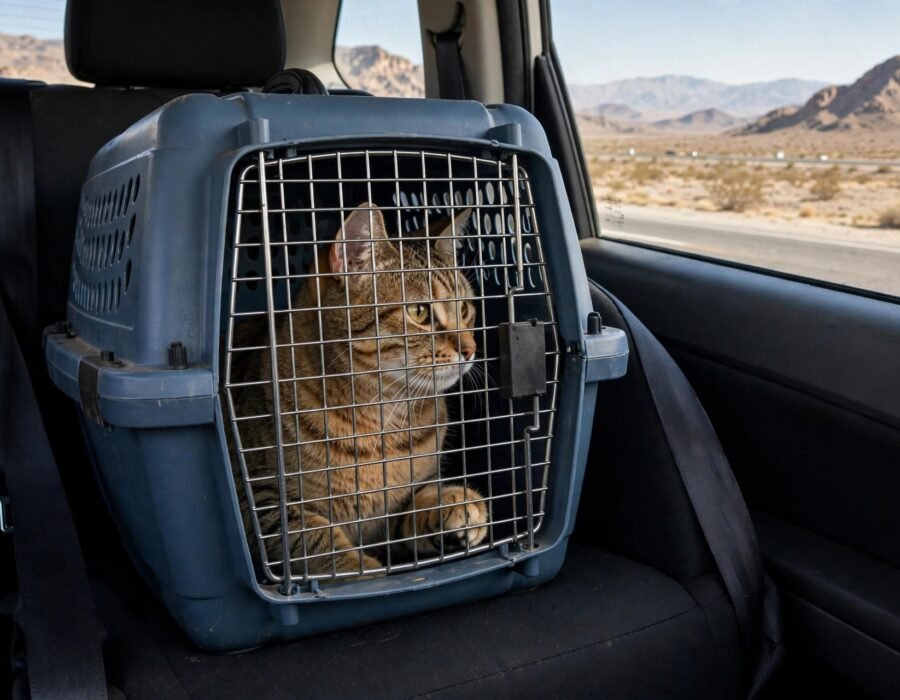
Moving across California with a cat in the car sounds simple until you’re three hours into I-5, the cat is yowling from the carrier, and you’re wondering if you’ve made a terrible mistake. Long-distance car travel with cats goes wrong in predictable ways — and most of them trace back to a handful of misconceptions about how cats experience travel. California’s distances make this a real issue: San Diego to Sacramento is 500+ miles, and LA to the Bay Area is a full day. Here’s what most people get wrong, and how to get it right.
Mistake #1: “My Cat Will Be Fine Loose in the Car”
The most dangerous mistake. A loose cat becomes a projectile in a sudden stop, can wedge under the brake pedal, or bolt through an open door at a rest stop — in an unfamiliar place, 500 miles from home. California Highway Patrol data on distracted-driving incidents doesn’t isolate cats, but the physics is unambiguous: an unrestrained 10-pound cat in a 50-mph stop hits with devastating force.
The fix: a hard-sided carrier, seat-belted into the back seat (thread the belt through the carrier handle or use a carrier with seat-belt loops). Carriers should be big enough for the cat to stand, turn, and lie down — roughly 1.5x the cat’s length. Wire crates work for large dogs; for cats, the enclosed security of a carrier reduces panic.
Mistake #2: Skipping Carrier Training
Most owners introduce the carrier on travel day — which teaches the cat that carrier equals terror. The carrier should live in your home for 2–4 weeks before the trip: door open, soft bedding inside, treats and meals served in it. The goal is a cat that naps in the carrier voluntarily. This single preparation step eliminates most travel-day panic.
Mistake #3: No Practice Drives
A cat’s first car experience shouldn’t be a 10-hour drive. Do graduated practice: 10-minute drives, then 30, then an hour, over the two weeks before the trip. You’ll learn whether your cat is a meower (most settle within 20–30 minutes), a panting stress case (needs vet discussion about anti-anxiety options), or a vomiter (motion sickness — your vet can prescribe cerenia/maropitant). Discovering motion sickness on the Grapevine at 70 mph is a mistake you make once.
Mistake #4: Sedating Without a Plan
Two errors here: sedating without ever testing the drug, and assuming sedation is required. Mild sedatives like gabapentin (increasingly prescribed for feline travel anxiety) must be trial-dosed at home first — some cats get paradoxically agitated. And many cats travel fine with just preparation plus a pheromone spray (Feliway) in the carrier 15 minutes before loading. Discuss options with your vet 2–3 weeks out, not the day before.
Never use human sleep aids or unprescribed tranquilizers. Acepromazine, once common, is now discouraged by many vets for travel — it sedates the body while leaving the mind anxious, which is arguably worse.
Mistake #5: Mishandling Food, Water, and Litter
The logistics people botch:
- Feeding: feed a normal meal 4–6 hours before departure, then light meals on the road. A full stomach plus motion equals vomit.
- Water: offer water at every stop. Spill-proof bowls or hamster-style bottle attachments for the carrier work. Dehydration is a real risk on long desert stretches of I-10 or I-40.
- Litter: bring a small disposable litter box and a bag of the cat’s usual litter. Offer it at rest stops inside the car (never outside — a loose cat at a rest stop is a lost cat). Most cats won’t use it while stressed, but the option matters on 8+ hour days.
- Temperature: never leave a cat in a parked car. California law explicitly allows good Samaritans and officers to break into vehicles to rescue animals in distress. On summer drives through the Central Valley, plan stops where the cat stays in the running, air-conditioned car with a passenger — or skip the stop.
Mistake #6: No ID, No Records, No Plan B
Before a California long-haul: microchip (and verify the registration has your current phone number), a breakaway collar with ID tag, vaccination records (required by boarding facilities and some pet-friendly hotels), and any medications in original packaging. Research pet-friendly hotels along your route in advance — finding pet-friendly hotels for road trips ahead of time beats a midnight search in Bakersfield with a stressed cat.
The AVMA’s pet travel guidelines cover the health-certification rules: California doesn’t require a health certificate for in-state car travel, but if your route clips Nevada or Arizona, or you’re flying any leg, requirements change.
Mistake #7: Underestimating California’s Specific Challenges
California long-distance drives have quirks: the Grapevine’s elevation and heat, desert stretches with 100+ mile gaps between services, wildfire-season detours and smoke (keep windows closed, AC on recirculate), and agricultural inspection stations (they’re for plants, but have your pet records handy anyway). Plan fuel and water stops around the cat’s needs, not just the gas gauge.
The Right Way: A Timeline
- 4 weeks out: carrier out in the living room, vet appointment for travel meds and record copies.
- 2 weeks out: practice drives begin; book pet-friendly hotels.
- 1 week out: trial-dose any sedative; pack the cat’s travel kit (food, water, bowls, litter, records, meds, familiar blanket).
- Travel day: feed light, Feliway the carrier, seat-belt it in, drive calmly. Most cats settle within the first hour.
Conclusion
What most people get wrong about long-distance car travel with cats in California is treating it as a transportation problem when it’s really a preparation problem. The carrier, the practice drives, the vet conversation, and the hotel research — done weeks ahead — turn a dreaded ordeal into an uneventful drive. And if this move is part of a bigger relocation, introducing your cat to the new home properly on arrival matters just as much as the drive itself.
Frequently Asked Questions
How long can a cat stay in a carrier in the car?
Most cats handle 6–8 hours with stops every 2–3 hours for water and a litter opportunity. For 10+ hour California drives, plan an overnight stop — it’s better for both of you.
Should I sedate my cat for a long car ride?
Not automatically. Many cats travel fine with carrier training and preparation. If anxiety is severe, ask your vet about gabapentin — and always trial-dose at home first. Never use unprescribed sedatives.
Is it legal to leave a cat in a parked car in California?
Effectively no — California law prohibits leaving animals in vehicles under dangerous heat conditions and allows rescue by officers or citizens. On summer drives, never leave the cat in a parked car.
What should I pack for a long car trip with a cat?
Carrier, harness/leash backup, regular food, water and spill-proof bowl, disposable litter box + usual litter, vaccination records, medications, a familiar blanket, and cleaning supplies for accidents.
Do I need a health certificate to drive my cat within California?
No — California doesn’t require health certificates for in-state car travel. But carry vaccination records, and check requirements if your route crosses state lines or includes any flight segment.
What if my cat hates car travel no matter what I try?
Some cats truly don’t acclimate — severe panting, drooling, or panic that doesn’t improve after several practice sessions. For these cats, discuss anti-anxiety medication with your vet well before the trip (trial-dosed at home), consider breaking the drive into shorter days, and as a last resort, explore pet transport services. A miserable cat and a stressed driver are a dangerous combination — don’t white-knuckle it.
Sources: AVMA pet travel guidelines and the Humane Society’s cat travel tips.