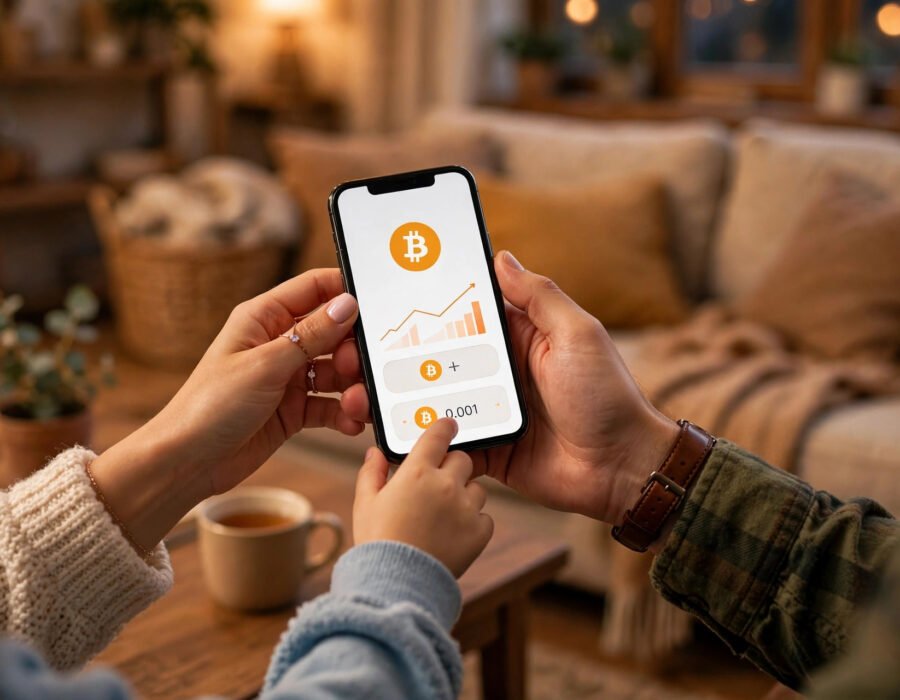
Every American family has had the conversation: should we put a little money into Bitcoin? The headlines swing between “digital gold” and “speculative casino,” and for a beginner with a small budget — say a few hundred dollars the family can genuinely afford to lose — the question isn’t whether Bitcoin will moon. It’s how to buy it without getting scammed, overcharged, or locked out of your own money.
This guide is the safe path: the exact steps, the traps to dodge, and the habits that protect a family’s first crypto purchase from the industry’s well-documented predators.
Step 1: Decide What “Small Budget” Means for Your Family
Before any app gets downloaded, have the money conversation. “Small budget” should mean money that wouldn’t change your life if it went to zero — not the emergency fund, not rent money, not the kids’ school savings. Financial planners often suggest limiting speculative investments to a small single-digit percentage of your portfolio, and the SEC’s plain-English materials at Investor.gov’s introduction to investing explain why position sizing matters more than picking the “right” asset.
For many families, that means $100–500 as a learning stake. Write the number down. Agree on it together. The families who get hurt in crypto aren’t the ones who bought $200 of Bitcoin — they’re the ones who bought $200, watched it double, and then put in $20,000 without a plan.
Step 2: Choose a Reputable U.S. Exchange
Your first purchase should happen on a well-established, U.S.-regulated exchange — names like Coinbase, Kraken, or similar platforms with years of operation, clear fee schedules, and real customer support. Avoid offshore exchanges promising lower fees, social-media “brokers” offering to buy for you, and Bitcoin ATMs, which routinely charge 7–15% markups that devour small budgets.
Compare the all-in cost for your budget: deposit fees, trading fees, and what it would cost to withdraw later. For small budgets, fee differences between major exchanges matter less than safety — a 1% fee gap on $200 is two dollars, while a scam costs everything.
Step 3: Secure the Account Before Funding It
This step comes before money, not after. Create the account with a unique, strong password (a password manager helps the whole family here). Then immediately set up two-factor authentication on your accounts — an authenticator app, not SMS, since SIM-swapping specifically targets crypto holders. Secure the email address behind the exchange account with 2FA too, because email is the master key to every password reset.
Make this a family lesson, not just a chore. If the kids are old enough to be curious about Bitcoin, they’re old enough to learn why passwords get reused never and why no one — not “support,” not anyone — ever asks for login codes. Teaching kids good money habits now includes digital security habits, and crypto is a vivid classroom.
Step 4: Fund With a Bank Transfer, Buy Simply
Link your bank account via ACH transfer — it’s the cheapest funding method, usually well under 1% in fees. Debit cards are faster but cost 2–4%, a painful premium on a small budget. Then buy with a simple market or limit order for your agreed amount. Don’t touch leverage, margin, futures, or any product with a multiplier — those are how small budgets become zero budgets.
Consider whether to buy all at once or split it across a few weeks. For a learning stake, a single purchase is fine. If the family plans to keep adding monthly, automating small recurring buys smooths out Bitcoin’s notorious volatility without any timing skill required.
Step 5: Decide Where the Bitcoin Lives
For a small first purchase, leaving Bitcoin on a reputable exchange is the pragmatic choice — moving $200 on-chain can cost a meaningful percentage in withdrawal and network fees. As the balance grows into the thousands, move it to a wallet you control (a hardware wallet for serious amounts), and practice the transfer with a small test amount first.
Whatever you choose, write down your login credentials and any recovery phrases on paper, stored somewhere safe — not in a phone note, not in an email draft. A family’s crypto is only as recoverable as its least tech-savvy member’s ability to find the credentials.
The Scams Targeting Beginner Families
Know the greatest-hits list, because beginners with small budgets are scammers’ favorite demographic. Fake “Bitcoin doublers” on social media. Impersonators posing as exchange support in your DMs. “Investment managers” who’ll trade for you for a cut. Romance-scam-adjacent “mentors” who befriend then pitch. Phishing texts about your account being locked. Learn how to spot scam text-message links as a household skill — these attacks target every family member, not just the account holder.
The universal rule: nobody legitimate will ever contact you first about your Bitcoin. Not the exchange, not “Elon Musk’s giveaway team,” not a friendly trader. If they reached out, it’s a scam. The Consumer Financial Protection Bureau tracks these fraud patterns at Ask CFPB, and the SEC maintains investor alerts on crypto fraud specifically.
Taxes: Boring, Mandatory, Simple at Small Scale
Buying Bitcoin isn’t taxable. Selling it, swapping it, or spending it is — and you’ll owe capital gains tax on any profit, even on a $200 purchase. Keep a simple record: date, amount, price paid. If you hold for over a year before selling, you qualify for lower long-term capital gains rates. The IRS virtual currency FAQ is the authoritative source, and at small scale, a one-line-per-trade spreadsheet is all the bookkeeping you need.
One more family consideration: gifting. Giving Bitcoin to your kids or relatives is a legitimate way to share the learning experience, and in the U.S. gifts under the annual exclusion amount (adjusted yearly for inflation) don’t trigger gift-tax filing. Just document the transfer — date, amount, dollar value — because the recipient inherits your cost basis and will need it when they eventually sell. A gifted fraction of Bitcoin with clean records beats a surprise tax headache years later.
Conclusion
The safest way for beginners to buy Bitcoin on a small family budget is deliberately unglamorous: agree on an affordable amount, use a reputable U.S. exchange, secure the account with two-factor authentication before funding it, buy with cheap bank transfers, skip every leveraged product, and treat unsolicited contact as fraud by default. Bitcoin’s volatility is the risk you accept; scams, fees, and sloppy security are risks you can eliminate. Handle the eliminable ones, and your family’s first crypto purchase becomes what it should be — a low-stakes education in the future of money, not a cautionary tale.
Frequently Asked Questions
How much Bitcoin should a beginner family buy first?
An amount you’d be comfortable losing entirely — often $100–500. Agree on the number as a family before opening any account, and never fund it with emergency or essential money.
Is Coinbase safe for beginners?
Major U.S. exchanges like Coinbase and Kraken are among the safest on-ramps, with regulatory oversight and security track records. No exchange is risk-free, which is why large balances eventually belong in your own wallet.
Can I buy Bitcoin for my kids?
Yes — custodial accounts and family trusts can hold crypto, and some platforms offer youth-oriented features. Consider the tax and estate implications, and use it as a teaching opportunity about money and security.
What if Bitcoin’s price crashes after I buy?
That’s the volatility you signed up for — Bitcoin has dropped 50%+ multiple times and recovered. Never invest money you’ll need soon, never panic-sell on headlines, and review the risk principles at Investor.gov before deciding your strategy.