Serum before moisturizer or after? Does retinol go before or after hyaluronic acid? Can you layer vitamin C with niacinamide? Skincare layering order confuses beginners because it seems arbitrary — but it’s actually governed by simple chemistry: thin-to-thick, water-before-oil, and pH-dependent actives first. Get the order right and every product works better; get it wrong and expensive serums sit uselessly on top of occlusive creams. Here’s the complete from-scratch guide.
The Master Rule: Thin to Thick
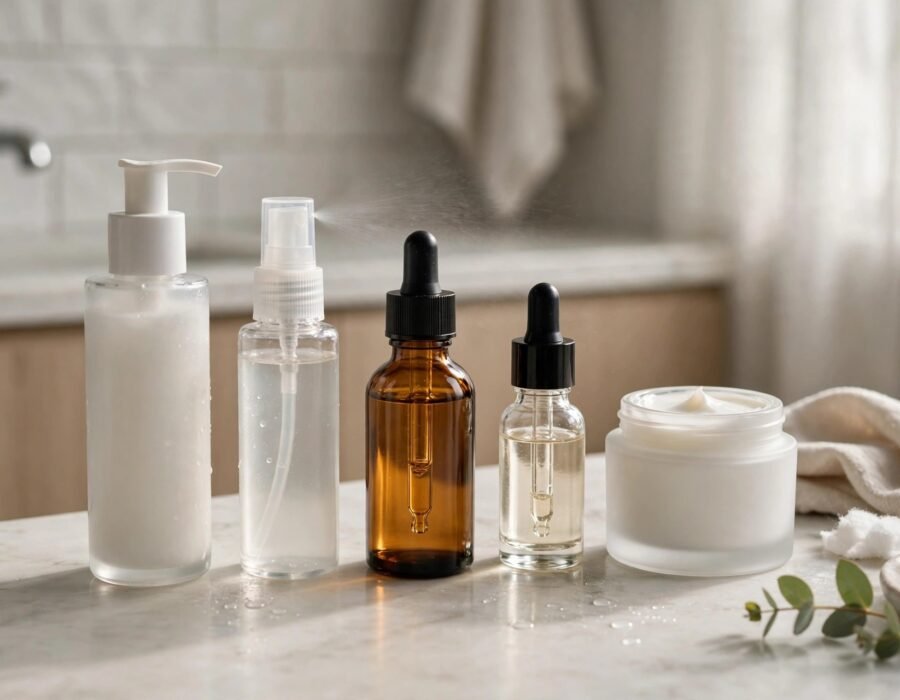
Apply products from thinnest consistency to thickest. This isn’t tradition — it’s physics. Lightweight, water-based formulas need direct skin contact to absorb; heavy creams and oils form occlusive barriers that block everything layered over them. The universal sequence:
- Cleanser (the reset — everything starts here)
- Toner/essence (watery hydrators — optional but useful)
- Serums/treatments (thin → thick among themselves; actives first)
- Eye cream (if used — thin formula, delicate area)
- Moisturizer (seals in the water-based layers)
- Facial oil (if used — occlusive, goes over moisturizer or mixed in)
- Sunscreen (AM only — always last, never layered under)
Morning vs. Night: Two Different Routines
Morning = protection. Keep it lean: cleanser (or just water rinse for dry skin), antioxidant serum (vitamin C is the morning star — it boosts sunscreen efficacy), moisturizer, sunscreen SPF 30+. That’s it. Morning is not the time for a 9-step routine — every extra layer under sunscreen risks pilling and reduces sun protection compliance.
Night = repair. This is where treatments live: double cleanse (oil cleanser then water-based — removes sunscreen and the day), exfoliating acids or retinoids (not both at full strength on the same night when starting), hydrating serums, moisturizer, optionally facial oil. Night is when skin does its repair work, and when the strong actives go on without UV interference.
The Actives Ordering Rules
This is where real mistakes happen:
- pH-dependent actives first: vitamin C (L-ascorbic acid) and chemical exfoliants (AHAs/BHAs) work best at low pH on clean skin. Apply them right after cleansing, before other serums. Wait 30–60 seconds (not the mythical 20 minutes) before the next layer.
- Niacinamide plays well with almost everything — including vitamin C, despite the old myth. (The myth came from a 1960s study using boiling temperatures; at skin temperature, the combination is fine and often synergistic.)
- Retinoids go on clean, dry skin — or buffered over moisturizer if you’re sensitive (the “sandwich” method: moisturizer, retinoid, moisturizer). Never combine retinoids with AHAs/BHAs or benzoyl peroxide in the same routine when starting — alternate nights instead.
- Benzoyl peroxide and retinoids can deactivate each other (except adapalene, which is stable with BP). Use BP in the morning, retinoid at night.
- Copper peptides + strong acids/vitamin C: separate these — acids can interfere with peptide function. Peptides in the morning, acids at night, or alternate days.
Wait Times: What’s Real
The internet prescribes elaborate waiting rituals. The evidence-based version: wait 30–60 seconds between layers — just long enough for the previous product to absorb to touch-dry. The exception is pH-dependent actives (vitamin C, exfoliating acids), which benefit from a few minutes on bare skin before the next layer. You do not need to wait 20 minutes between products; that guidance comes from clinical testing protocols, not real-life efficacy.
Common Layering Mistakes
- Oil before serum: the classic order-killer. Oil seals; anything water-based applied over it can’t penetrate. Serums first, oil last.
- Sunscreen under moisturizer: sunscreen must be the outermost layer to form its protective film. (Moisturizing sunscreen hybrids are the exception — they’re formulated as the final step.)
- Too many actives, one routine: vitamin C + AHA + retinol + benzoyl peroxide in one night isn’t “thorough” — it’s a barrier-destruction event. One strong active per routine when starting; build slowly.
- Mixing everything together: cocktailing products in your palm to save time destabilizes formulations and makes it impossible to know what’s irritating you. Layer; don’t blend.
- Applying to dry skin: hydrating serums (hyaluronic acid especially) work best on damp skin — they pull water in. In dry climates, HA on dry skin can actually pull moisture out of skin. Dampen first.
The AAD’s skin care basics confirm the fundamentals: cleanse, treat, moisturize, protect — in that order, with sunscreen as the non-negotiable final morning step.
The Beginner’s Starter Routine
If this all feels like a lot, start here — the 80/20 of skincare:
AM: gentle cleanser → moisturizer → SPF 30+ sunscreen.
PM: cleanser → moisturizer.
After 2–4 weeks: add one active (vitamin C mornings or retinoid nights) — not both at once.
Master the basic order before adding complexity. Most skin problems attributed to “wrong products” are actually wrong order or too many actives at once.
Layering for Sensitive Skin: The Gentle Rules
Sensitive skin follows the same order — but with guardrails. Rule 1: fewer layers. Every additional product is another potential irritant; sensitive skin does best with 3–4 steps, not 9. Rule 2: introduce one product at a time, with a week between additions, so you can identify the culprit when something reacts. Rule 3: buffer your actives — apply moisturizer first, then the treatment product. This slows absorption and dramatically reduces irritation while preserving most of the benefit. Rule 4: fragrance-free everything — fragrance is the most common cosmetic irritant, and “unscented” isn’t the same as “fragrance-free” (unscented products can contain masking fragrance). Rule 5: patch-test actives on the jawline for 48 hours before full-face use. Rule 6: when in doubt, simplify back to basics — cleanser, moisturizer, sunscreen — for a week to reset, then rebuild slowly. Sensitive skin also benefits from the “skinimalism” insight: a short routine done consistently outperforms a long routine done sporadically, because consistency is what lets you actually evaluate what’s working. And remember that sensitivity fluctuates — winter, stress, illness, and over-exfoliation all temporarily lower your tolerance. A routine that worked in July may need paring back in January; adjust seasonally rather than assuming the products “stopped working.”
Conclusion
Skincare layering order from scratch is: thinnest to thickest, water-based before oils, pH-dependent actives on clean skin first, sunscreen always last in the morning. Mornings are for protection (keep it lean), nights are for treatment (one strong active at a time). Wait 30–60 seconds between layers, apply hydrating products to damp skin, and build complexity slowly. Get the order right and even a simple routine outperforms an expensive one layered wrong. For the internal side of skin health, the stress-skin connection explains breakouts no routine can fix alone — and finding your personal style is the reminder that skincare serves your life, not the other way around.
Frequently Asked Questions
What order should I apply skincare products?
Thinnest to thickest: cleanser → toner/essence → serums (actives first) → eye cream → moisturizer → facial oil → sunscreen (AM, always last).
Do I need to wait between skincare layers?
30–60 seconds — until the previous layer is touch-dry. pH-dependent actives (vitamin C, exfoliating acids) benefit from a few extra minutes on bare skin. The 20-minute waits are a myth.
Can I use vitamin C and niacinamide together?
Yes. The old incompatibility warning came from a 1960s study at boiling temperatures. At normal skin temperature they’re compatible and often work well together.
Should retinol go before or after moisturizer?
On clean, dry skin for maximum efficacy — or buffered (moisturizer first, then retinol) if you’re sensitive. Don’t combine with AHAs/BHAs in the same routine when starting.
Where does sunscreen go in the routine?
Always last in the morning routine, over moisturizer. Sunscreen needs to form an even film on the skin’s surface; anything layered over it disrupts protection.
Sources: AAD skin care basics.