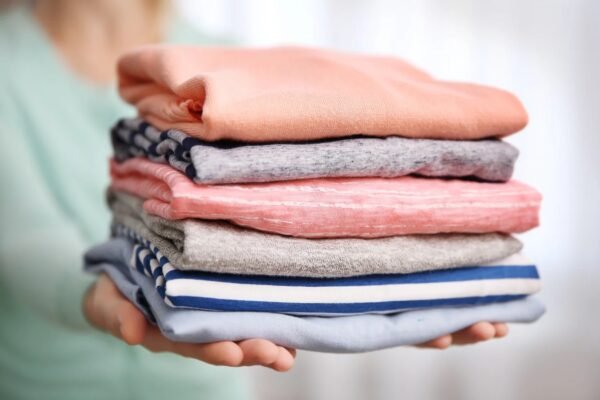
You pull a shirt from the drawer and it looks like a topographic map. You hang a blazer and the shoulders develop mysterious bumps. If you’re asking what the best way to store clothes to avoid wrinkles is, here’s the complete system: wrinkles happen from compression, moisture, and time — so the strategy is giving fabrics space, keeping them dry, and choosing the right method (hang vs. fold) for each garment type.
Hang vs. Fold: The Rules
Always hang: blazers, suits, dress shirts, dresses, coats, anything structured. Gravity is your wrinkle-fighter — hanging lets fibers relax straight.
Always fold: sweaters and heavy knits (hanging stretches them into sadness), tees, jeans, casual pants. Knits on hangers develop shoulder nipples that never fully recover.
Either: casual button-downs, blouses — hang if closet space allows, fold carefully if not.
Hanging Right
- Use proper hangers: wide wooden or velvet hangers for jackets (they support shoulder structure); thin velvet for shirts (grip prevents slipping). Wire hangers are the enemy — they create shoulder points and rust.
- Button the top button on shirts and the middle button on jackets — it holds the shape.
- Don’t cram. Clothes need air between them — about an inch. A stuffed closet wrinkles everything in it. (If space is tight, see organizing a small closet.)
- Hang pants by the cuff (clamp hangers) or folded over a bar — never bunched on a hook.
- Let worn clothes air before re-hanging — 30 minutes on a hook releases moisture and odor.
Folding Right
- The file fold (KonMari): fold into rectangles that stand upright in drawers — no digging, no unfolding three shirts to reach one. (See space-saving folding for the technique.)
- Fold knits loosely — tight folds crease; gentle folds don’t.
- Don’t stack too high — bottom items compress and wrinkle. Shallow stacks or file-folding solves this.
- Tissue paper for precious items — acid-free tissue between folds prevents creasing on silk, pleats, and formal wear.
The Environment Matters
- Dry, cool, dark: humidity wrinkles and mildews; heat yellows; sunlight fades. A dry closet beats a damp basement every time.
- Cedar, not mothballs: cedar blocks and lavender sachets deter moths without the chemical stink.
- Breathe, don’t seal: garment bags for storage are fine short-term, but long-term plastic traps moisture. Canvas bags breathe.
- Shoes stuffed: shoe trees or tissue in shoes hold their shape — collapsing shoes wrinkle adjacent clothes.
Travel Wrinkle Defense
- Bundle wrapping: wrap clothes around a central core — fewer folds, fewer wrinkles. The best packing method, full stop.
- Dry-cleaning bags between layers reduce friction wrinkles.
- Unpack immediately on arrival — hang everything; bathroom steam releases remaining wrinkles.
For textile science, how wrinkle-resistant fabrics work explains the fiber treatments — useful when buying travel clothes.
Wrinkle-Resistant Fabrics: Buy the Problem Away
Storage helps; fabric choice helps more. Some fabrics simply don’t wrinkle — worth prioritizing for travel and low-maintenance wardrobes.
The champions: wool (especially merino — naturally wrinkle-resistant, which is why travel blazers are wool), polyester blends (the reason for their existence), nylon, and Tencel/lyocell. A wool-blend travel blazer emerges from a suitcase wearable; a linen one emerges as modern art.
The offenders: linen (beautiful, wrinkles if you look at it), rayon/viscose, silk, and 100% cotton (especially oxford cloth). These aren’t bad fabrics — they’re high-maintenance ones. Own them intentionally, not by default.
The middle ground: cotton-poly blends (the classic “easy care” dress shirt), ponte knits, and performance fabrics. They split the difference: mostly natural feel, significantly fewer wrinkles.
Shopping strategy: check the label for wrinkle-resistance if low maintenance matters to you. For travel wardrobes, build around the champions. For homebodies with a steamer, buy whatever you love. And “wrinkle-free” finishes (formaldehyde resins) work but wash out over time — they’re a temporary treatment, not a permanent property.
The ultimate wrinkle strategy is layered: right fabrics, right storage, and a steamer for the rest. No single fix does it all — but together, ironing becomes a rare event rather than a routine.
Travel Wrinkle Strategy: Packing Like a Pro
Home storage is half the battle; travel is where wrinkles ambush you. Here’s the system.
The fabric-first packing list: travel with wrinkle-resistant fabrics — merino wool, synthetic blends, and knit fabrics bounce back; linen and rayon surrender. Choosing travel clothes by wrinkle resistance matters more than any folding technique.
Bundle wrapping: the space-and-wrinkle champion — wrap clothes around a central core (pouch of underwear/socks), creating one tight bundle with no folds under pressure. Fewer fold lines = fewer wrinkles. It sounds fussy; it takes 5 minutes and works.
The hotel refresh: hang everything immediately on arrival — gravity plus bathroom steam (hot shower, door closed, garments hung nearby, 15 minutes) releases most travel wrinkles without an iron. A $30 travel steamer handles the stubborn ones.
Business travel specifics: suits and dress shirts travel in a garment bag or folded with tissue at the fold points; wear the blazer on the plane rather than packing it. (See the business trip packing guide for the full system.)
The wrinkle-emergency kit: travel steamer or wrinkle-release spray ($6), plus the hotel-shower-steam trick as backup. With the kit and the technique, you can step off a red-eye looking pressed. Wrinkles are a logistics problem, and logistics problems have solutions.
The Drawer Method for Wrinkle-Prone Items
When closet space runs out, drawers take over — but drawers wrinkle. The fix: file-folding (fold into rectangles, stand upright like files) eliminates the crushing weight of stacked piles, and every item stays visible. Place tissue paper between delicate items, don’t overfill (compression causes wrinkles — leave 10% breathing room), and put the smoothest fabrics on top. A well-organized drawer keeps clothes nearly as smooth as hanging, at a fraction of the space.
Key Takeaways
- Hang structured pieces; fold knits. Never hang heavy sweaters.
- Use proper hangers; give clothes breathing room; don’t overstuff.
- File-fold drawers; fold knits loosely; tissue for delicates.
- Store dry, cool, and dark; cedar for moths; breathable bags.
- Bundle-wrap for travel; unpack and steam on arrival.
The Bottom Line
Storing clothes to avoid wrinkles comes down to: right method per garment, real hangers, breathing room, and a dry closet. Do this and you’ll iron 80% less — and the clothes you own will look more expensive simply by being wrinkle-free.