Pacific Northwest forests produce more wild mushrooms than anywhere else in North America — chanterelles, morels, porcini — and every fall, foragers disappear into the damp woods with baskets and field guides. But wild foraging has a learning curve measured in years and mistakes measured in liver failure. Growing mushrooms at home gives you the magic without the mycology degree: fresh, gourmet mushrooms in weeks, grown safely indoors. This guide tells Pacific Northwest beginners when and how to start growing mushrooms at home.
You’ll learn why the PNW is ideal for mushroom growing, the best beginner species, the two main growing methods (kits vs. from scratch), step-by-step instructions for your first grow, and how to avoid the contamination that ruins most beginner attempts.
Why the Pacific Northwest Is Mushroom Paradise
Mushrooms need what the PNW has in abundance: cool temperatures (55–70°F is ideal for most gourmet species), high humidity, and low light. While desert growers fight their climate with humidifiers and AC, PNW growers often just need a basement corner or garage shelf. Fall through spring — roughly October to May — is prime growing season; summer growing is possible but requires cooling.
The region also has the country’s best mushroom-growing community: mycological societies in Seattle, Portland, and Eugene offer classes and spawn swaps; local suppliers sell fresh spawn (the mushroom equivalent of seeds) without shipping delays; and coffee shops practically give away spent grounds — an excellent oyster mushroom substrate. You’re growing in the Saudi Arabia of fungi; act like it.
Timing your start: begin in fall for the easiest success (natural temperatures cooperate), though indoor growing works year-round with minimal climate control. If you’re new to indoor growing generally, starting a small herb garden teaches the environmental-control basics that transfer directly to mushrooms.
Best Beginner Species (Start Here, Not With Shiitake Dreams)
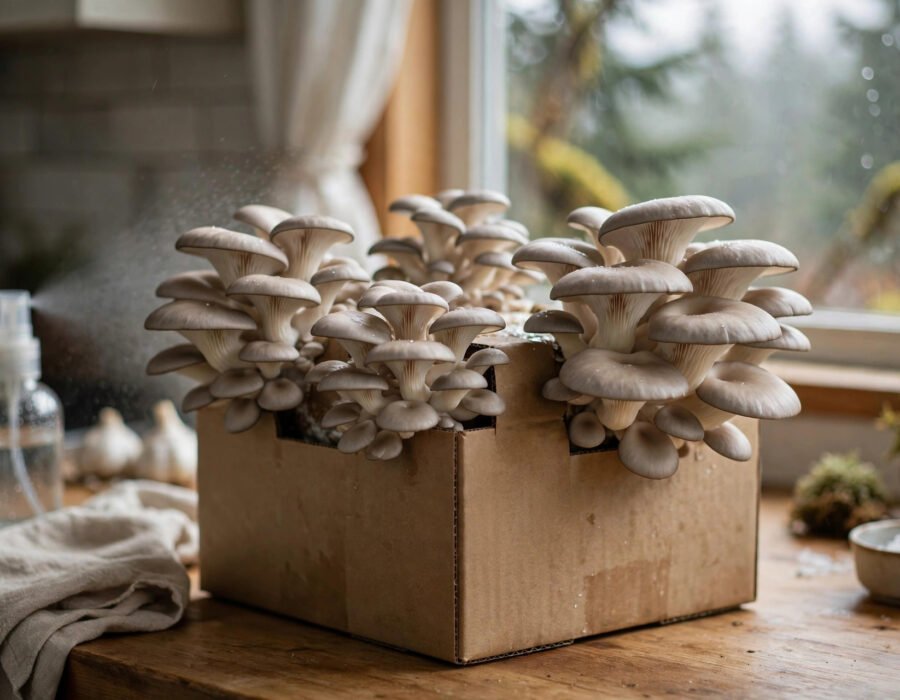
Oyster mushrooms (Pleurotus ostreatus): The undisputed beginner champion. Aggressive colonizers that outrun contamination, fruit in 2–3 weeks, grow on everything from straw to coffee grounds to cardboard, and tolerate beginner mistakes gracefully. Blue oysters love PNW cool temperatures especially. Start here. Seriously.
Wine cap (Stropharia rugosoannulata): The outdoor beginner’s best friend — inoculate wood chips in a shady garden bed in spring, harvest giant wine-red mushrooms by fall. Nearly foolproof, perennial (returns yearly), and improves your garden soil simultaneously.
Lion’s mane (Hericium erinaceus): Slightly more demanding but hugely rewarding — delicious (tastes like crab/lobster), visually stunning, and well-suited to indoor kits. Good second grow after oysters.
Save for later: Shiitake (slower, pickier, needs hardwood logs or supplemented sawdust), reishi (slow, medicinal rather than culinary), morels (notoriously difficult — even experts struggle; buy these at the farmers market). Beginners who start with difficult species usually quit; beginners who start with oysters get hooked.
Method 1: Grow Kits (Start Here)
A mushroom grow kit ($20–$35) contains a pre-colonized block of substrate — the hard part (sterile inoculation, weeks of colonization) is done for you. Your job: cut an X in the bag, mist 2–3 times daily, and harvest in 7–14 days. It’s nearly foolproof and the right first step for 90% of beginners.
Maximize kit success: place in indirect light (not darkness — mushrooms need light cues to fruit properly, just not direct sun), maintain humidity by misting or tenting with a plastic bag with air holes, keep temperatures 60–70°F (a cool PNW basement is perfect), and harvest when caps are still slightly curled under — overmature mushrooms drop spores everywhere and taste worse. Most kits fruit 2–3 flushes (harvests) over 6–8 weeks; soak the block in water overnight between flushes to rehydrate.
Buy kits from reputable suppliers (North Spore, Field & Forest, or local PNW mycology suppliers) — freshness matters, and old kits underperform. Check reviews for colonization quality, not just price.
Method 2: From Scratch (Your Second Grow)
Once kits click, growing from spawn teaches the real craft. The simplest from-scratch method is oyster mushrooms on pasteurized straw: chop wheat straw into 2–4 inch pieces, pasteurize by soaking in 160–180°F water for 1–2 hours (a cooler works perfectly), drain and cool, mix with grain spawn (2–5% by weight) in clean bags or buckets with air holes, and incubate in the dark at 65–75°F for 2–3 weeks until fully white with mycelium. Then move to fruiting conditions: light, fresh air, 85–95% humidity, 55–65°F.
Contamination is the beginner killer. The rules: wash hands thoroughly, work in still air (turn off fans, close windows — airborne contaminants are the enemy), pasteurize properly (temperature and time both matter), and use quality spawn from reputable suppliers. Green, black, or orange mold means contamination — don’t try to salvage; discard the batch outside (not in indoor trash) and review your sterile technique. One contaminated batch teaches more than ten successful kits.
Bucket tek (drilling 1/4-inch holes in food-grade 5-gallon buckets, filling with inoculated straw) is the beloved intermediate method — cheap, scalable, and oddly satisfying. The Oregon State University Extension publishes research-backed mushroom growing guides specific to PNW conditions, and the North American Mycological Association connects growers with local clubs — the rare free resource that’s genuinely excellent.
Harvest, Storage, and What’s Next
Harvest oysters by twisting the whole cluster off at the base when caps are 2–4 inches and edges still curl under. Don’t cut individual mushrooms — clusters harvest together. Expect 1–2 pounds per kit over its life, more from bucket grows.
Fresh mushrooms store 5–7 days refrigerated in paper bags (never sealed plastic — they sweat and slime). For abundance: sauté and freeze (best texture preservation), dehydrate (powdered dried mushrooms are umami bombs for cooking), or share with neighbors — homegrown mushrooms make you briefly the most popular person on the block. Once you’re hooked on growing things, explore the best plants for beginner gardeners to expand beyond fungi.
Your progression path: kits → straw buckets → exploring lion’s mane and chestnut mushrooms → outdoor wine cap beds and shiitake logs → (eventually, maybe) the deep end of sterile agar work. Each level teaches skills the previous one assumed. There’s no rush — the fungi aren’t going anywhere, and neither is the PNW rain.
Frequently Asked Questions
When is the best time to start growing mushrooms in the PNW?
Fall (October–November) is ideal — natural cool temperatures and humidity do half the work. Indoor growing works year-round, but summer requires cooling to keep temperatures in range.
Is it safe to grow mushrooms at home?
Growing known gourmet species from reputable spawn/kits is very safe — you’re growing a specific identified species, not foraging unknowns. Never eat anything you didn’t intentionally inoculate; volunteer mushrooms in outdoor beds should be identified by an expert first.
How much space do I need?
A shelf. Seriously — a 2×4 foot area fits several kits or buckets. Mushroom growing is the highest food yield per square foot of any home cultivation, which is part of its charm.
Why did my kit stop producing?
Usually dehydration (soak the block overnight), temperature out of range, or it’s simply done (2–3 flushes is normal). Contamination shows as odd colors or smells — healthy mycelium is white and smells faintly sweet/earthy.
The Bottom Line
Growing mushrooms at home in the Pacific Northwest is one of the highest-reward beginner gardening projects: start in fall with an oyster mushroom kit ($25, two weeks to harvest), graduate to straw buckets from spawn, expand to wine cap beds outdoors, and lean on the region’s mycological societies and extension resources. The PNW gives you the climate for free — all you need to add is a kit, a spray bottle, and a little patience. Fresh oysters in November, grown in your basement, will ruin store-bought mushrooms for you forever. Consider yourself warned.