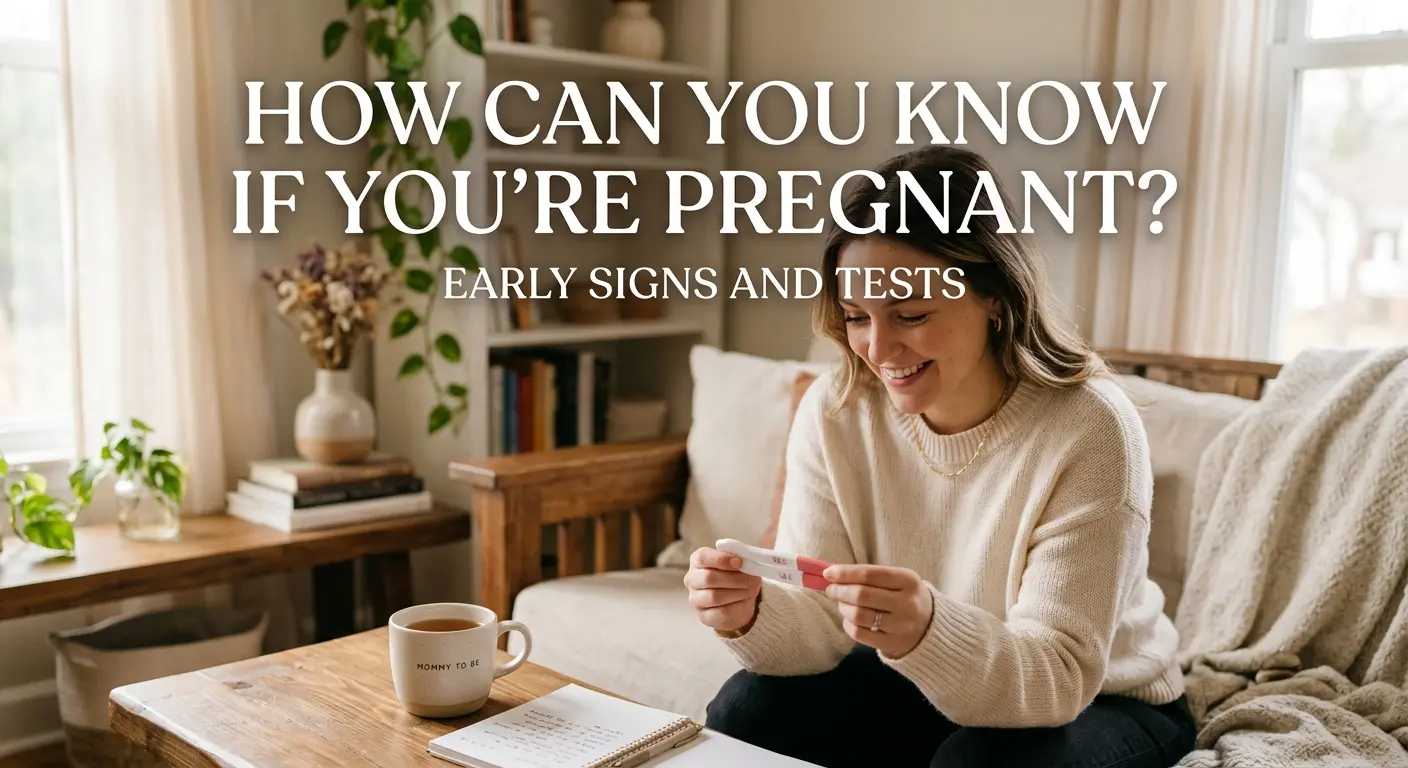
You can find out if you’re pregnant by taking a home pregnancy test, which detects the hormone human chorionic gonadotropin (hCG) in your urine. Early signs of pregnancy may include a missed period, tender breasts, unusual tiredness, nausea, and frequent urination. However, these symptoms can also occur before a period or because of other conditions, so a pregnancy test is the most reliable way to check. Most home pregnancy tests can be used from the first day of a missed period.
What Are the Earliest Signs of Pregnancy?
Early pregnancy symptoms vary from person to person. Some people notice changes before their expected period, while others experience few or no symptoms during the first several weeks.
According to the NHS guide to early pregnancy symptoms, symptoms commonly begin around four to six weeks of pregnancy, although the timing can vary.
Here are the main signs to watch for.
1. A Missed Period
A missed period is often the first noticeable sign of pregnancy, particularly if your menstrual cycle is usually regular.
If your period is late and you’ve had sex that could result in pregnancy, taking a home pregnancy test is a sensible next step.
However, missing a period does not automatically mean you’re pregnant. Stress, changes in weight, intense exercise, hormonal contraception, and certain health conditions can also affect your menstrual cycle.
2. Tender or Swollen Breasts
Hormonal changes during early pregnancy can make your breasts feel sore, sensitive, swollen, or heavier than usual. Your nipples may also feel more sensitive.
These changes can resemble the breast tenderness many people experience before menstruation. Therefore, breast discomfort alone cannot confirm pregnancy.
3. Nausea and Vomiting
Nausea, sometimes accompanied by vomiting, is a familiar early pregnancy symptom. Despite being called morning sickness, it can happen at any time of day or night.
Some people experience nausea early in pregnancy, while others never experience it. The absence of morning sickness does not mean you’re not pregnant.
If vomiting becomes severe or you cannot keep fluids down, seek medical advice to avoid dehydration.
4. Unusual Tiredness
Feeling unusually exhausted, even after getting enough sleep, can be an early pregnancy symptom.
Hormonal changes, including changes in progesterone, contribute to fatigue during pregnancy. However, tiredness can also result from poor sleep, stress, anemia, illness, or other causes.
If the fatigue is persistent or accompanied by other concerning symptoms, consider speaking with a healthcare professional.
5. Frequent Urination
You might notice that you need to urinate more frequently than usual, including during the night.
Pregnancy-related changes in hormones and blood flow can increase the need to urinate. However, frequent urination is not specific to pregnancy.
If urination is painful or accompanied by fever, seek medical advice because a urinary tract infection may be responsible.
6. Light Spotting or Mild Cramping
Some people experience light spotting or mild cramping during early pregnancy. Spotting may appear pink, red, or brown and can occur around the time a period would normally begin.
Light bleeding is sometimes described as implantation bleeding, but spotting alone cannot establish that implantation has occurred or confirm pregnancy.
Bleeding and cramping can have several causes. Seek medical advice if you experience bleeding during a suspected or confirmed pregnancy, particularly if it is persistent or accompanied by pain.
7. Other Possible Early Pregnancy Symptoms
Other changes that may occur during early pregnancy include:
- Bloating or a feeling of fullness in the abdomen.
- Constipation.
- Increased sensitivity to smells.
- Changes in appetite, food cravings, or food aversions.
- A metallic taste in the mouth.
- Mood changes.
- Increased vaginal discharge without itching, soreness, or an unpleasant odor.
These symptoms are not unique to pregnancy. You may experience several, only one, or none at all.
Can You Know You’re Pregnant Before a Missed Period?
It is possible to detect pregnancy before a missed period with some sensitive home pregnancy tests. However, testing this early is less reliable because the pregnancy hormone hCG may not yet have reached a detectable level in your urine.
You might notice breast tenderness, fatigue, or mild cramping before your period is due. Unfortunately, these changes can also occur during the normal menstrual cycle.
The timing of ovulation and implantation affects when a pregnancy test becomes positive. If you test too early, you could receive a negative result even if you are pregnant.
The practical approach: If you test before your expected period and the result is negative, test again when your period is due or after it has been missed.
There is no dependable way to confirm pregnancy based on symptoms alone.
When Can You Take a Pregnancy Test?
The best time to take a home pregnancy test depends on your menstrual cycle and when you last had sex that could result in pregnancy.
Testing From the First Day of a Missed Period
For most home pregnancy tests, the first day of a missed period is a good time to test. Results are generally more reliable at this stage than they are before your expected period.
If your period is already late, you can take a test now rather than waiting for symptoms to develop.
For more information, see the NHS guidance on when to take a pregnancy test.
Testing When Your Periods Are Irregular
If you do not know when your next period is due, the NHS recommends taking a pregnancy test at least 21 days after the last unprotected sex.
This is particularly useful if your cycles vary in length or you cannot reliably estimate your ovulation date.
If you’ve had unprotected sex more recently, a negative test may not rule out pregnancy from that encounter. You may need to test again when enough time has passed.
How to Use a Home Pregnancy Test Correctly
Home pregnancy tests are straightforward to use, but following the instructions carefully helps reduce the chance of an inaccurate result.
Follow these steps:
- Check the expiration date. Do not use an expired test.
- Read the instructions. Different brands may have different procedures and result-reading times.
- Collect or apply urine as directed. Some tests are held in the urine stream, while others require a urine sample in a clean container.
- Wait for the specified time. Read the result within the time window stated in the instructions.
- Check the control indicator. If the test does not show its required control line or symbol, the result may be invalid.
- Repeat if necessary. If you tested too early or the result is negative but your period has not arrived, test again at the appropriate time.
You can use many home pregnancy tests at any time of day. However, if you are testing very early, first-morning urine may improve your chances of detecting low levels of hCG because it is often more concentrated.
Avoid drinking excessive amounts of water immediately before testing, as this can dilute your urine.
How Do Pregnancy Tests Work?
Pregnancy tests detect hCG, a hormone produced during pregnancy after implantation begins. The hormone enters the blood and eventually becomes detectable in urine.
A home urine test checks for hCG, while a healthcare professional may arrange a blood test when additional information is needed.
A blood test can detect smaller amounts of hCG in some circumstances, but it is not necessary for everyone. A home test is often the first step.
What If Your Pregnancy Test Is Negative?
A negative result does not always mean you are not pregnant. Testing too early is one of the most common reasons a pregnancy test may fail to detect an existing pregnancy.
If your period has not arrived, follow this plan:
- If you tested before your expected period: Wait until the day your period is due or later, then test again.
- If your period is already late: Repeat the test in a few days, following the instructions carefully.
- If a second test is negative but your period still has not arrived: Contact a healthcare professional for advice.
- If your results are inconsistent: A clinician can help determine whether another urine test, a blood test, or further assessment is appropriate.
A late period can also occur because of stress, hormonal changes, weight fluctuations, thyroid problems, or other conditions. Repeated negative tests and a persistently missed period deserve appropriate evaluation.
Do not rely on a negative home test to dismiss severe pain, fainting, or other urgent symptoms.
How Can You Tell Pregnancy Symptoms From PMS?
Early pregnancy symptoms and premenstrual syndrome (PMS) can be difficult to distinguish because both involve hormonal changes.
| Symptom | Early pregnancy | PMS |
|---|---|---|
| Breast tenderness | Common | Common |
| Fatigue | Possible | Possible |
| Bloating | Possible | Common |
| Mood changes | Possible | Common |
| Mild cramps | Possible | Common |
| Missed period | A possible sign | Menstruation may be delayed for other reasons |
| Positive pregnancy test | Indicates hCG was detected | Not caused by PMS |
The most useful difference is not how a symptom feels but whether pregnancy hormone is detected by a properly performed test.
PMS symptoms often improve when menstruation begins. Pregnancy symptoms may continue, but this is not a reliable way to diagnose pregnancy.
If your symptoms feel unusual or your period is late, take a pregnancy test instead of trying to interpret every physical change.
Can You Be Pregnant Without Any Symptoms?
Yes. You can be pregnant without noticing obvious symptoms, particularly in the early weeks.
Some people do not experience nausea, breast tenderness, or unusual fatigue. Others notice changes only after their period has been missed.
Not having symptoms does not rule out pregnancy, just as having several symptoms does not prove it.
If you have had sex that could result in pregnancy, use the recommended testing timeline even if you feel completely normal.
What to Do After a Positive Pregnancy Test
A positive home pregnancy test is usually reliable when the instructions have been followed correctly.
If your result is positive, consider these next steps:
- Arrange medical care. Contact a qualified healthcare professional or pregnancy care provider to discuss confirmation, timing, and next steps.
- Review any medicines you take. Ask a healthcare professional or pharmacist whether your medicines are suitable during pregnancy. Do not stop prescribed medicines without appropriate advice.
- Consider folic acid. If you may continue the pregnancy, seek guidance on starting folic acid supplementation; 400 micrograms daily is the usual recommendation for many people before conception and during early pregnancy, although some need a higher prescribed dose.
- Avoid alcohol and smoking. If you are pregnant or may be pregnant, avoiding alcohol and smoking is the safer choice.
- Discuss your options. If the pregnancy was unexpected or you are uncertain about continuing it, a qualified healthcare professional can explain your options confidentially, subject to local laws and services.
You do not always need a blood test or ultrasound immediately after a positive home test. The appropriate next step depends on your circumstances, symptoms, and how far along the pregnancy may be.
Pregnancy Warning Signs That Need Medical Attention
Most early pregnancy symptoms are not emergencies, but certain symptoms require prompt assessment.
Seek urgent medical attention if you could be pregnant and experience:
- Severe or worsening abdominal or pelvic pain, particularly on one side.
- Shoulder-tip pain accompanied by abdominal pain or other concerning symptoms.
- Heavy vaginal bleeding.
- Severe dizziness, fainting, or collapse.
These can be warning signs of an ectopic pregnancy, in which a pregnancy develops outside the uterus. An ectopic pregnancy can become life-threatening and needs urgent medical evaluation.
Do not wait for a positive pregnancy test before seeking help if you have concerning symptoms. An early test can be negative even when a serious problem is developing.
For further information, read the NHS guide to ectopic pregnancy symptoms.
Frequently Asked Questions
How can you know if you’re pregnant without a test?
You cannot reliably confirm pregnancy without testing. A missed period, nausea, fatigue, and breast tenderness may suggest pregnancy, but they can also have other causes. A pregnancy test is the practical way to check.
How soon after sex can you know if you’re pregnant?
A pregnancy test cannot reliably detect a pregnancy immediately after sex. If you know when your next period is due, test from the first day it is missed. If you do not know when your period is due, test at least 21 days after the last unprotected sex.
What are the first signs of pregnancy before a missed period?
Possible early symptoms include breast tenderness, tiredness, bloating, mild cramping, or light spotting. However, these symptoms overlap with PMS and are not reliable proof of pregnancy.
Can you feel pregnant one week after sex?
Some people notice physical changes early, but symptoms one week after sex cannot reliably establish pregnancy. The timing of ovulation, implantation, and hCG production varies. Follow the recommended testing timeline for a more dependable answer.
Can you be pregnant and still get your period?
True menstruation does not occur during pregnancy, but some people experience bleeding in early pregnancy that they may mistake for a period. If bleeding is unusual or pregnancy is possible, take a test and seek medical advice as appropriate.
Does a negative pregnancy test mean you’re definitely not pregnant?
Not necessarily. A test taken too early, diluted urine, or incorrect use can produce a false-negative result. Repeat the test after a few days or seek medical advice if your period remains absent.
What does a positive pregnancy test look like?
Depending on the brand, a positive result may appear as two lines, a plus sign, or the word “pregnant.” Read the instructions for your specific test, including the required control indicator and the time window for interpreting results.
Can birth control affect a pregnancy test?
Most hormonal contraceptives, including birth control pills, do not prevent a pregnancy test from detecting hCG. No contraceptive method is completely effective, so testing may still be appropriate if you suspect pregnancy.
Do you always have morning sickness when you’re pregnant?
No. Some pregnant people experience nausea or vomiting, while others have neither. The absence of morning sickness does not rule out pregnancy.
When should you see a doctor after a positive pregnancy test?
Arrange an appointment with a qualified healthcare professional to discuss pregnancy care and any questions you have. Seek urgent assessment sooner if you develop severe abdominal pain, heavy bleeding, fainting, or other concerning symptoms.
Conclusion
If you’re wondering how you can know if you’re pregnant, start by considering whether your period is late and whether you have noticed any possible early symptoms. Remember that symptoms alone cannot confirm pregnancy, and you may be pregnant even if you feel no different.
For the clearest answer, take a home pregnancy test at the right time, follow its instructions, and repeat it if the result is negative but your period still does not arrive. A positive result is a reason to arrange appropriate pregnancy care, while severe pain, heavy bleeding, or fainting requires urgent medical attention.
The most important takeaway is simple: use symptoms as a reason to test, not as a substitute for a pregnancy test.