Going gray is having a cultural moment — but most people don’t go gracefully silver all at once. They get the skunk stripe, the salt-and-pepper patch, the grays that look yellow and wiry while the rest of the hair still holds color. Coloring gray hair at home sits in that awkward middle: you want the convenience and savings of DIY, but gray hair is genuinely harder to color than pigmented hair, and the mistakes are visible. Here’s how to understand what makes gray different and how to get salon-plausible results at home.
Why Gray Hair Resists Color (The Science)
Gray hair isn’t just hair without pigment — it’s structurally different. The cuticle (outer layer) is thicker and more tightly sealed, which means dye molecules struggle to penetrate. Gray hair also tends to be coarser and drier, because the oil glands produce less sebum as we age, and the hair often has a yellowish cast from accumulated environmental damage and the natural keratin showing through. Three consequences:
- Color takes longer to process. The resistant cuticle needs extended timing — gray coverage shades often need the full 40–45 minutes, not the 25 that works on pigmented hair.
- Color fades faster. The same resistant cuticle that blocks dye going in lets it wash out faster. Gray coverage needs more maintenance, not less.
- Warm tones go brassy. That underlying yellow cast grabs warm dye tones and amplifies them — which is why first-time gray colorers often end up orange.
Choosing the Right Product
Permanent vs. demi-permanent: for significant gray (over 50%), permanent color gives the coverage and longevity you need. Demi-permanent blends and fades gracefully — ideal for the first grays (under 30%) or for blending during grow-out. Semi-permanent washes out in weeks and barely grips resistant gray — skip it for coverage.
Shade selection — the critical part: choose a shade one level lighter than your target. Box dye runs dark, especially on gray, and dark-over-gray looks harsh and wig-like. If you’re between shades, go lighter. For the yellow-cast problem, choose neutral or ash tones over warm/golden ones — ash counteracts the underlying yellow instead of amplifying it. And “gray coverage” labeled lines (formulated with extra pigment load) genuinely perform better on resistant hair than standard lines.
Root touch-up products (sprays, powders, mascaras) are the unsung heroes — they extend the interval between full colorings by 2–3 weeks, which matters because over-processing already-colored hair causes the banding and damage that make DIY obvious.
The At-Home Process, Done Right
- Strand test first. Every time, with new products. Gray hair’s resistance varies wildly person to person — the test lock tells you the real timing.
- Don’t wash right before. Color on hair washed 24–48 hours prior — natural oils protect the scalp. (Exception: heavy styling product buildup — then clarify first.)
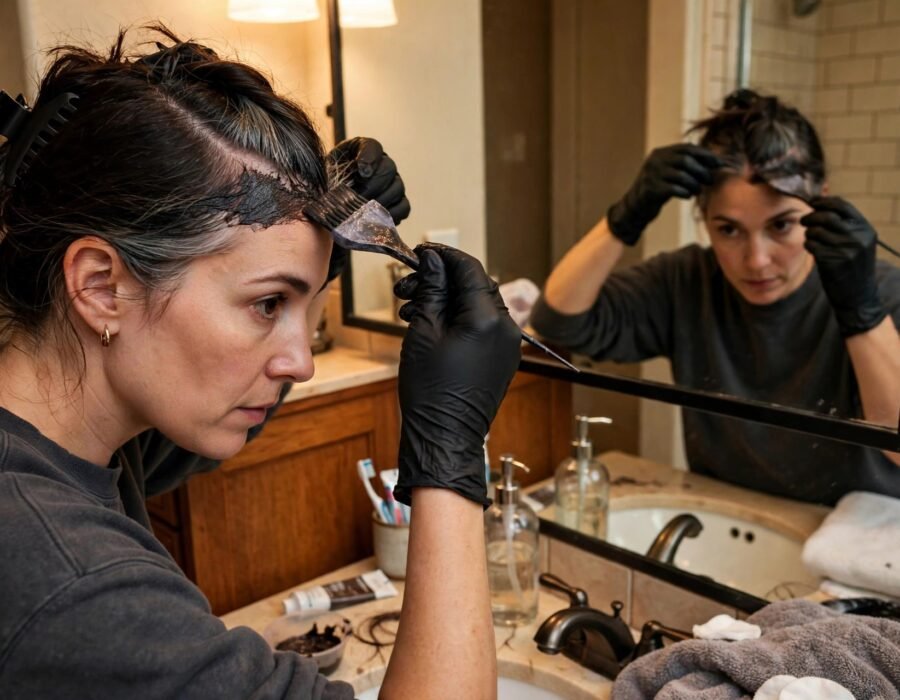
- Apply to regrowth first. Gray regrowth needs the most processing time. Apply to roots, wait 20–25 minutes, then pull through the lengths for the last 10–15 minutes to refresh (not re-process) previously colored hair.
- Section properly. Four quadrants, working in 1/4-inch subsections. Skipping this is why DIY color looks patchy — missed spots show brutally on gray.
- Time it fully. Set a timer. Rinsing early is the #1 cause of translucent, under-covered gray.
- Rinse cool, condition well. Cool water seals the cuticle; a deep conditioner or the included mask restores moisture gray hair desperately needs.
Maintaining Gray Coverage
Plan on root touch-ups every 4–6 weeks (gray regrowth shows faster than pigmented regrowth — it’s high-contrast). Between colorings: sulfate-free shampoo (sulfates strip color), purple/silver shampoo once a week if you’re fighting brassiness (it deposits violet pigment that neutralizes yellow), heat protectant always (gray hair is drier and more heat-vulnerable), and deep conditioning masks weekly. The AAD’s hair care guidance covers the fundamentals of keeping processed hair healthy.
When to Call a Professional
DIY has limits. See a colorist for: going significantly lighter (bleach on resistant gray is a damage risk), corrective color (fixing a bad DIY job is harder than doing it right), resistant “sparkle” grays around the hairline that won’t take color (pros have pre-softening treatments), or if you have scalp conditions, allergies (always do the 48-hour skin allergy test — PPD allergies are serious), or are pregnant (most OBs say it’s fine after the first trimester, but confirm with yours).
The Grow-Out Option
Worth mentioning: the most stylish choice might be not coloring at all. The gray-grow-out movement has real momentum, and silver hair done intentionally — with purple shampoo for tone, regular trims, and good conditioning — looks striking. The awkward phase (the demarcation line) lasts 6–12 months; strategies include shorter cuts, blending highlights, or demi-permanent that fades gradually. If you’re on the fence, growing out is free to try.
Cost Comparison
DIY: $10–$25 per application (box dye + supplies), ~$150–$300/year. Salon gray coverage: $80–$200+ per visit, $1,000–$2,400/year. The savings are real — which is exactly why learning to do it well matters. Budget for quality products, not just cheap ones; the $8 box and the $20 box differ meaningfully in pigment load and conditioning.
Conclusion
Coloring gray hair at home works when you respect what makes gray different: resistant cuticles need full processing time and gray-coverage formulas, shades should go lighter and cooler than instinct suggests, and maintenance (purple shampoo, sulfate-free care, root touch-ups every 4–6 weeks) matters as much as the coloring itself. Strand-test, section carefully, and know when a correction needs a professional. And if hair health is the broader project, understanding hair shedding and finding your personal style round out the picture — because the goal was never just covering gray, it’s liking what you see.
Frequently Asked Questions
Why won’t hair dye cover my gray hair?
Gray hair has a thicker, more resistant cuticle that blocks dye penetration. Use gray-coverage formulas, process the full recommended time (40–45 min), apply to regrowth first, and choose one shade lighter than your target.
Should I use permanent or demi-permanent color on gray hair?
Permanent for significant gray (50%+) — it has the pigment load and longevity resistant hair needs. Demi-permanent for early grays (under 30%) or blending during grow-out; it fades gracefully without a harsh line.
How do I stop my gray hair from turning yellow?
Use purple/silver shampoo once a week (violet pigment neutralizes yellow), choose ash/neutral dye tones over warm ones, protect from sun and heat, and deep-condition regularly — dryness amplifies the yellow cast.
How often should I touch up gray roots at home?
Every 4–6 weeks for the regrowth line; use root touch-up sprays or powders between full applications to stretch the interval and avoid over-processing the lengths.
Is box dye bad for gray hair?
Not inherently — but choose gray-coverage lines, go one shade lighter than your goal, and always strand-test. Box dye fails on gray mainly from under-processing and wrong shade selection, not from being box dye.
How do I fix brassy orange tones after coloring gray hair?
Brassiness comes from gray hair’s underlying yellow cast grabbing warm dye tones. Fix it with a purple/silver toning shampoo (1–2x weekly), and next time choose an ash or neutral shade one level lighter than your target. For severe brassiness, a demi-permanent ash toner applied for 10–15 minutes neutralizes the orange without re-bleaching.
Sources: AAD hair care guidance and FDA cosmetics safety information.