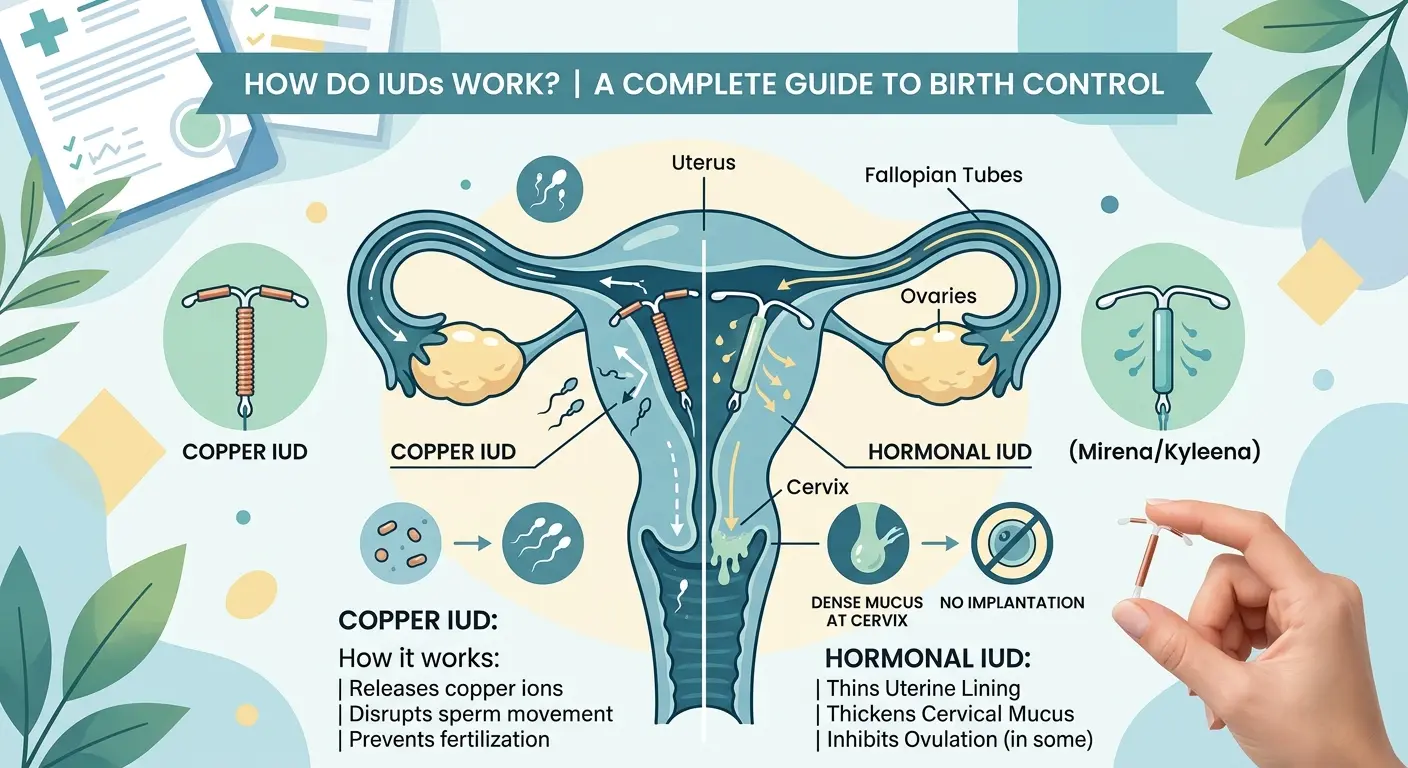
IUDs (intrauterine devices) prevent pregnancy by making it difficult for sperm to reach and fertilize an egg. A hormonal IUD releases a small amount of progestin, which thickens cervical mucus and makes it harder for sperm to enter the uterus. A copper IUD releases copper ions that interfere with sperm movement and function. Both types are placed inside the uterus by a healthcare professional, provide highly effective long-term contraception, and can be removed when pregnancy is desired.
How Do IUDs Work to Prevent Pregnancy?
An IUD is a small, usually T-shaped device that sits inside the uterus. It provides continuous contraception without requiring you to take a daily pill or use birth control immediately before every sexual encounter.
There are two main types: hormonal IUDs and copper IUDs. Both primarily prevent fertilization, but they work through different mechanisms.
How hormonal IUDs work
Hormonal IUDs release a synthetic hormone called progestin into the uterus. This hormone changes the reproductive environment in ways that prevent sperm from reaching an egg.
Their main effects include:
- Thickening cervical mucus: The mucus around the cervix becomes thicker, making it difficult for sperm to pass into the uterus.
- Interfering with sperm movement and function: The changes in the reproductive tract make fertilization less likely.
- Thinning the uterine lining: Progestin reduces the thickness of the lining of the uterus.
- Sometimes suppressing ovulation: Some hormonal IUD users continue to release eggs each month, while others experience suppressed ovulation. Preventing ovulation is not the primary mechanism for every hormonal IUD.
Because these effects work together, hormonal IUDs are highly effective at preventing pregnancy.
How copper IUDs work
A copper IUD does not contain hormones. Instead, it releases small amounts of copper into the uterus, creating an environment that interferes with sperm movement and function.
This makes it much harder for sperm to reach an egg and fertilize it.
Unlike hormonal IUDs, copper IUDs do not routinely suppress ovulation. Your ovaries generally continue their usual hormonal cycle, which means you may continue to experience your regular menstrual cycle.
Copper IUDs can also be used as emergency contraception when inserted within the recommended timeframe after unprotected sex. A healthcare professional can advise whether this option is appropriate for your situation.
Types of IUDs and How They Compare
Choosing an IUD often comes down to whether you prefer hormone-free contraception, want lighter periods, or need a method that fits your medical history.
| Feature | Hormonal IUD | Copper IUD |
|---|---|---|
| Contains hormones | Yes, progestin | No |
| Main mechanism | Thickens cervical mucus and interferes with sperm reaching an egg | Copper interferes with sperm movement and function |
| Effect on periods | Often lighter bleeding and fewer cramps over time | May cause heavier bleeding and stronger cramps |
| Ovulation | May continue; suppression varies | Usually continues |
| Duration | Depends on the product, commonly 3–8 years for products approved in the United States | Depends on the product; some are approved for up to 10 years or longer in certain countries |
| Fertility after removal | Returns promptly | Returns promptly |
| Emergency contraception | Certain hormonal products may be used under applicable clinical guidance | Established, highly effective option |
Duration varies by product, country, and approved indication. Check the instructions for your particular device rather than assuming every IUD lasts the same number of years.
How Effective Are IUDs?
IUDs are among the most effective reversible forms of birth control. Fewer than one in 100 users typically becomes pregnant during the first year of use.
The CDC reports typical-use failure rates of approximately 0.1–0.4% for hormonal IUDs and 0.8% for the copper IUD. These figures represent population-level estimates, not an individual’s exact risk.
Several factors help explain their effectiveness:
- An IUD provides continuous contraception after it becomes effective.
- You do not need to remember a daily dose.
- Ordinary activities, including exercise and sex, do not normally reduce its effectiveness.
- Both hormonal and copper devices work for years, depending on the product.
Pregnancy is still possible, although uncommon. If you think you may be pregnant while using an IUD, take a pregnancy test and contact a healthcare professional promptly. Pregnancy with an IUD requires assessment because, if pregnancy occurs, the relative likelihood of an ectopic pregnancy is higher than among pregnancies generally.
When Does an IUD Start Working?
The answer depends on the type of IUD and when it is inserted.
When a copper IUD starts working
A copper IUD provides contraception immediately after insertion. It can also be used for emergency contraception when inserted within five days of unprotected sex, subject to clinical assessment and applicable guidance.
When a hormonal IUD starts working
A hormonal IUD may provide immediate protection when inserted at certain points in the menstrual cycle. If it is inserted at another time, you may need to use condoms or avoid vaginal sex for the next seven days.
The exact recommendation depends on the product, the timing of insertion, and whether you are switching from another contraceptive method. Ask your healthcare professional when it is safe to rely on the IUD alone.
An IUD does not protect against pregnancy from sex that occurred before insertion unless it is being used appropriately as emergency contraception.
How Long Does an IUD Last?
An IUD can provide contraception for several years, but its approved lifespan depends on the model.
Hormonal IUDs commonly last between three and eight years for products approved in the United States. Some copper IUDs are approved for up to ten years, and certain products have longer approved durations in some countries.
You do not have to keep an IUD for its full approved lifespan. A healthcare professional can remove it sooner if you want to change birth control methods, experience troublesome side effects, or try to become pregnant.
Do not assume a device is still effective beyond its approved duration without checking its specific instructions with a clinician.
How IUD Insertion and Removal Work
What happens during IUD insertion?
An IUD must be inserted by a trained healthcare professional. The procedure usually takes only a few minutes, although the appointment may take longer.
The process typically involves:
- Discussing your health and contraceptive needs. The clinician reviews your medical history, pregnancy possibility, and relevant risks.
- Examining the cervix and uterus. A pelvic examination helps assess the uterus before insertion.
- Placing the device. The clinician guides the folded IUD through the cervix and into the uterus using a narrow insertion tube.
- Trimming the strings. Small threads remain extending into the vagina so the device’s position can be checked and the IUD can later be removed.
Some people experience cramping, pressure, or brief sharp pain during insertion. Others experience less discomfort. Ask about pain-management options before the procedure if you are concerned.
Does getting an IUD hurt?
Pain varies from person to person. You may feel cramps during insertion and for a short time afterward. Light bleeding or spotting is also common.
Your clinician can discuss appropriate pain relief and available local anesthetic options. You should not feel pressured to tolerate severe pain without support.
How does IUD removal work?
A healthcare professional gently pulls the IUD’s strings to remove the device. Most removals are straightforward and brief.
If the strings cannot be seen or the device does not come out easily, additional instruments or imaging may be needed. Do not try to remove an IUD yourself.
Fertility generally returns promptly after removal, so you can become pregnant soon afterward if you have sex without another effective contraceptive method.
How IUDs Affect Your Period
Changes in menstrual bleeding are among the most noticeable differences between the two types of IUDs.
Hormonal IUDs and periods
Hormonal IUDs commonly cause irregular bleeding or spotting during the first three to six months. Over time, periods often become lighter, shorter, or less painful.
Some users stop having periods altogether. This can be an expected effect of the hormone and does not automatically mean that blood is building up inside the uterus.
If you develop new or unusual symptoms, consult a healthcare professional rather than assuming the IUD is responsible.
Copper IUDs and periods
Copper IUDs can make periods heavier, longer, or more painful, particularly during the first few months.
If you already experience heavy menstrual bleeding or significant cramps, discuss this possibility before choosing a copper device. A hormonal IUD may be more suitable for some people because it often reduces menstrual bleeding.
Seek medical advice if bleeding becomes unusually heavy, continues to worsen, or is accompanied by dizziness, weakness, severe pain, or other concerning symptoms.
IUD Side Effects, Risks, and Warning Signs
Most IUD users do not experience serious complications, but it is important to understand possible side effects and risks.
Common side effects
Depending on the type, side effects may include:
- Cramping or pelvic discomfort after insertion.
- Irregular bleeding or spotting, especially with hormonal IUDs.
- Heavier or more painful periods with copper IUDs.
- Lighter periods or absent periods with hormonal IUDs.
- Hormone-related symptoms, such as headaches, acne, or breast tenderness, in some hormonal IUD users.
Many early bleeding changes improve over time. Persistent or severe symptoms deserve medical evaluation.
Less common complications
Rare but important complications include:
- Expulsion: The IUD partly or completely comes out of the uterus, reducing or eliminating its contraceptive protection.
- Uterine perforation: The device damages the uterine wall during insertion or, rarely, afterward.
- Infection: A pelvic infection can occur, with the risk associated with insertion particularly relevant when an untreated infection is present.
- Pregnancy: No contraceptive method is completely effective.
An IUD does not protect against sexually transmitted infections (STIs), including HIV. Condoms reduce the risk of many STIs and can be used alongside an IUD.
When should you seek medical care?
Contact a healthcare professional promptly if you experience severe or worsening pelvic pain, fever, unusual or foul-smelling discharge, very heavy bleeding, or a positive pregnancy test while an IUD is in place.
If you suspect that your IUD has moved or come out, use condoms or avoid vaginal sex until you have received advice about alternative contraception. If you recently had sex without additional protection, ask promptly whether emergency contraception is appropriate.
Severe abdominal pain, fainting, or significant pain with a positive pregnancy test warrants urgent medical assessment.
Benefits and Limitations of IUD Birth Control
Benefits of IUDs
IUDs offer several practical advantages:
- Long-lasting protection: Depending on the product, protection lasts for years.
- High effectiveness: Pregnancy is uncommon with either type.
- Convenience: There is no daily pill to remember.
- Reversibility: A healthcare professional can remove the device when you want to stop using it.
- Choice: A hormonal option and a hormone-free option are available.
- Potential period benefits: Hormonal IUDs can reduce heavy bleeding and menstrual cramps.
- Emergency contraception: The copper IUD is an established emergency contraceptive option.
Limitations of IUDs
IUDs also have drawbacks to consider:
- Insertion requires a trained healthcare professional.
- Insertion may cause pain or cramping.
- Copper IUDs can increase menstrual bleeding and cramps.
- Hormonal IUDs can cause irregular spotting and other hormone-related symptoms.
- Expulsion and other complications are possible, although uncommon.
- IUDs do not protect against STIs.
- Availability, cost, and approved duration vary by country and product.
An IUD may be an excellent option for one person but less suitable for another. A clinician can help you consider your medical history, menstrual symptoms, preferences, and reproductive plans.
Frequently Asked Questions
Do IUDs stop ovulation?
Copper IUDs generally do not stop ovulation. Hormonal IUDs may suppress ovulation in some users, but many users continue to ovulate. Their main contraceptive effect is to make it difficult for sperm to reach and fertilize an egg.
Can you get pregnant with an IUD?
Yes, but it is uncommon. Fewer than one in 100 IUD users typically becomes pregnant during the first year. If you suspect pregnancy, take a test and seek prompt medical advice because an IUD-associated pregnancy needs assessment.
Do IUDs protect against sexually transmitted infections?
No. IUDs prevent pregnancy but do not protect against STIs. Condoms and appropriate STI testing are important when infection prevention is needed.
Can an IUD move out of place?
An IUD can occasionally shift or be expelled, particularly in the months following insertion. New or worsening pain, unusual bleeding, missing or noticeably changed strings, or feeling hard plastic at the cervix should prompt medical advice. Do not pull on the strings or attempt to reposition the device yourself.
Can you use an IUD while breastfeeding?
IUDs can generally be used while breastfeeding. The appropriate timing of insertion depends on individual circumstances and how recently you gave birth. A healthcare professional can help determine the safest timing.
Can an IUD be used as emergency contraception?
Yes. A copper IUD is an established, highly effective option when inserted within five days after unprotected sex. Certain 52-mg levonorgestrel hormonal IUDs are also supported for emergency contraception in some clinical guidelines, but recommendations and approved indications vary. Ask a qualified clinician promptly about local options.
Does an IUD cause infertility?
IUDs do not generally cause infertility. Fertility usually returns promptly after removal. Untreated reproductive tract infections can affect fertility, which is one reason screening and appropriate care for infections matter.
Can you have sex with an IUD?
Yes. Once the IUD is in place and effective, it generally does not interfere with sex or normal daily activities. Follow your clinician’s instructions about when to rely on the device for contraception after insertion. Use condoms when STI protection is needed.
Can an IUD end an existing pregnancy?
No. An IUD is a contraceptive method, not an abortion treatment. If you are pregnant with an IUD in place, contact a healthcare professional promptly for assessment.
Conclusion
IUDs work by preventing sperm from fertilizing an egg, but copper and hormonal devices achieve this in different ways. Copper IUDs use copper to interfere with sperm function, while hormonal IUDs release progestin that thickens cervical mucus and changes the reproductive environment.
Both options provide highly effective, long-lasting, reversible contraception. The best choice depends on your preferences, menstrual symptoms, health history, and whether you want a hormone-free method. A qualified healthcare professional can explain the available devices, insertion timing, potential side effects, and the option that best suits your needs.