You have been playing in your bedroom for a year. Your friends say you are good. Now you want to play for strangers — and the open mic night, that beautiful low-stakes institution, is calling. But where do you find them, what should you expect, and how do you not embarrass yourself? If you are asking what should I know before I find local open mic nights near you, this guide covers the finding, the etiquette, and the performing — the complete first-timer’s manual.
Open mics are the grassroots of live music: bars, cafés, bookstores, and community spaces hosting regular nights where anyone can sign up and play a few songs. They are where songwriters test material, where beginners get stage time, and where local scenes are born. The barrier to entry is gloriously low — which is exactly why the etiquette matters so much.
Finding Open Mics Near You
Start with the obvious: search “[your city] open mic night” and check dedicated listings — many cities have open-mic calendars maintained by local music communities. Social media is the real directory: search Facebook events and local musician groups, where hosts post weekly. Music stores often maintain bulletin boards (physical and digital) of local nights. And ask working musicians — the guitarist at the coffee shop knows every open mic in town.
Evaluate before committing: visit once as an audience member first. You will learn the vibe (listening room or rowdy bar?), the format (sign-up sheet or lottery? how many songs?), the sound quality, and whether the host runs a tight ship. A well-run open mic with an attentive audience is worth driving for; a chaotic one with a broken PA is not, no matter how close. NAMM’s community resources sometimes list local music events, and finding local live music events near you uses the same discovery muscles — the open mic is often where those local acts started.
The Etiquette: Unwritten Rules, Written Down
Open mic etiquette exists because the format only works if everyone respects it. Sign up early — slots fill, and regulars know to arrive first. Play your allotted time exactly (usually 2–3 songs or 10–15 minutes); running long steals from the next performer and infuriates hosts. Be set up and ready when called — tune before your turn, know your chords, minimize dead air. Thank the host and the sound person by name; they are volunteers or near-volunteers making your stage time possible.
Stay for the whole night, or at least a respectful portion — playing your set and leaving is the cardinal sin, signaling that others’ music is not worth your time. Listen actively: applause, attention, no phone scrolling during others’ sets. Do not heckle, do not request songs from performers (they are not your jukebox), and do not treat the host’s equipment carelessly. Buy a drink or food — the venue hosts the night to sell things, and supporting it keeps the night alive. These rules sound obvious until you watch a newcomer break all of them in one evening.
What to Play
Play your best two or three songs — not your newest untested one, not a ten-minute epic. Covers are fine and often smart (familiar songs connect instantly), but originals are the point of most open mics — this is where songwriters workshop. Read the room: a listening café wants dynamics and lyrics; a bar wants energy. And have a backup plan for nerves — a simpler song you can play on autopilot when adrenaline eats your fine motor skills.
Performing: Surviving Your First Set
The nerves are normal and universal — every performer you admire was once terrified at an open mic. Practical management: arrive early to get comfortable in the space, breathe slowly backstage (adrenaline is oxygen-hungry), and remember the audience is rooting for you — open mic crowds are the most forgiving audiences in music. Start with your most comfortable song; confidence compounds.
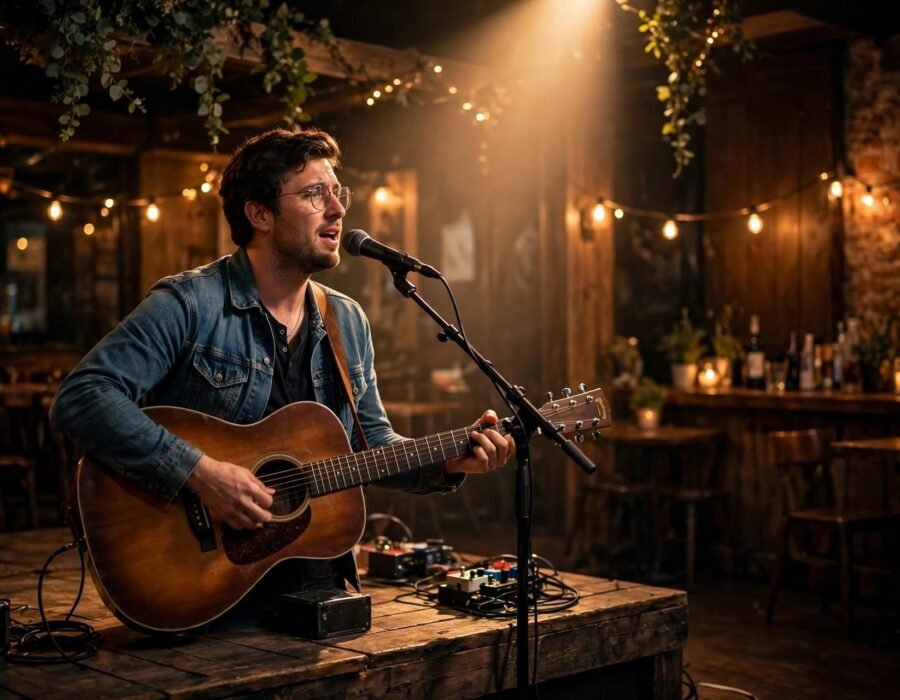
Technical basics: learn to use a microphone (close for quiet parts, pull back when loud — the sound person will love you), bring your own essentials (picks, capo, tuner, spare strings), and keep stage banter brief — a sentence or two between songs, not a monologue. If something goes wrong (broken string, forgotten lyric), smile and keep going; the audience forgets mistakes instantly but remembers grace under pressure forever. The Recording Academy’s artist resources include performance advice from professionals who all started exactly where you are. And when you are ready for bigger rooms, enjoying a music festival on a budget is the natural next step in live music immersion.
From Open Mic to Paid Gigs: The Path
Open mics are the bottom rung of a real ladder. Regulars who develop get invited to feature slots (longer sets), then to open for touring acts at local venues, then to paid local gigs. The progression is meritocratic in the best way: audiences and hosts promote what works. Along the way, you will build the two assets that matter more than talent — a local network of musicians and a reputation for reliability. Show up consistently, be easy to work with, keep improving, and the scene will carry you upward. Every working musician in your city started exactly where you are standing, holding a sign-up sheet with shaky hands.
The Bottom Line
Find open mics through local listings, social media, and musician networks; visit first as an audience member; then show up early, play your time exactly, stay and listen, and support the venue. The open mic is the most democratic stage in music — all it asks is respect for the format and courage for three songs. Your bedroom practice got you here. The stage is waiting.
Frequently Asked Questions
Do I have to pay to play at an open mic?
Usually not — most are free to performers, though venues expect you to buy food or drinks. Some have a small cover for the audience. Be wary of “pay-to-play” schemes disguised as open mics; legitimate nights do not charge performers.
How many songs do you get at an open mic?
Typically 2–3 songs or 10–15 minutes, depending on turnout. When many performers sign up, sets shrink. Never run over your slot — it is the fastest way to irritate hosts and fellow musicians.
Can beginners play at open mics?
Absolutely — that is what they are for. Open mics welcome all levels, and audiences are famously supportive of nervous first-timers. Play within your ability, keep it short, and you will be met with encouragement, not judgment.
Should I play covers or originals?
Both work. Covers connect instantly with audiences; originals are the point of most songwriter-oriented nights. A mix is often ideal — open with a familiar cover to win the room, then play your original. Read the specific night’s culture first.
What if I mess up on stage?
Smile and keep going — the audience forgets mistakes instantly but remembers grace under pressure. Every performer messes up; the professionals just recover smoothly. Acknowledge it lightly if needed, then move on. Nobody came to judge you; they came to enjoy live music. And one day, you will be the veteran welcoming the next nervous first-timer. Pay it forward.