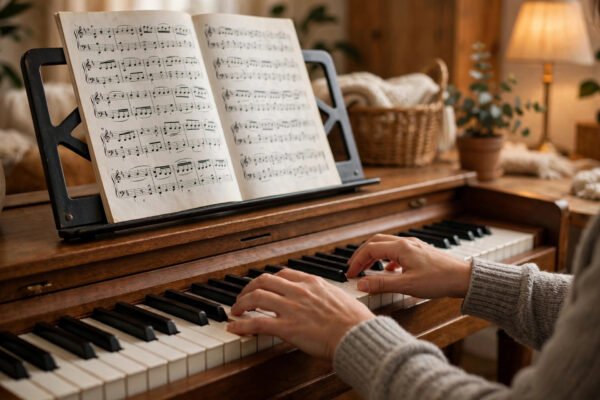
Those five lines with dots on them look like an alien transmission. Everyone says “just learn to read music” as if it’s obvious, but for a beginner in Arizona staring at their first piece of sheet music, it’s anything but. Here’s the encouraging reality: reading sheet music is simpler than reading this sentence. It’s a system with about a dozen core concepts, and most beginners can read basic melodies within two weeks. This guide gives you the safest, fastest way to learn to read sheet music quickly — without the boring theory-first approach that makes most people quit.
You’ll learn the absolute minimum to start reading today, a two-week rapid-learning plan, the mnemonics that actually stick, how to connect reading to playing (or singing), and the shortcuts for specific instruments.
The Minimum Viable Music Reading (Learn This Today)
Sheet music has three pieces of information: which note (pitch — shown by vertical position), how long (rhythm — shown by note shape), and how loud/expressive (dynamics — shown by symbols). Beginners should learn pitch first, rhythm second, dynamics later. Trying to learn all three simultaneously is why most people bounce off.
Pitch in 5 minutes: The five lines of the staff (treble clef — the swirly symbol) represent E-G-B-D-F from bottom to top (“Every Good Boy Deserves Fudge”). The four spaces between them are F-A-C-E (“FACE” — it spells a word). Notes go up the staff alphabetically: A-B-C-D-E-F-G, then repeat. Middle C sits on a small extra line below the staff. That’s it — you can now identify any treble-clef note by counting from a landmark. Bass clef (for left hand/low instruments) uses G-B-D-F-A on lines (“Good Boys Deserve Fudge Always”) and A-C-E-G in spaces (“All Cows Eat Grass”).
Rhythm in 5 minutes: A whole note (open oval) = 4 beats. Half note (open oval + stem) = 2 beats. Quarter note (filled oval + stem) = 1 beat. Eighth notes (filled + stem + flag) = half a beat each. The shapes are just fractions — filled notes are shorter than open ones, flags/beams make them shorter still. Clap quarter notes while counting “1-2-3-4” and you’ve got the foundation.
Seriously — that’s the core. Everything else is elaboration. If this clicked, you already read music at a basic level. For training your ear alongside your eyes, active music listening builds the audiation skills that make reading musical instead of mechanical.
The Two-Week Rapid Plan
Days 1–3: Landmark notes. Don’t memorize all 88 keys — memorize landmarks and count from them. Treble clef: G (second line — the clef curls around it), middle C (below staff), F (first space). Everything else is “two notes above G” etc. Drill with a free app (Tenuto, Note Trainer) 10 minutes daily. Speed comes from landmark fluency, not total memorization.
Days 4–7: Add rhythm. Clap and count simple rhythms. Start with quarter and half notes in 4/4 time, then add eighths. Use a metronome app at 60 BPM — slow enough to think. The goal is automaticity: seeing a quarter note and feeling “one beat” without translating.
Days 8–10: Combine on your instrument. Play (or sing) the simplest melodies from a beginner book while reading — “Ode to Joy,” “Twinkle Twinkle,” folk songs. Go painfully slow. The magic moment is when your eyes read ahead of your fingers — that’s real reading, and it starts happening within days of combined practice.
Days 11–14: Expand range and speed. Add ledger lines (notes above/below the staff — just keep counting alphabetically), key signatures (the sharps/flats at the start that apply to the whole piece — learn the common ones: G major has F#, F major has Bb), and simple dynamics (p = soft, f = loud, crescendo = growing).
Twenty minutes daily beats weekend marathons — reading is pattern recognition, and patterns need sleep to consolidate. Two focused weeks gets most beginners to “slow but real” reading of simple pieces.
Mnemonics and Tricks That Actually Stick
The classic mnemonics work because they’re silly — embrace them. Beyond EGBDF/FACE: for intervals (distance between notes), learn the sound of common ones through songs — “Here Comes the Bride” is a perfect fourth, “Star Wars” theme opens with a perfect fifth, “Somewhere Over the Rainbow” starts with an octave. Associating intervals with familiar melodies makes them instantly recognizable.
The “say and play” method: Say note names aloud as you play them. It feels childish; it builds the note-to-key mapping twice as fast as silent practice. Flashcard apps (Anki with a music deck, or dedicated apps) exploit spaced repetition — and musictheory.net’s free lessons drill these concepts interactively — 5 minutes daily outperforms 30 minutes weekly. Write it: Copy simple melodies by hand onto blank staff paper. The physical act of drawing notes cements recognition in a way that reading alone doesn’t.
Chunk, don’t spell: Advanced readers don’t identify individual notes — they recognize patterns (scales, chords, arpeggios) the way you recognize words, not letters. From week two, practice spotting these shapes: “that’s a C major scale fragment,” “that’s an ascending triad.” Pattern recognition is the entire difference between slow and fluent reading. If you’re starting an instrument alongside reading, learning a musical instrument as an adult covers the broader journey.
Connecting Reading to Your Instrument
Piano: Easiest mapping — the staff visually mirrors the keyboard (up = right). Start with right hand alone, add left hand after a week. Middle C is your anchor landmark.
Guitar: Trickier — the same pitch exists in multiple places. Learn one position thoroughly (open position first), reading simple melodies there before expanding. Tablature is a useful supplement but a poor substitute; standard notation teaches you music, tab teaches you finger positions.
Voice: Singers read intervals and rhythm more than absolute pitches — solfège (do-re-mi) is the singer’s superpower for this. Learn the major scale in solfège and you can sight-sing most melodies.
Band/orchestral instruments: You likely need only one clef — master it deeply rather than dabbling in both. Transposing instruments (trumpet, clarinet, sax) read written pitches that sound different — learn your instrument’s transposition early to avoid confusion.
Whatever your instrument, the Recording Academy’s education resources include musician interviews discussing how reading skills shaped their careers — useful motivation when practice feels tedious.
Frequently Asked Questions
How long does it take to read sheet music fluently?
Basic reading (simple melodies, slowly): 2–4 weeks. Comfortable reading (hymns, easy pieces at tempo): 3–6 months. True sight-reading fluency (playing unfamiliar music at sight): 1–2 years of regular practice. Most hobbyists only need the first two levels.
Do I need to learn bass clef too?
Only if your instrument uses it (piano left hand, bass instruments, trombone, etc.). Treble-clef instruments (violin, flute, trumpet, voice, guitar) can focus on treble. Don’t split your effort unnecessarily.
Is reading music necessary to be a good musician?
No — many brilliant musicians play by ear. But reading unlocks: learning songs 10x faster, communicating with other musicians precisely, accessing centuries of written music, and session/studio work. It’s a multiplier, not a requirement.
What’s the best app for learning to read music?
Tenuto (iOS) and Music Tutor (Android) for note drills; Perfect Ear for rhythm and intervals; Simply Piano or Flowkey if you want guided instrument learning. Any of them work — consistency matters more than the app.
The Bottom Line
Reading sheet music quickly comes down to: learn pitch landmarks first (EGBDF, FACE — count from landmarks, don’t memorize everything), add rhythm second (shapes are just fractions of beats), combine them on your instrument within the first week, drill 20 minutes daily with apps and flashcards, and think in patterns rather than individual notes. It’s a two-week project to become functional, not a multi-year ordeal. The dots on lines are just an alphabet — and you already learned one of those.