
You know the feeling. The deadline is close, the task is sitting right there on your list, and yet you find yourself scrolling your phone, reorganizing your desk, or suddenly deciding it’s the perfect time to clean the kitchen. If this sounds familiar, you’re not lazy — you’re procrastinating, and it’s one of the most common struggles people deal with today.
In this guide, we’ll break down what procrastination actually is, why it happens, and — most importantly — practical, research-backed ways to stop procrastinating for good.
What Is Procrastination?

The simplest definition of procrastination is this: it’s the act of delaying or postponing a task despite knowing that the delay will likely make things worse for you. It’s not just “putting something off” — it’s putting something off even though you know it’s a bad idea.
That last part is what separates procrastination from ordinary time management. Choosing to do task B before task A because it’s genuinely more urgent isn’t procrastination. Avoiding task A because it makes you anxious, bored, or unsure of yourself — and doing task B instead just to escape that feeling — is.
Why Do I Procrastinate So Much?
If you’ve ever asked yourself, “why do I procrastinate so much?“, the answer usually isn’t about willpower. Psychologists who study this behavior generally agree that procrastination is an emotional regulation problem, not a time management problem. In other words, you’re not procrastinating because you can’t manage your calendar — you’re procrastinating because the task triggers an uncomfortable feeling and your brain wants an escape from that feeling right now.
Here are the most common root causes:
1. Fear of failure (or even fear of success) When a task feels tied to your self-worth, avoiding it can feel safer than trying and falling short.
2. Perfectionism If “good enough” doesn’t feel good enough, starting can feel overwhelming, so you don’t start at all.
3. Task feels too big or unclear Vague, massive tasks (“write the report,” “fix my finances”) don’t give your brain a clear entry point, so it looks for an easier win elsewhere.
4. Low immediate reward Our brains are wired to prioritize what feels good right now. A task with a payoff weeks away will always lose to a text message with a payoff in seconds — unless you change the equation.
5. Poor mood regulation Some studies suggest procrastination is essentially a short-term mood repair strategy: you feel bad about the task, so you do something else to feel better, even though it costs you later.
How to Stop Procrastinating: Practical Strategies That Actually Work
Knowing why you procrastinate is only half the battle. Here’s how to overcome procrastination using methods that are simple enough to start today.
1. Break the Task Into Tiny Steps
Big projects feel heavy because your brain can’t see a clear starting point. Instead of “write the report,” try “open a blank document and write one sentence.” Small, specific steps lower the mental barrier to starting.
2. Use the 5-Minute Rule
Tell yourself you’ll work on the task for just five minutes. That’s it. Most of the time, once you start, momentum carries you past the five-minute mark — because starting, not finishing, is usually the hardest part.
3. Try the Pomodoro Technique
Work in focused 25-minute sprints followed by a 5-minute break. This structure makes tasks feel more manageable and gives your brain regular, guaranteed rest — which reduces the urge to escape early.
4. Make the Task’s Reward More Immediate
Pair something you enjoy with the task you’re avoiding — listen to a favorite playlist only while doing that task, or treat yourself to something small right after a work block. This technique, sometimes called “temptation bundling,” works with your brain’s craving for instant reward instead of fighting it.
5. Remove Distractions Before You Start
Put your phone in another room. Close unnecessary browser tabs. Use a website blocker during work sessions. Willpower is limited — a distraction-free environment does a lot of the work for you.
6. Set Deadlines, Even Artificial Ones
Tasks without deadlines are easy to postpone indefinitely. Give yourself a specific date and time, and if possible, tell someone else about it so you have accountability.
7. Be Honest About the Real Reason
Ask yourself: am I avoiding this because it’s boring, because I’m afraid of doing it badly, or because I genuinely don’t know where to start? Naming the real reason often makes it easier to address directly instead of just fighting the symptom.
8. Forgive Yourself for Past Procrastination
This one surprises people, but research shows that self-forgiveness after procrastinating actually reduces the odds of procrastinating again on the same task. Guilt and shame tend to fuel more avoidance, not less.
Time Management Techniques for Procrastination
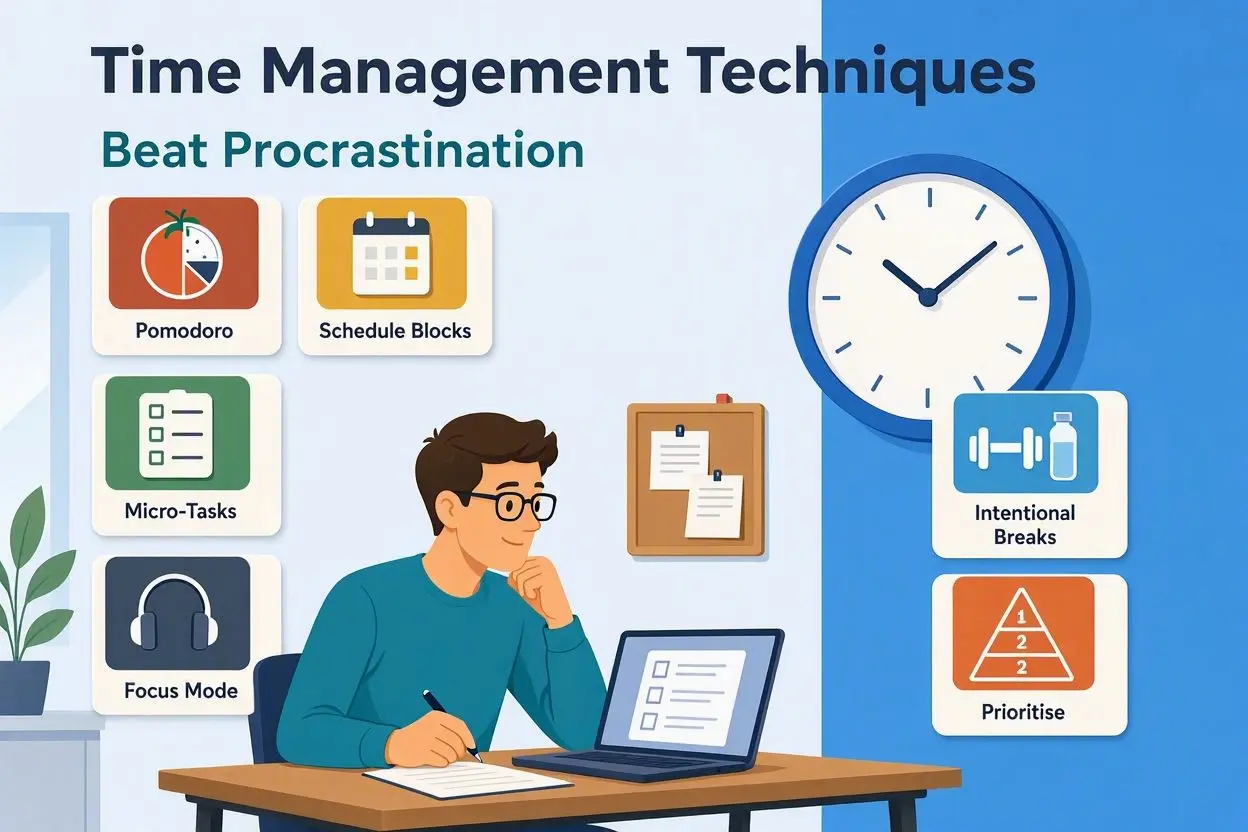
If procrastination shows up mainly around scheduling and workload rather than fear or perfectionism, these time-management-focused techniques can help:
- Time blocking – Assign every task a specific slot in your day instead of a vague “sometime today.”
- Eat the frog – Do your hardest or most-avoided task first thing, before your willpower is depleted.
- The two-minute rule – If something takes less than two minutes, do it immediately instead of adding it to a list.
- Weekly planning sessions – Spend 15 minutes each week mapping out priorities so daily decisions require less mental effort.
How to Get Out of the Habit of Procrastination for Good
Stopping procrastination once is easy. Staying consistent is the real challenge. To break the habit rather than just win one battle:
- Track your patterns. Notice which tasks and times of day trigger procrastination most.
- Redesign your environment. Make starting the easy option and distraction the hard option.
- Celebrate small wins. Positive reinforcement rewires the habit loop faster than criticism does.
- Be patient. Habit change typically takes weeks of consistent practice, not a single motivated afternoon.
Final Thoughts
Procrastination isn’t a character flaw — it’s a predictable response to fear, overwhelm, or an unclear starting point. The good news is that once you understand what’s actually driving the avoidance, you can use small, practical tools — breaking tasks down, working in short bursts, removing distractions, and being kind to yourself along the way — to build lasting momentum.
You don’t need to overhaul your entire life today. Pick one strategy from this list, apply it to the task you’re avoiding right now, and start with just five minutes.

Be First to Comment