“Why should I care about guinea pig care?” is a question that sounds dismissive but is actually worth answering seriously — because guinea pigs occupy a strange blind spot in American pet culture. They’re sold as disposable starter pets for children, priced like toys, and housed in cages barely bigger than shoeboxes. Yet they’re intelligent, social, vocal animals that live 5–7 years and have welfare needs most owners never learn about. The gap between how guinea pigs are typically kept and how they should be kept is one of the widest in pet ownership.
Here’s why their care deserves your attention — and what good care actually looks like.
Guinea Pigs Are Not Low-Maintenance (Despite the Marketing)
The pet-store narrative — cheap, easy, perfect for kids — is the root of most guinea pig suffering. The reality:
- They’re herd animals. In the wild, guinea pigs live in groups of 5–10. A solitary guinea pig is a lonely guinea pig — isolation causes depression, lethargy, and behavioral problems. They should be kept in same-sex pairs or small groups at minimum. (Males can fight; neutered male/female pairs or female pairs work best.)
- They live 5–7 years, sometimes 8+. That’s a real commitment — longer than many dogs’ puppyhood-to-adulthood arc. “Starter pet” implies disposability; the lifespan says otherwise.
- They’re prey animals that hide illness. Like all prey species, guinea pigs mask sickness until they’re critically ill. Owners must learn subtle signs: reduced hay intake, sitting hunched, crusty eyes, weight loss. A kitchen scale and weekly weigh-ins catch problems weeks before visible symptoms.
- They need exotic vets. Not all vets treat guinea pigs, and emergency exotic care is expensive and hard to find. Before adopting, locate your nearest exotics vet — this is non-negotiable.
The Cage Lie (and What They Actually Need)
This is where you should care most. The cages sold as “guinea pig cages” in US pet stores — typically 30″ x 18″ or similar — are widely condemned by welfare organizations. The Humane Society recommends a minimum of 7.5 square feet for one guinea pig and 10.5+ for two, with bigger always better. The popular C&C (cubes and coroplast) DIY cages that dominate the guinea pig community exist precisely because commercial cages are inadequate.
Why space matters so much: guinea pigs don’t climb or use vertical space — every square inch must be floor. In cramped cages they can’t popcorn (the joyful leaping that signals happiness), can’t establish separate sleeping/eating/bathroom zones, and develop obesity and bumblefoot (painful foot infections) from inactivity on poor bedding.
Bedding: fleece liners (with absorbent layers underneath) have largely replaced wood shavings in the knowledgeable community — cheaper long-term, dust-free, and better for respiratory health. If using shavings, never cedar or pine (aromatic oils damage their respiratory systems); aspen is the safe wood option. Paper-based bedding works too.
Diet: Hay Is Everything
The single most important care fact: unlimited grass hay (timothy, orchard, or meadow) must be available 24/7. Hay isn’t a snack — it’s 80% of the diet. It wears down their continuously growing teeth (dental disease from hay deficiency is a leading killer) and keeps the gut moving (GI stasis can be fatal within hours).
Beyond hay: a daily cup of fresh vegetables per pig (bell peppers, romaine, cilantro — bell peppers are the vitamin C champions), a small amount of plain timothy-based pellets (not the colorful “gourmet” mixes full of seeds and dyed bits), and fresh water. And vitamin C specifically: guinea pigs, like humans, can’t synthesize it. Without adequate dietary vitamin C, they develop scurvy — lethargy, swollen joints, rough coat. This is unique among common pets and the most overlooked nutritional need.
Foods to avoid: iceberg lettuce (no nutrition, causes diarrhea), potatoes, onions, garlic, chocolate, dairy, seeds/nuts (choking and fat), and anything sugary. The Humane Society’s guinea pig care guide has the most reliable US-facing diet reference.
The Sounds: Learning Their Language
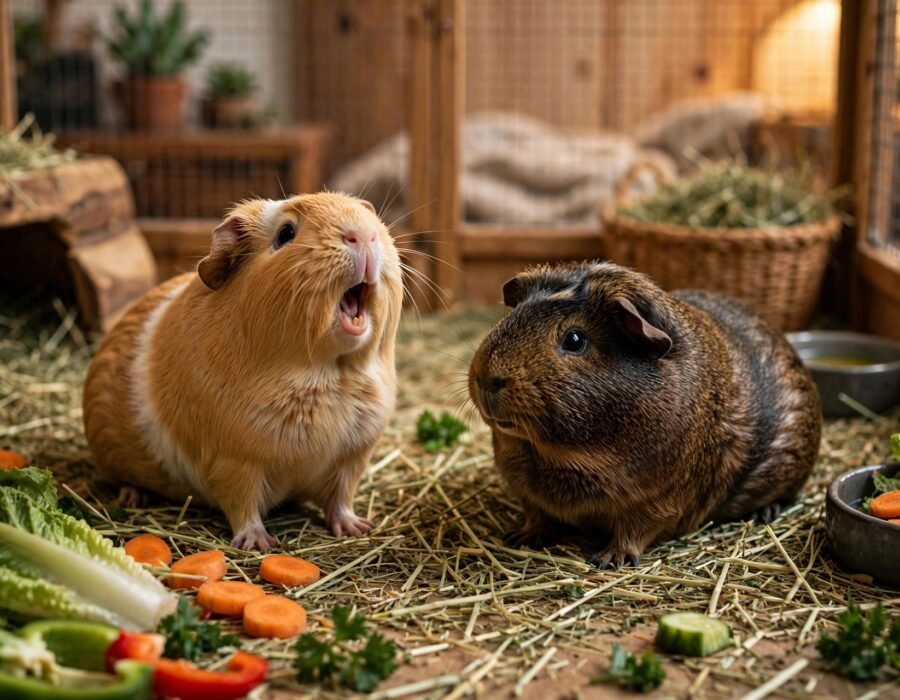
Here’s the reward for caring: guinea pigs are among the most communicative small pets. Wheeking (the loud whistle when they hear a bag rustle), purring (contentment — or annoyance, depending on pitch and body language), rumbling (dominance), chutting (exploration), and teeth-chattering (back off). Owners who learn the vocabulary get something genuinely interactive — a pet that greets them vocally every day. Children who are taught to listen rather than just cuddle get a far richer experience.
Why This Matters Beyond Your Living Room
Guinea pigs are among the most surrendered small pets in the US, precisely because the “easy starter pet” myth collides with the reality of their needs. Shelters and rescues are full of them. Caring about guinea pig care — really caring — means: adopting rather than buying from pet stores (which source from rodent mills), keeping them in pairs, housing them properly, and teaching kids that small doesn’t mean simple.
The financial reality is modest but real: expect $500–$800/year for a pair (hay, veggies, bedding, vet fund). Exotic vet emergencies can run $300–$1,000+. It’s not a $30 pet; it’s a $30 adoption fee on a multi-year commitment.
Conclusion
You should care about guinea pig care because these are 5-to-7-year commitments from intelligent, social animals — not disposable starter pets. The care that matters most is unglamorous: a big enough cage, unlimited hay, vitamin C, a companion, and an exotics vet on speed dial. Get those right and you’re rewarded with one of the most charming, vocal, personality-packed pets available. Get them wrong and you have a suffering animal in a too-small box. When bringing any new animal home, introducing a new pet properly applies to small pets too — and pet-friendly flooring makes floor-time play sessions (which guinea pigs need daily) practical and mess-manageable.
Frequently Asked Questions
Can guinea pigs live alone?
They shouldn’t. Guinea pigs are herd animals and suffer in isolation — lethargy and depression are common in solitary pigs. Keep same-sex pairs or small groups (females, or neutered male/female pairs).
How big should a guinea pig cage be?
Minimum 7.5 sq ft for one and 10.5+ sq ft for two, per Humane Society guidance — and bigger is always better. Most commercial “guinea pig cages” fall short; C&C-style DIY cages are the community standard.
What do guinea pigs eat?
Unlimited grass hay (80% of diet), a daily cup of fresh vegetables per pig (bell peppers for vitamin C), a small amount of plain timothy pellets, and fresh water. They cannot synthesize vitamin C — deficiency causes scurvy.
How long do guinea pigs live?
5–7 years on average, occasionally 8+. This is a genuine multi-year commitment, not a short-term children’s project.
Are guinea pigs good pets for kids?
They can be, with adult supervision and realistic expectations. They’re fragile (improper handling injures them), hide illness, and need daily care adults must oversee. The “starter pet” label undersells the commitment significantly.
Do guinea pigs need baths?
Rarely. Guinea pigs are self-cleaning, and frequent bathing strips their skin oils and stresses them. Bathe only when genuinely dirty (2–3 times a year max) using a small-animal or kitten shampoo — never human shampoo — in a few inches of lukewarm water. Long-haired breeds (Peruvians, Silkies) need regular brushing to prevent matting, which matters more than bathing.
Sources: The Humane Society on guinea pig care and Guinea Lynx medical reference.