“Smart contracts” is one of those phrases that sounds like it requires a law degree and a computer science PhD to understand. It doesn’t. At its core, a smart contract is just an agreement that enforces itself — no lawyers, no escrow agents, no trust required. If you can understand a vending machine, you can understand a smart contract. Here’s the plain-English version, built for Americans who want to actually use this stuff, not just nod along at dinner parties.
The Vending Machine: Your Mental Model
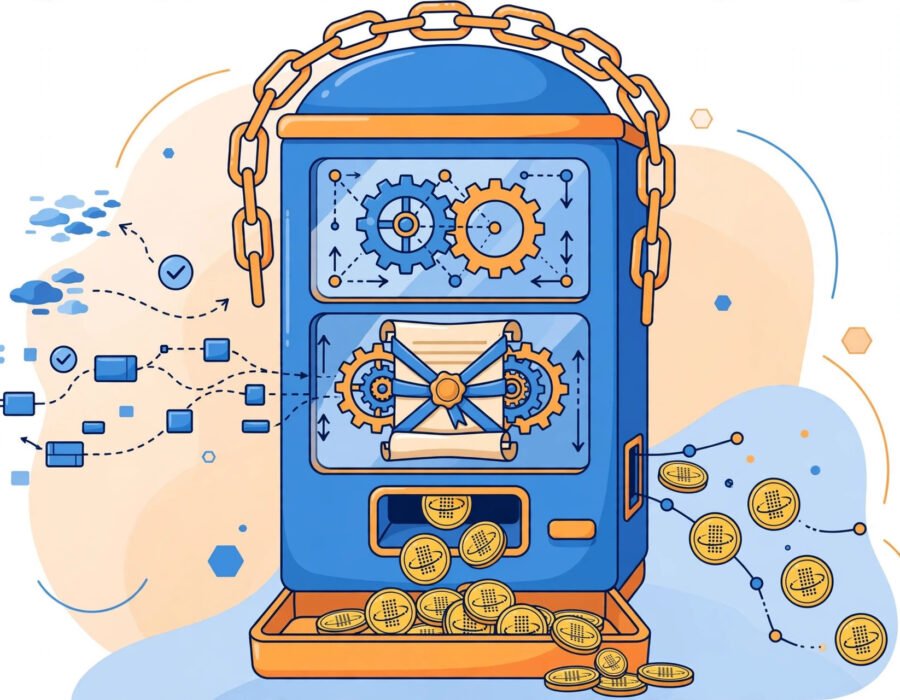
A vending machine is the perfect smart contract. You put in $2 and press B4; the machine automatically drops your chips. No cashier to trust, no negotiation, no chance the vendor takes your money and walks away. The terms are posted on the front, the execution is mechanical, and both sides get exactly what the rules say.
A smart contract is that vending machine, running on a blockchain instead of a street corner. It’s code that says “IF this happens, THEN do that” — and once deployed, it executes automatically whenever the conditions are met. Lend crypto on a DeFi platform? A smart contract holds the collateral, pays the interest, and liquidates if needed — all without a bank employee touching anything. Buy an NFT? A smart contract transfers ownership and routes the artist’s royalty the instant payment arrives. The “smart” part isn’t intelligence; it’s automation that nobody can stop or alter mid-deal.
What Makes Them Different From Regular Agreements
Three properties separate smart contracts from every contract you’ve signed. Self-executing: performance is automatic, not promised. A traditional contract says what should happen and relies on courts if it doesn’t; a smart contract makes it happen. Immutable: once deployed on the blockchain, the code generally can’t be changed — the rules you see are the rules forever, which is reassuring and terrifying in equal measure. Transparent: anyone can read the code and verify exactly what it does, unlike the fine print nobody reads.
The tradeoff is rigidity. A human judge can consider circumstances; a smart contract cannot. If the code has a bug, the bug executes perfectly — which is why smart-contract hacks are so devastating. The machine does exactly what it was told, including the parts the developer got wrong.
Where Americans Actually Encounter Smart Contracts
You’ve probably touched smart contracts without knowing it. Every DeFi transaction — swapping tokens, earning yield, borrowing — runs on them. Every NFT mint and sale is one. Blockchain games, prediction markets, decentralized insurance, and even some supply-chain tracking systems use them. If you’ve ever approved a token spend in a crypto wallet, you’ve interacted with a smart contract’s permission system.
Beyond crypto, U.S. companies are piloting smart contracts for real-estate closings (funds release automatically when the title clears), royalty distributions in music, and parametric insurance — policies that pay out automatically when verifiable conditions occur, like a flight delay or a hurricane’s measured wind speed. The pattern is always the same: replace trusted middlemen with verifiable code.
The Risks in Plain English
Smart contracts fail in ways regular contracts don’t. Bugs are law: the 2016 DAO hack stole $60 million because of a code flaw — the contract executed the theft “correctly.” Upgrades are trust: many contracts include admin keys letting developers change the code, which reintroduces the human trust the technology was supposed to remove — always check who holds the keys. Oracles are weak points: contracts needing real-world data (prices, weather, scores) depend on “oracle” feeds, and manipulated feeds mean manipulated outcomes.
For users, the practical risks are approving malicious contracts (a fake site asking your wallet to “connect” can drain funds), interacting with unaudited code, and misunderstanding what a contract actually does. Never approve a transaction you don’t understand — modern wallets now simulate transactions in plain English before you sign, and reading that simulation is the single best self-defense habit. If the mechanics of AI versus automation confuse you too, our explainer on AI versus machine learning in simple terms clears up the related buzzwords.
Smart Contracts and U.S. Law
Here’s the genuinely murky part: the legal status of smart contracts in America is still evolving. Most states treat them under existing contract law — Arizona was actually an early pioneer, passing legislation in 2017 recognizing blockchain signatures and smart contracts. But enforcement across state lines, liability for buggy code, and whether specific DeFi contracts constitute unregistered securities are active legal battlegrounds.
The SEC has argued that many DeFi arrangements are securities offerings regardless of their automated nature — code doesn’t exempt you from law, a position detailed at the SEC’s official site. For ordinary users, the takeaway is simpler: a smart contract’s automation doesn’t make its purpose legal or safe. A fraudulent scheme executed by code is still fraud. Investor.gov remains the best starting point for understanding how these innovations intersect with investor protection.
Using Smart Contracts Safely: The Checklist
Before interacting with any smart contract: verify you’re on the legitimate site (bookmark it; never follow links) — phishing is the top attack vector, so knowing how to spot scam links is essential. Check the protocol’s track record — years of operation and billions in value locked beat a flashy new launch. Read the wallet’s transaction simulation before signing. Limit token approvals to what the transaction needs, and revoke old approvals periodically. Start with small amounts on any new protocol. And set up two-factor authentication on your accounts — the wallet and exchange around your contract interactions need the same protection as the contracts themselves.
Conclusion
Smart contracts are vending machines for agreements: put in the conditions, get out the guaranteed result, with no middleman to trust or pay. They’re already running billions in DeFi, NFTs, and emerging real-world uses from insurance to real estate — and Arizona helped pioneer their legal recognition in the U.S. But automation cuts both ways: code that can’t be stopped also can’t be reasoned with, so bugs execute as faithfully as features. Understand what you’re signing, verify where you’re signing it, start small, and let the machine’s transparency work for you — read the code’s behavior through your wallet’s simulation before you commit. The future isn’t contracts that need lawyers to enforce. It’s contracts that never needed them.
Frequently Asked Questions
Do smart contracts need lawyers?
They don’t need lawyers to execute — that’s the point. But the humans deploying them still face legal liability, and complex arrangements still benefit from legal review of what the code is supposed to do.
Can a smart contract be changed after deployment?
Truly immutable ones cannot — that’s a feature. Many include upgrade mechanisms controlled by developers, which adds flexibility but reintroduces trust. Always check which kind you’re dealing with.
Are smart contracts legally binding in the US?
Generally yes, under existing contract law — several states including Arizona have explicit legislation. But cross-jurisdiction enforcement and the regulatory status of specific DeFi contracts remain evolving areas.
What happens if a smart contract has a bug?
The bug executes exactly as written, which is why hacks are so severe — there’s no customer service to reverse it. This is why audits, track records, and starting with small amounts matter so much. The Consumer Financial Protection Bureau’s Ask CFPB library explains consumer recourse concepts that highlight how different this world is.