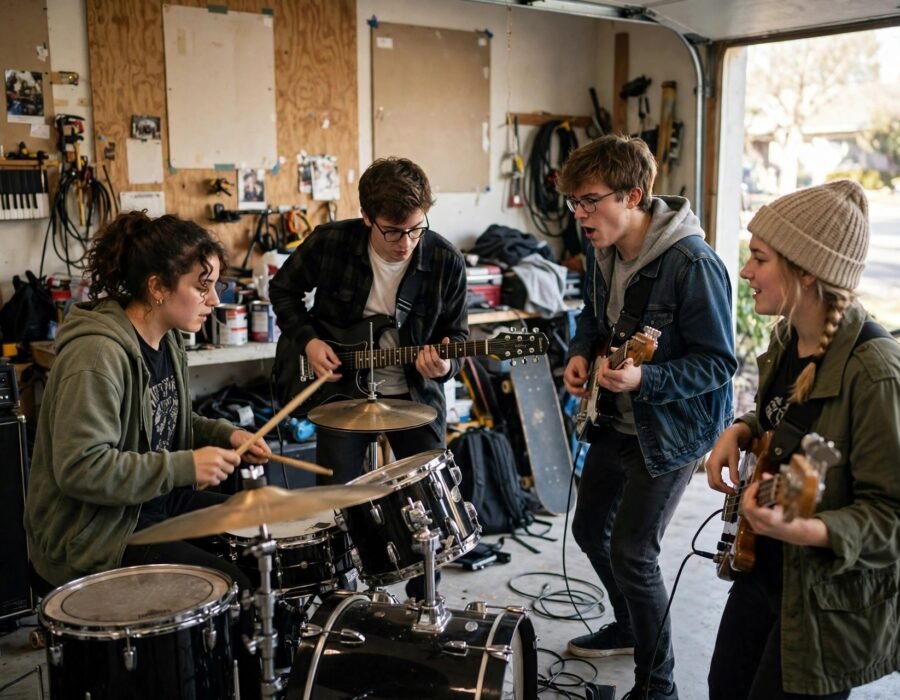
You and your friends can each kind of play an instrument. Someone suggests starting a band. It sounds amazing — until the third rehearsal, when nobody learned the songs, the drummer cannot keep time, and two members are not speaking. Most bands die in the first month, and the causes are almost always the same handful of beginner mistakes. If you are wondering what do most people get wrong when they start a band with no experience in Colorado — or anywhere — this guide is the manual you wish someone had handed you at rehearsal one.
The core truth: a beginner band is a small group project with instruments, and it fails for the same reasons group projects fail — unclear expectations, unequal effort, no structure, and avoided conversations. The music is the easy part. The band is the hard part.
Mistake 1: No Clear Agreement on Goals
The most fatal mistake is assuming everyone wants the same thing. One member dreams of touring; another wants a fun weekend hobby; a third is building a portfolio for music school. None of these are wrong, but they are incompatible — and the incompatibility surfaces as resentment when the “touring” member pushes for nightly rehearsals the “hobby” member never signed up for. Have the explicit conversation before the first rehearsal: what is this band for? How serious? What is the time commitment? What does success look like?
Write it down — not a legal contract, but a shared note everyone agrees to. Revisit it quarterly, because goals evolve. Bands that skip this conversation do not avoid conflict; they schedule it for later, with interest. The Small Business Administration’s guidance on partnerships applies surprisingly well — a band is a partnership, and partnerships need aligned expectations. And when you are ready to protect original songs, the U.S. Copyright Office explains how songwriting copyrights actually work.
Mistake 2: Rehearsing Without Structure
Beginner rehearsals go like this: arrive late, noodle for 30 minutes, attempt a song, argue about the arrangement, noodle more, leave having accomplished nothing. Productive rehearsals need structure: a set list decided in advance, individual practice expected before rehearsal (rehearsal is for playing together, not learning your parts), a timekeeper, and a rule against noodling between songs. Two focused hours beat four chaotic ones.
Record every rehearsal — phone on a stand, nothing fancy. Listening back reveals what the room hides: rushing tempos, muddy arrangements, the fact that nobody can hear the vocals. Assign homework: specific songs, specific sections, specific deadlines. The bands that improve fastest treat rehearsal like practice with a purpose, not a hangout with instruments. And finding local live music events near you gives you a target — book a low-stakes gig early, because deadlines focus rehearsals like nothing else.
Mistake 3: Ignoring the Business From Day One
Money ruins bands faster than creative differences. Decide early: how are expenses split (rehearsal space, recordings, merch)? How is income split? Who owns the band name? What happens when someone leaves — do they take their songs? These conversations feel mercenary for a fun project, but they are precisely what prevents the blowup later. Equal splits are simplest and fairest for beginners; revisit if contributions become wildly unequal. The bands that survive are the ones that treated the business as seriously as the music, from the start.
Mistake 4: Playing Shows Before You’re Ready (or Never Playing)
Two opposite errors: gigging after three rehearsals (embarrassing, demoralizing) and rehearsing for a year without gigging (the band becomes a social club that slowly dissolves). The sweet spot: play your first low-stakes show — a friend’s party, an open mic as a band — once you can get through 30 minutes without train wrecks. Live performance teaches what rehearsal cannot: stage presence, set flow, reading a room, recovering from mistakes.
And promote honestly: do not bill yourselves as experienced when you are not. Local scenes are small and memories are long — a reputation for overpromising follows you. Underpromise, overdeliver, and let the reputation build itself. Enjoying a music festival on a budget is also field research — watch how working bands handle sets, crowds, and between-song dead air, then steal everything.
The Rehearsal Recording Habit
Record every rehearsal — phone on a stand, nothing fancy. Listening back reveals what the room hides: rushing tempos, muddy arrangements, vocals buried under guitars. Make it a ritual: spend the first ten minutes of each rehearsal listening to key moments from the last one. Bands that record themselves improve visibly faster than bands that rely on room memory, because the recording does not flatter. It is the cheapest coach you will ever hire, and it never misses a rehearsal.
Mistake 5: No Online Presence
In 2026, a band with no recordings online effectively does not exist to bookers, fans, or future members. You do not need a studio album — phone recordings of rehearsals, a simple video of a live set, a social media page with your name spelled consistently. Bookers google you before replying; give them something to find. The barrier is so low that its absence reads as not-serious. Document from day one: the early recordings become treasured artifacts if the band succeeds, and useful diagnostics regardless.
The Bottom Line
Starting a band with no experience works when you: align on goals explicitly, rehearse with structure, handle money and ownership early, and gig at the right time — not too early, not never. The music will come with practice. The band survives on communication, and communication is a skill you can start building at rehearsal one. Most bands do not fail from lack of talent. They fail from lack of honesty. Be the band that talks.
Frequently Asked Questions
How good do we need to be to start a band?
Good enough to play simple songs together in time — which is a lower bar than you think. Punk rock was built on three chords. Start simple, improve together, and let ambition grow with ability. Waiting until everyone is “good enough” means never starting.
How often should a beginner band rehearse?
Once a week for 2–3 focused hours is the sustainable sweet spot. More burns out busy adults; less stalls progress. Consistency beats intensity — weekly rehearsals compound, sporadic marathons do not.
Who owns the songs if a member leaves?
By default, songwriting copyright belongs to whoever wrote the song — which gets murky fast in collaborative bands. Decide this explicitly early: many bands agree that songs written collaboratively belong to the band. When in doubt, document contributions and consider a simple written agreement.
How do we get our first gig?
Start with low-stakes rooms: open mics (as a band), friends’ parties, community events. Record a simple demo — phone recordings are fine — and approach local venues’ bookers with specifics: who you are, what you play, what you draw. Local scenes run on relationships; show up, be easy to work with, deliver.
Should we record before we’re “ready”?
Yes — early recordings are diagnostics, not products. They reveal timing issues, arrangement problems, and mix imbalances you cannot hear in the room. Record everything from day one; the embarrassment fades, but the improvement compounds. Future you will treasure the artifacts.