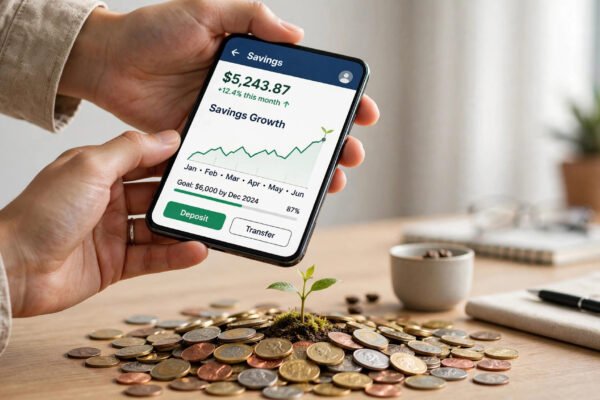
You’re paying $1,800 a month in rent in Dallas, watching home prices climb, and wondering if every rent check is money thrown away — while also knowing you can’t afford a down payment yet. The question of when to start saving for a house deposit while renting in Texas has a sharper edge here than in most states: Texas has no state income tax (more take-home pay to save), but property taxes are among the nation’s highest (which changes the affordability math), and the market moves fast. This guide gives Texas renters a clear timeline and strategy.
You’ll learn how much you actually need (it’s less than you think), when to start saving based on your timeline, where to keep the money, how Texas-specific factors change the math, and how to accelerate the savings without miserable frugality.
How Much Do You Actually Need?
The myth: you need 20% down. The reality: the median US down payment for first-time buyers is around 6–7%, and Texas first-time buyers routinely purchase with 3–5% down through conventional, FHA (3.5%), and Texas-specific programs. On a $300,000 Texas home, 5% down is $15,000 — not the $60,000 the 20% myth demands.
But down payment isn’t the total. Budget: down payment + closing costs (2–5% of price in Texas — roughly $6,000–$15,000 on $300,000) + moving and immediate setup ($2,000–$5,000) + emergency reserve (3–6 months of the new housing payment — non-negotiable; buying with zero reserves is how foreclosures start). Realistic total cash needed for that $300,000 home: $25,000–$40,000. That’s the true target — not just the down payment.
Texas programs that help: the Texas State Affordable Housing Corporation (TSAHC) offers down payment assistance grants and mortgage credit certificates to qualifying first-time buyers; TDHCA’s My First Texas Home program bundles low-rate mortgages with down payment assistance; and FHA loans (3.5% down) are widely used across Texas. The HUD homebuyer assistance directory lists additional federal and state programs by zip code. These programs have income limits and requirements — research them a year before you’re ready, not a month. The Consumer Financial Protection Bureau’s homebuying guide walks through loan types clearly.
When to Start: The Timeline Framework
Buying in 3+ years: Start now, but invest the savings. With a multi-year horizon, a conservative investment mix (or even I-bonds) can outpace savings accounts meaningfully. Open a dedicated high-yield savings account today and automate transfers — the habit matters more than the amount at this stage.
Buying in 1–3 years: Start now, keep it safe. Money needed within three years belongs in high-yield savings accounts, money market accounts, or short-term CDs — not the stock market (a 20% dip the year before buying is catastrophic). This is the prime house-saving window: automate aggressively, cut the big expenses (not the lattes), and track progress monthly.
Buying in under a year: You should already be saving — but if you’re not, go into sprint mode: pause retirement contributions beyond the employer match temporarily (controversial but mathematically sound for a 12-month sprint), sell unused assets, bank windfalls (tax refunds, bonuses) entirely, and consider a temporary side income stream. Every $1,000 matters at this stage.
“Someday” (no timeline): This is where most renters live — and where savings never happen. Set a date, even a soft one. “Buy by 2029” transforms vague intention into a monthly savings target ($30,000 ÷ 48 months = $625/month). Without the date, there’s no target; without the target, there’s no saving. If homeownership is genuinely a goal, the timeline starts the day you set it.
Where to Keep the Money
For timelines under 3 years: high-yield savings accounts (currently 4–5% APY at online banks — 10x traditional banks) are the default. Keep the house fund in a separate account from emergency savings — mental accounting works, and commingled funds get raided. Money market accounts offer similar yields with check-writing flexibility. CD ladders (3, 6, 9, 12-month CDs) squeeze slightly higher yields if you won’t need the money imminently.
What NOT to do: don’t invest house money in stocks or crypto (volatility risk), don’t keep it in your checking account (it evaporates), and don’t “borrow” from it for vacations (the fund is a contract with your future self). Automate the transfer for the day after payday — money you never see doesn’t get spent. For the mechanics of building the savings habit, budgeting systems for irregular expenses help you find the monthly amount reliably.
Texas-Specific Math That Changes Everything
Property taxes: Texas has no state income tax but the 6th-highest effective property tax rates nationally (~1.6–1.8%, varying wildly by county — Harris County differs enormously from rural counties). On a $300,000 home, that’s $400–$450/month in taxes alone — often more than the PMI buyers obsess over. Factor this into your monthly affordability before falling in love with a price point. Texas homestead exemptions help somewhat — file for yours immediately after closing.
Insurance: Texas homeowners insurance runs above the national average (hail, hurricanes on the coast, tornadoes) — budget $150–$300/month depending on location, and get quotes during house hunting, not after closing. Flood insurance is separate and essential in flood-prone areas — check FEMA maps for any property you consider.
The rent-vs-buy tilt: Texas’s combination of relatively affordable home prices (outside Austin) and high property taxes creates a nuanced calculation. In many Texas metros, buying beats renting within 3–5 years — but run the numbers for your specific situation with the NYT rent-vs-buy calculator or equivalent. Don’t buy on ideology; buy on math. And when you’re ready to evaluate the market itself, understanding property evaluation basics helps you assess what you’re actually buying.
Accelerating Without Misery
The big levers (in order of impact): Housing: The rent itself is the biggest lever — a roommate, a cheaper unit, or moving slightly farther out can free $300–$600/month. It’s unglamorous and it’s the fastest accelerator. Transportation: Texas is car-dependent, but one car instead of two, or a paid-off used car instead of a financed new one, frees hundreds monthly. Windfalls: Tax refunds, bonuses, cash gifts — route 100% to the house fund before lifestyle absorbs them. Side income: Even $300/month in freelance or gig work, sustained for two years, is $7,200 — nearly half a 5% down payment on a starter home.
What NOT to cut: the $5 daily expenses that make life livable. Cutting lattes to save for a house is mathematically trivial ($150/month maximum) and psychologically costly — it breeds resentment and abandonment of the whole plan. Cut the big fixed costs once rather than the small joys daily.
Frequently Asked Questions
How much should I save each month for a house in Texas?
Divide your target ($25,000–$40,000 for a typical starter home) by months until purchase. For a 3-year timeline: $700–$1,100/month. Automate it as a non-negotiable “bill” paid to yourself.
Is 3% down enough in Texas?
Yes, with conventional 3%-down programs or FHA at 3.5% — but you’ll pay PMI until you reach 20% equity, and your monthly payment will be higher. It’s a valid tradeoff for getting in earlier, especially with Texas assistance programs.
Should I pause investing to save for a house?
For timelines under 2 years, redirecting non-matched investment contributions to the house fund is reasonable. Never give up employer 401(k) matching — that’s a 100% return you’re forfeiting.
Does renting while saving hurt my mortgage chances?
No — lenders care about income stability, credit score, debt-to-income ratio, and down payment size. A history of on-time rent payments (increasingly reported to credit bureaus) can actually help. What hurts is new debt taken on right before applying.
The Bottom Line
Start saving for your Texas house deposit the day you set a target date — even a soft one. Budget the true number ($25,000–$40,000 all-in for a starter home, not just the down payment), keep it in high-yield savings separate from everything else, automate the monthly transfer, exploit Texas assistance programs (TSAHC, TDHCA), and pull the big levers (housing costs, windfalls, side income) instead of agonizing over small ones. Every rent check while saving isn’t wasted — it’s funding the war chest. Make the timeline real, and the savings follow.