Rain falls. Rivers flow. Clouds gather. Lakes evaporate. The same water dinosaurs drank is in your glass right now — every drop on Earth has been here for billions of years, endlessly recycled through the greatest plumbing system imaginable. If you want to understand how long does it take to really understand the water cycle for curious kids in the US — or curious adults, because this is genuinely fascinating at any age — give it ten minutes. The water cycle is simple enough for a five-year-old and deep enough for a PhD.
The water cycle is the continuous journey of Earth’s water: evaporating from oceans and lakes, rising as vapor, condensing into clouds, falling as rain or snow, flowing through rivers and groundwater, and returning to the sea. The Sun powers it; gravity directs it; and the total amount never changes — Earth is a closed system for water. Every sip you take is ancient.
The Four Stops: Evaporation, Condensation, Precipitation, Collection
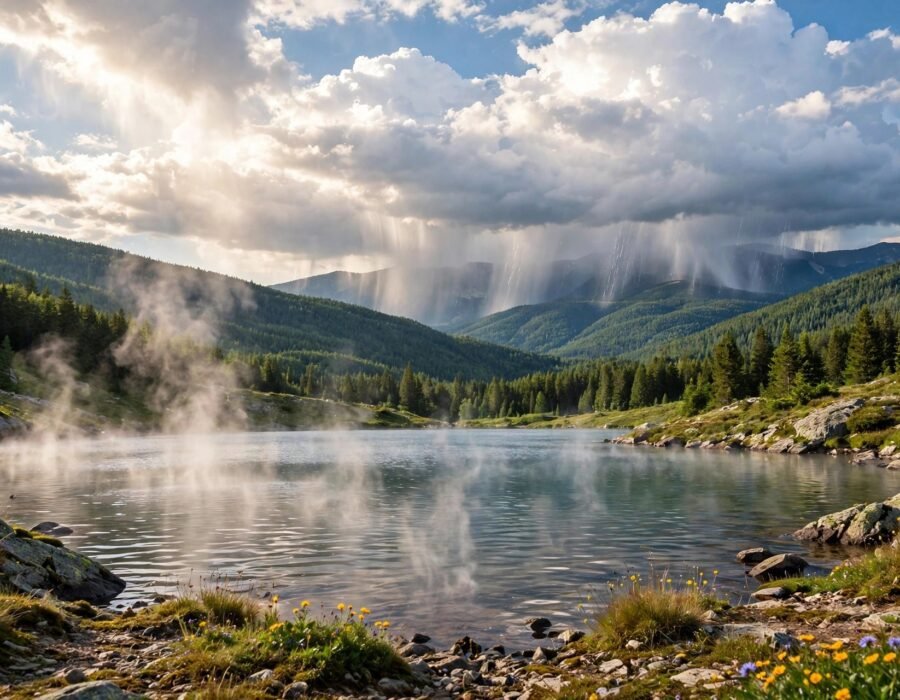
Evaporation: the Sun heats oceans, lakes, and rivers, and water molecules escape as invisible vapor — about 500,000 cubic kilometers yearly, 90% from oceans. Plants join in through transpiration, breathing out water vapor from leaves; together, evapotranspiration moves more water than all the world’s rivers. Condensation: rising vapor cools, clinging to tiny particles (dust, salt, pollution) to form cloud droplets — clouds are not vapor but liquid water (or ice) floating in air.
Precipitation: droplets collide and grow until gravity wins — rain, snow, sleet, or hail depending on temperature. A single raindrop gathers a million cloud droplets on its fall. Collection: water lands and goes places — some flows overland to rivers and oceans (runoff), some soaks underground into aquifers (infiltration), some freezes into glaciers, some is drunk by plants and animals. Then evaporation starts it again. The USGS Water Science School offers the best kid-friendly diagrams of this cycle on the internet — genuinely excellent for classrooms and curious families. And how much water you should actually drink every day is your personal connection to this planetary system.
The Hidden Parts: Groundwater and Glaciers
The visible cycle — rain, rivers, oceans — is only part of the story. Groundwater holds vastly more freshwater than all lakes and rivers combined: rain soaks through soil into aquifers, underground rock layers that store water for centuries or millennia. Wells tap these reserves; springs are where they surface naturally. But aquifers recharge slowly — pumping them faster than rain refills them (as in California’s Central Valley and India’s Punjab) depletes reserves built over thousands of years. It is a savings account being spent as income.
Glaciers and ice caps lock up about 68% of Earth’s freshwater — frozen reservoirs that release water slowly through melt. They are also climate archives: ice cores preserve 800,000 years of atmospheric history in layered ice. As they melt, they raise sea levels and disrupt the currents and weather patterns the water cycle depends on. The NOAA’s climate resources track these changes in real time. For young explorers, packing for a beach vacation with kids is a chance to see the cycle’s ocean phase up close — every wave is the collection step, waiting for the Sun.
How Old Is Your Water?
Some of your glass’s molecules evaporated last week; others fell as rain when mammoths walked; a few have cycled since before dinosaurs. Deep groundwater can be tens of thousands of years old — “fossil water” from wetter climates, mined like a mineral. The water cycle mixes these ages constantly, so every drink is a time-travel cocktail. Kids love this fact; adults should too.
Experiments to See It Yourself
The water cycle is wonderfully demonstrable. The bag-on-a-plant experiment: tie a clear bag over a leafy branch on a sunny day — by afternoon, droplets of transpired water coat the inside. The cold-glass experiment: ice water in a glass “sweats” as vapor condenses — a cloud in miniature. The puddle watch: mark a puddle’s edge with chalk and observe it shrink — evaporation made visible. For the ambitious: build a mini water cycle in a sealed container with soil, water, and a plant — a self-sustaining ecosystem in a jar.
These are not just cute demos — they are the actual science, at tabletop scale. Every meteorologist, hydrologist, and climate scientist started by noticing what you can notice this afternoon. The cycle is happening above you right now; you just needed to know where to look.
How Water Shapes Civilization
The water cycle is not just nature — it is history. Rivers enabled the first civilizations (the Nile, the Tigris, the Indus); droughts toppled empires (the Maya, the Akkadians); and modern cities exist where water is manageable. Today, 2 billion people lack safe drinking water, and water stress drives conflict and migration worldwide. Understanding the cycle is understanding the stakes: every reservoir, every aquifer, every glacier is a savings account, and humanity is drawing heavily. The kids learning the cycle today will manage its future — which makes the ten minutes well spent twice over.
The Bottom Line
The water cycle is evaporation, condensation, precipitation, and collection — Sun-powered, gravity-directed, endlessly recycling the same ancient water through oceans, clouds, rivers, groundwater, and ice. It is simple enough to demonstrate with a bag and a plant, and profound enough to underpin all life and civilization. The next time it rains, remember: you are watching dinosaurs’ drinking water fall from the sky. Drink up — it is all recycled, and it is all magnificent.
Frequently Asked Questions
Where does rain come from?
Ocean and land water evaporates (powered by the Sun), rises and cools, condenses onto tiny particles to form clouds, and falls when droplets grow heavy enough. About 90% of atmospheric moisture evaporates from oceans — most rain began as seawater.
Is the amount of water on Earth fixed?
Essentially yes — Earth is a closed system for water. The same ~1.4 billion cubic kilometers has cycled for billions of years. What changes is distribution: more locked in ice during ice ages, more in oceans during warm periods, and human redistribution through pumping and dams.
What is groundwater?
Water soaked into underground rock layers (aquifers), holding far more freshwater than all surface lakes and rivers. It recharges slowly from rain — centuries to millennia — so pumping it faster than recharge depletes ancient reserves. Many regions depend on it unsustainably.
How can kids see the water cycle in action?
Try the bag-on-a-leaf experiment (transpiration droplets appear by afternoon), the cold glass “sweating” (condensation), or marking a puddle’s edge to watch evaporation. Each demonstrates a real cycle stage at tabletop scale — genuine science, not just a demo.
Why is the ocean salty but rain isn’t?
Rain starts as evaporated water — and evaporation leaves salt behind. The salt stays in the ocean while pure water vapor rises, so rain is fresh. It is the same reason the ocean keeps getting its salt delivery from rivers but never returns it to the sky. The cycle is a one-way salt ratchet powered by the Sun — elegant and ancient. Every glass of water is a sip of deep time. Cheers to that — drink up, young explorer.