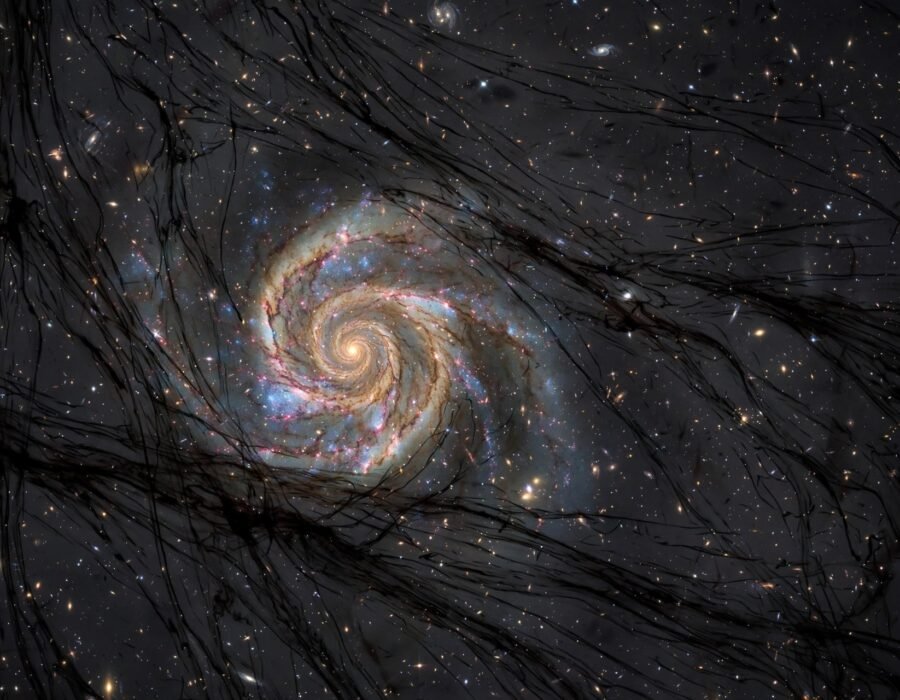
Everything you can see — stars, planets, galaxies, yourself — makes up less than 5% of the universe. The rest is dark: about 27% dark matter and 68% dark energy, substances we have never directly detected but whose existence is demanded by the evidence. If you want to know what is the best way to understand dark matter in plain English, here it is: dark matter is the universe’s invisible scaffolding, five times more abundant than ordinary matter, felt only through gravity, and one of the greatest mysteries in science.
The name is slightly misleading — “dark” means “does not interact with light,” not “evil” or “black.” Dark matter neither emits nor absorbs light; it is invisible to every telescope. We know it is there because galaxies behave as if they contain far more mass than we can see: stars at galaxies’ edges orbit too fast, galaxy clusters bend light too strongly, and the cosmic web’s structure requires far more gravity than visible matter provides.
The Evidence: Three Pillars
Pillar one: galaxy rotation curves. In the 1970s, Vera Rubin measured stars orbiting spiral galaxies and found the outer stars move just as fast as inner ones — impossible if only visible matter provided gravity, since orbital speed should drop with distance (as planets do around the Sun). Something invisible supplies the extra gravitational glue. Rubin’s data was initially resisted, then confirmed everywhere: every spiral galaxy shows the same anomaly.
Pillar two: gravitational lensing. Galaxy clusters bend light from background galaxies far more than their visible mass allows — the bending reveals the true mass distribution, and it is dominated by invisible halos far larger than the glowing galaxies within. Pillar three: the cosmic microwave background — the Big Bang’s afterglow — shows acoustic patterns whose precise shape requires dark matter’s gravitational influence in the early universe. Three independent lines of evidence, one conclusion: most matter is invisible. The Department of Energy’s dark matter research programs pursue direct detection, and their public explanations are models of clarity. For the visible side of cosmic wonder, the best documentaries to watch this year visualize these invisible structures beautifully.
What Could It Be?
The leading candidate is WIMPs — Weakly Interacting Massive Particles, hypothetical particles that feel gravity and the weak nuclear force but ignore light and ordinary matter. Decades of exquisitely sensitive detectors, buried deep underground to shield from cosmic rays, have found nothing — progressively ruling out WIMP parameter space without killing the idea. Alternative candidates: axions (ultralight particles that could convert to photons in magnetic fields), sterile neutrinos, and primordial black holes.
Then there is the radical alternative: maybe our theory of gravity is wrong. MOND (Modified Newtonian Dynamics) and its relativistic successors propose that gravity behaves differently at galactic scales, eliminating the need for dark matter. MOND explains rotation curves elegantly but struggles with galaxy clusters and the cosmic microwave background — where dark matter succeeds. Most physicists bet on particles, but the honest answer is that neither camp has closed the case. The NSF supports both detector experiments and theoretical work, because the answer will come from evidence, not preference.
Dark Matter vs. Dark Energy
Do not confuse them — they are unrelated mysteries sharing an adjective. Dark matter clumps under gravity, forming the scaffolding galaxies hang on. Dark energy is uniformly distributed and drives the accelerating expansion of the universe — a repulsive effect, the opposite of clumping. One is invisible mass; the other is invisible pressure. Cosmology’s dirty secret is that we do not understand 95% of the universe’s contents, and we named our ignorance twice.
Why It Matters
Dark matter is not academic trivia — it built everything. In the early universe, dark matter’s gravity pulled ordinary matter into the first structures; without it, galaxies, stars, planets, and people would not exist. The cosmic web — the vast filamentary structure connecting galaxy clusters — is dark matter’s architecture made visible by the galaxies draped on it. Understanding dark matter means understanding why the universe has structure at all.
And the quest drives technology: the ultra-sensitive detectors built for dark matter searches advance low-background physics, cryogenics, and photonics — techniques that migrate into medicine and industry. The same pattern appears across science: how AI is used in weather forecasting shows how hunting faint signals in noise transforms fields far beyond its origins. The search itself, win or lose, expands human capability. When (not if) dark matter is identified — or gravity rewritten — it will rank among the great discoveries, reshaping physics as profoundly as relativity did.
The Hunt for Dark Matter on Earth
The search happens a mile underground. Detectors like LUX-ZEPLIN (South Dakota), XENONnT (Italy), and PandaX (China) sit in deep mines, shielded by rock from cosmic rays, watching tons of liquid xenon for the faintest flash of a dark matter particle collision. They have found nothing — but “nothing” with ever-tightening precision is progress, ruling out vast regions of possibility. Complementary searches look for axions with resonant cavities, and the Large Hadron Collider tries to manufacture dark matter particles directly. Three approaches, one quarry, zero results so far — and physicists remain optimistic, because the evidence that something is there is overwhelming.
The Bottom Line
Dark matter is invisible matter, five times more abundant than everything we can see, revealed by galaxy rotations, gravitational lensing, and the Big Bang’s afterglow. It built the cosmic web and every galaxy in it. We do not know what it is — WIMPs, axions, or revised gravity are the contenders — but we know it is there with the confidence of triple-confirmed evidence. The universe’s greatest mystery is also its most common substance. We are the 5%.
Frequently Asked Questions
Have scientists directly detected dark matter?
No — all evidence is gravitational and indirect. Decades of direct-detection experiments have found nothing, progressively narrowing where WIMPs could hide. The search continues with ever-more-sensitive detectors; a discovery would be Nobel-caliber.
Could dark matter just be regular matter we can’t see?
Ruled out. The cosmic microwave background’s precise measurements limit ordinary matter to ~5% of the universe — brown dwarfs, black holes, and interstellar dust cannot account for the missing mass. Dark matter must be something fundamentally different.
What is the difference between dark matter and dark energy?
Dark matter clumps via gravity and built cosmic structure; dark energy is evenly spread and accelerates cosmic expansion. They are unrelated phenomena — one is invisible mass, the other is a repulsive effect. Physics named its two biggest mysteries confusingly similarly.
Will we ever solve the dark matter mystery?
Probably — the history of physics suggests every well-posed mystery eventually yields. Direct detection, particle collider production, or indirect astrophysical signals could each crack it. The timeline is uncertain, but the experimental program is the most ambitious in particle astrophysics.
How do we know dark matter isn’t just a measurement error?
Because three independent methods — galaxy rotation curves, gravitational lensing, and the cosmic microwave background — all demand the same missing mass. Independent lines of evidence converging on one answer is the gold standard of science; measurement error cannot coordinate across such different techniques. The case is closed on the “whether” — only the “what” remains.