
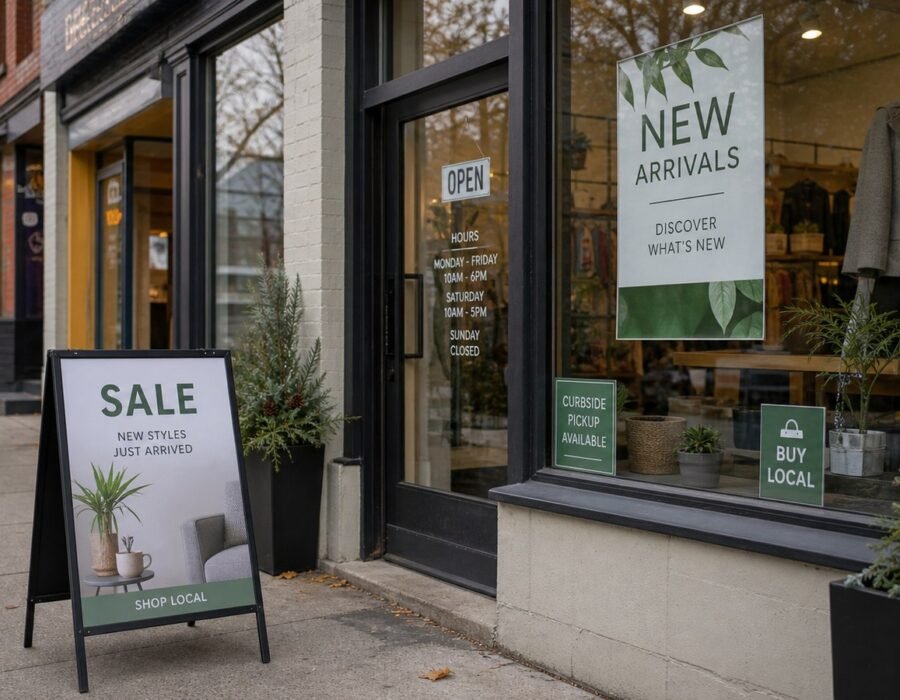
Big ad budgets are for big companies. The cheapest effective local advertising: Google Business Profile (free), Nextdoor ($0–$50/month), and $5/day Facebook ads targeted to a 10-mile radius. Here’s the full ranking from free to “still cheap.”
What Is the Cheapest Way to Advertise a Local Business?
Free tier (do all of these): Google Business Profile optimization (see our visibility guide) — the #1 free local channel. Nextdoor business page — neighbors recommend neighbors; insanely high trust. Yelp profile (free tier) — complete it even if you hate Yelp. Local Facebook groups — participate genuinely, not spammy. Under $50/month: $5/day hyperlocal Facebook/Instagram ads (10-mile radius, specific demographics — $150/month reaches thousands locally). Nextdoor ads ($30–$50/month in most markets). Under $200/month: Google Local Services Ads (pay per lead, not per click — plumbers, cleaners, lawyers love these).
Why Hyperlocal Digital Beats Everything
The math: $150/month in Facebook ads at a 10-mile radius = ~30,000–50,000 local impressions. A local newspaper ad: $300+ for one day, unmeasurable. Direct mail: $500+ per 5,000 homes. Digital wins on: targeting (show ads only to homeowners 35–65 within 8 miles), measurability (cost per lead, exactly), and flexibility (pause anytime). What still works offline: vehicle wraps/signage (one-time $500–$2,000, years of impressions), yard signs at job sites (free after $5/sign), and referral partnerships with complementary businesses (free, highest-converting).
The $100 Test Budget (Spend It Like This)
Got exactly $100 to test advertising? Week 1–2 ($40): Facebook/Instagram ad, 10-mile radius, one clear offer (“$20 off first cleaning”), optimized for messages/calls — not likes. Week 3 ($30): Boost your best-performing organic post to the same audience — social proof amplifies paid reach. Week 4 ($30): Retarget everyone who engaged (website visitors, video viewers) with a stronger offer — retargeting converts 3–5x better than cold. Measure: cost per lead (total spend ÷ leads). Under $15/lead for most local services = scale it up. Over $30/lead = fix the offer or targeting before spending more. Then: double down on what worked, kill the rest. This $100 test tells you more than $1,000 of guessing — and our marketing budget guide shows how to scale the winners.
Free Channels Most Businesses Ignore
- Referral program: $25 credit for referrer + referee — your cheapest acquisition channel, period.
- Community involvement: sponsor a Little League team ($200–$500/season) — logo everywhere, goodwill unlimited.
- Local press: pitch your story to the local paper — “local business does X” is exactly what they need.
- Partnerships: the wedding photographer partners with the florist; the plumber with the realtor. Cross-referral costs nothing.
Google Local Services Ads: The Pay-Per-Lead Option
Different from Google Ads — you pay per lead, not per click: How it works: “Google Guaranteed” badge at the very top of local search — customers call/message through Google, you pay $20–$60 per lead (varies by industry/market). Who it’s for: plumbers, electricians, cleaners, lawyers, HVAC — service businesses with high job values. The math: $40/lead × 10 leads = $400 for (typically) 3–5 jobs — at $300/job, that’s $900–$1,500 revenue on $400 spend. Requirements: background checks, insurance verification, license verification — Google vets you (which is why customers trust it). Vs. regular Google Ads: no click fraud (you pay for calls, not clicks), simpler management, but less control. Start with: a $300 test budget, track cost-per-booked-job (not cost-per-lead). For high-value services, it’s the best-paid channel available.
Vehicle Wraps: The Moving Billboard Math
One-time cost, years of impressions: Cost: $2,000–$4,000 full wrap, $500–$1,500 partial — lasts 5–7 years. Impressions: 30,000–70,000 daily in metro areas (Arbitron data). Cost per thousand impressions: under $1 — vs. $10–$30 for digital. The math: $3,000 wrap ÷ 6 years ÷ 365 days = $1.37/day for 50,000 impressions. Nothing in advertising touches this ROI. Design rules: big logo, big phone number, 3-second readability (they’re driving past) — no paragraphs, no QR codes (unscannable at speed). Who it suits: service businesses with branded vehicles (plumbers, electricians, cleaners, landscapers). Track it: dedicated phone number on the wrap — you’ll be shocked how many calls it generates. Park strategically: the wrapped truck at a busy job site is a billboard you don’t pay rent for.
Community Sponsorships: Goodwill That Converts
$200–$500 that buys what ads can’t: What to sponsor: Little League teams ($200–$500/season — logo on jerseys, banner at games), school events, charity 5Ks, local festivals. Why it works: parents remember who sponsored their kid’s team — for years. It’s trust transference, not impression counting. The ROI: unmeasurable directly, undeniable anecdotally — “we picked them because they sponsor the league” is a real sentence customers say. Maximize it: show up (coach, volunteer — presence beats logos), share it on social (see our social guide), and put it on your website (“Proud sponsor of…”). What to avoid: sponsoring everything (dilutes impact) — pick 1–2 and go deep. The businesses that win locally aren’t the ones with the biggest ad budgets — they’re the ones woven into the community fabric.
Measuring What Matters (The 3 Numbers)
Track three numbers, ignore the rest: 1) Cost per lead: total ad spend ÷ leads — by channel. Under $15 for most local services = scale; over $30 = fix or kill. 2) Lead-to-customer rate: leads ÷ customers — under 20% means follow-up or offer problems (see our follow-up system). 3) Customer acquisition cost: spend ÷ customers — must be under 1/3 of lifetime value. How to track: “How did you hear about us?” (every customer, every time) + a simple spreadsheet. Review monthly: 15 minutes — kill the worst channel, feed the best. What not to track: impressions, likes, followers — vanity metrics that correlate with nothing. Three numbers, monthly review, relentless optimization — that’s the entire measurement system.
The SBA’s marketing guidance for small businesses covers the fundamentals this article builds on — including how to set a marketing budget as a percentage of revenue. Their resources are free and written specifically for businesses without marketing departments.
How to Measure Advertising ROI on a Small Budget
Small-budget advertising lives or dies on measurement — you can’t afford to waste $200 learning nothing. The only metric that ultimately matters is cost per acquired customer (CAC): total spend on a channel divided by customers it produced. Everything else (clicks, impressions, likes) is vanity until tied to CAC.
Set up tracking before spending: ask every customer how they found you (log it in a spreadsheet), use unique phone numbers or promo codes per channel (Google Voice numbers are free), and add UTM parameters to ad links. For a $200/month budget, this manual tracking beats expensive analytics — you’ll know within 90 days which channel earns its keep.
The decision rule: any channel with CAC below one-third of customer lifetime value is a winner — feed it more budget. Channels above that get 90 days to improve, then get cut. Ruthless reallocation from losers to winners is how small budgets beat big ones.
Frequently Asked Questions
What is a good cost per click for local ads?
Varies enormously: $1–$3 for Facebook local, $2–$8 for Google Search local (higher for lawyers/plumbers, lower for restaurants). But CPC is vanity — a $5 click converting at 20% ($25/customer) beats a $1 click converting at 1% ($100/customer). Track to the customer.
How long before I know if an ad works?
90 days minimum for most channels — algorithms need learning time and customers need multiple exposures. Kill obvious failures earlier (zero conversions after 2 weeks with decent traffic), but don’t judge winners before 90 days of consistent spend.
Should I boost Facebook posts?
Rarely — boosted posts optimize for engagement (likes), not customers. Use Ads Manager with conversion objectives instead: same money, better targeting, measurable results. Boosting is Facebook’s tax on the lazy.
What is the cheapest advertising that actually works?
Google Business Profile optimization and review generation: $0 and consistently the highest-ROI local marketing. After that, referral programs ($20–$50 per referred customer) and hyperlocal Facebook ads ($5/day). Free and cheap beats expensive and unmeasured.
How do I track which ad brought a customer?
Ask directly (‘how did you hear about us?’), use channel-specific promo codes or phone numbers, and UTM-tag all links. For a small business, disciplined manual tracking outperforms neglected fancy analytics.
Is radio advertising worth it for local business?
Rarely on small budgets — broad reach wastes most impressions, and $500+ minimums buy little frequency. The exceptions: highly targeted local stations during drive time for businesses serving commuters. Test small before committing.
The bottom line
Free: Google Profile + Nextdoor + referrals. Cheap: $5/day hyperlocal Facebook ads. Test: the $100 budget above. Measure cost per lead, scale winners, kill losers. Local advertising isn’t about budget — it’s about targeting the 10 miles that matter and being the obvious choice when neighbors need you (see our local social media guide).



2 Comments