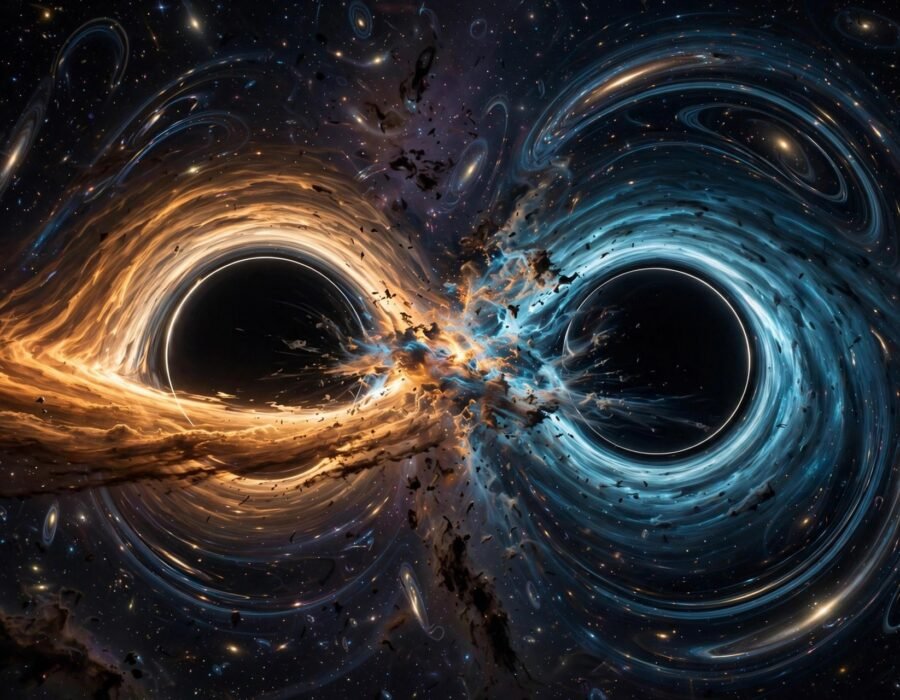
On September 14, 2015, at 5:51 a.m. Eastern time, the universe whispered. Two black holes, each about 30 times the mass of the Sun, collided 1.3 billion light-years away — and the ripple from that collision stretched and squeezed the entire Earth by less than the width of a proton. Detectors in Louisiana and Washington State caught it. Humanity had just “heard” spacetime itself for the first time. If you are wondering why should I care about gravitational waves in the US, it is because this discovery opened an entirely new sense with which to perceive the cosmos — like gaining hearing after a lifetime of only sight.
Gravitational waves are ripples in the fabric of spacetime, predicted by Einstein in 1916 and doubted — even by Einstein at times — for a century. Their detection confirmed one of physics’ boldest predictions, launched a new field of astronomy, and is already reshaping what we know about black holes, neutron stars, and the violent history of the universe. You do not need a physics degree to grasp why that matters; you just need curiosity about the 95% of reality we cannot see. For the visual side of cosmic wonder, the best documentaries to watch this year include stunning treatments of exactly these discoveries.
What a Gravitational Wave Actually Is
Spacetime is the four-dimensional fabric combining space and time, and mass dents it — that denting is gravity. When massive objects accelerate, especially in tight orbits or collisions, they radiate ripples outward at the speed of light: gravitational waves. Imagine the universe as a vast trampoline; rolling a bowling ball creates a dip, and two bowling balls spiraling into each other send shudders across the whole surface. Those shudders are gravitational waves, and by the time they reach Earth from a billion light-years away, they are unimaginably faint.
Everything with mass makes them — you generate gravitational waves when you wave your hand — but only the most violent cosmic events make detectable ones: merging black holes, colliding neutron stars, supernovae. The waves carry information that light cannot. Light gets blocked by dust, scattered by gas, and simply never escapes a black hole. Gravitational waves pass through everything untouched, delivering pristine reports from regions of the universe that are otherwise permanently hidden.
How LIGO Caught the Uncatchable
The Laser Interferometer Gravitational-Wave Observatory (LIGO) is arguably the most precise measuring device ever built. Each detector is an L-shaped vacuum tunnel 2.5 miles long per arm. Laser beams bounce between mirrors, and when a gravitational wave passes, it stretches one arm and squeezes the other by about 1/10,000th the width of a proton — a change so small it is like measuring the distance to the nearest star to the width of a human hair. Detecting that required isolating the mirrors from earthquakes, traffic, ocean waves, and even quantum fluctuations of the laser light itself.
The first detection, GW150914, was almost suspiciously perfect: a textbook “chirp” signal rising in frequency as the black holes spiraled inward, exactly matching Einstein’s equations. Since then, LIGO and its partners Virgo (Italy) and KAGRA (Japan) have detected around a hundred events, all logged in the LIGO Scientific Collaboration’s public data releases. Each one is a census entry in a previously invisible population — and the census keeps surprising astronomers. Detecting such faint signals from overwhelming noise is a triumph of data science as much as physics; how AI is used in weather forecasting shows the same pattern of extracting weak signals from chaos, just pointed at clouds instead of cosmos.
The 2017 Kilonova: The Discovery That Changed Everything
In August 2017, detectors caught gravitational waves from two colliding neutron stars — and this time, telescopes saw the flash. For the first time, astronomers observed the same event in gravitational waves and light simultaneously: “multi-messenger astronomy.” The collision forged heavy elements — gold, platinum, uranium — in its fireball, solving a decades-old mystery about where the universe’s heavy elements come from. The gold in your wedding ring was made in a neutron-star collision detected as a ripple in spacetime. Let that sink in.
What They Have Already Taught Us
Before gravitational waves, astronomers had never directly observed a black hole merger — they inferred black holes from their effects. Now they have a catalog: black holes heavier than expected, spinning in unexpected ways, merging at surprising rates. Some detections revealed black holes in “forbidden” mass ranges that stellar theory said should not exist, forcing revisions of how massive stars die. Others showed mergers happening far more often than predicted, implying the universe is more violent — and more interesting — than models assumed.
The neutron-star merger gave us something else: a new way to measure the expansion of the universe. Gravitational waves encode the distance to their source directly, offering an independent check on the cosmic distance ladder — one of cosmology’s most contentious measurements. If the current “Hubble tension” (disagreeing measurements of cosmic expansion) is ever resolved, gravitational-wave “standard sirens” may be what does it. A century after Einstein’s prediction, his equations are now precision measurement tools.
Why It Matters to Non-Physicists
Fair question: what does any of this do for you? Start with the practical. LIGO’s absurd precision requirements spun off advances in lasers, optics, vibration isolation, and quantum measurement that migrate into industry — the same way the space program gave us memory foam and water filters. The detectors are funded substantially by the National Science Foundation, and NSF-supported research has a long record of such spillovers. The economic return on basic science consistently exceeds the investment; we just cannot predict which discovery pays off or when.
Then there is the deeper argument. Gravitational waves confirmed that spacetime is real and dynamic — not a backdrop but a participant. They let us “hear” black holes colliding across cosmic time, watch gold being forged, and test Einstein’s theory in the most extreme conditions imaginable. Every generation gets a few discoveries that permanently enlarge the human worldview. Heliocentrism. Evolution. The expanding universe. Gravitational-wave astronomy belongs on that list, and it is happening right now, in your lifetime.
The Bottom Line
Gravitational waves are ripples in spacetime from the universe’s most violent events, detected by the most precise instruments ever built. They have confirmed Einstein, revealed a hidden population of colliding black holes, shown us where gold comes from, and opened a new sense for exploring the cosmos. You should care because this is one of those rare moments when humanity’s picture of reality gets permanently bigger — and because the technologies born from chasing the impossible have a habit of changing everyday life a decade later.
Frequently Asked Questions
What creates gravitational waves?
Accelerating massive objects — most detectably, pairs of black holes or neutron stars spiraling into each other. These cataclysms warp spacetime so violently that ripples propagate outward at light speed. Everyday objects create them too, but far too weakly to ever detect.
How does LIGO detect something so tiny?
Each LIGO detector splits a laser beam down two 2.5-mile-long arms. A passing gravitational wave stretches one arm and squeezes the other by less than a proton’s width, shifting the interference pattern where the beams recombine. Extreme isolation from vibration and noise makes this infinitesimal change measurable.
Can gravitational waves hurt us?
No. By the time they reach Earth from cosmic distances, they distort space by absurdly tiny amounts — far below anything biological systems could register. You have been bathed in gravitational waves your entire life without effect.
What is next for gravitational-wave astronomy?
LISA, a space-based detector planned for the 2030s, will use three spacecraft millions of miles apart to detect lower-frequency waves from supermassive black hole mergers. Meanwhile, pulsar timing arrays are already hunting the background hum of countless distant mergers. The field is just getting started.