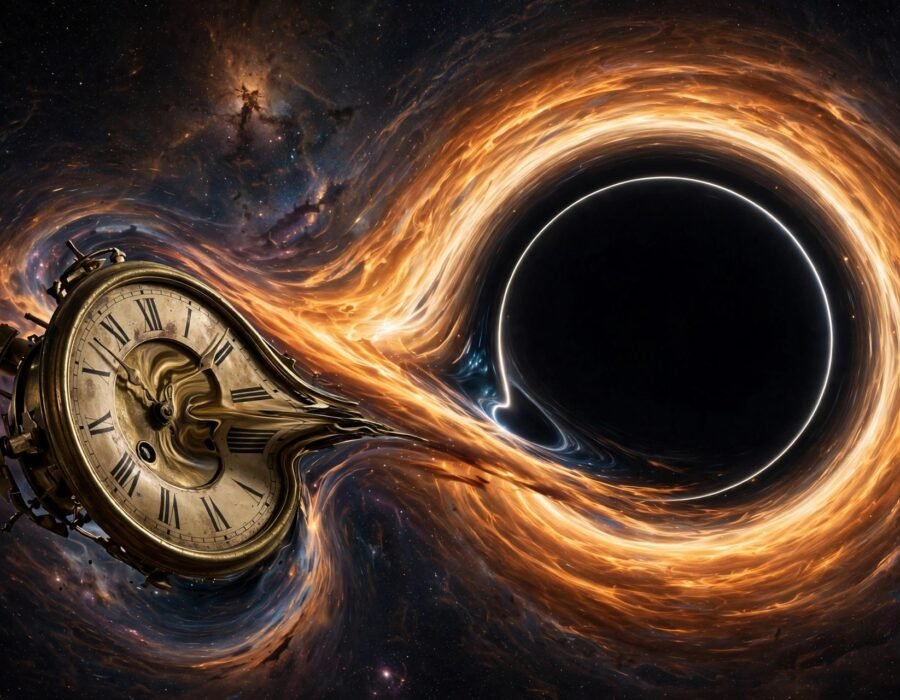
Imagine two clocks: one on Earth, one hovering near a black hole. After an hour passes on Earth, the black-hole clock reads only a few minutes. Both clocks are working perfectly. Neither is broken. Time itself is flowing at different rates in different places — and that sentence, though it sounds like science fiction, is one of the most thoroughly tested facts in physics. If you have ever wondered why is it so hard to understand why time slows near black holes, take comfort: it contradicts every intuition your brain evolved, because your brain evolved in a world where gravity is gentle and time seems universal.
The difficulty is not intelligence — it is that relativity asks you to abandon the stage on which all your thinking happens. We experience time as a river carrying everything along at the same speed. Einstein showed it is more like terrain: it flows differently in different places, shaped by mass and speed. Near a black hole, the most extreme object in the universe, that terrain becomes a waterfall. Understanding why requires rebuilding your mental model from the foundation — which is exactly what we will do, step by step.
Step One: Time Was Never Universal
Before Einstein, everyone — including Newton — assumed time ticked the same everywhere. Einstein’s 1905 insight was that the speed of light is constant for all observers, and something had to give to make that true. What gave was time itself. If you race toward a beam of light, the light does not approach you faster; instead, your time slows relative to a stationary observer so the math works out. This is special relativity: the faster you move through space, the slower you move through time, relative to someone standing still.
This is not theoretical. GPS satellites orbit fast enough and high enough that both their speed and their distance from Earth’s gravity change their clocks’ rates — engineers must correct for about 38 microseconds per day, or GPS positions would drift by miles within hours. Muons, subatomic particles created in the upper atmosphere, survive their trip to the ground only because time dilation extends their brief lives from Earth’s perspective. Time’s flexibility is an engineering fact, documented in NASA’s explanations of relativity, as routine as the best time to book holiday flights is a matter of timing strategy — except this timing is written into the universe.
Step Two: Gravity Is Time Flowing Unevenly
Einstein’s 1915 general relativity went further: gravity is not a force pulling you down, but the curvature of spacetime caused by mass. And here is the crucial part — where spacetime is more curved, time flows more slowly. Stand on Earth’s surface and your head ages slightly faster than your feet, because your feet are deeper in Earth’s gravity well. Physicists have measured this with atomic clocks separated by less than a meter of height. The effect on Earth is absurdly tiny, but it is real, and it is the same effect that becomes monstrous near a black hole.
Think of the classic trampoline analogy: a bowling ball (a star) dents the trampoline (spacetime), and marbles (planets) roll around the dip. Now imagine the dent getting deeper and steeper until it becomes a bottomless well — that is a black hole. Clocks deeper in the well tick slower as seen from outside, an effect confirmed by NIST’s ultra-precise atomic clock experiments. At the event horizon — the point of no return — the well becomes infinitely deep, and from a distant observer’s perspective, time at the horizon stops entirely.
Why Your Brain Rebels
Your intuition insists time is a universal background because, in your entire evolutionary history, the differences were too small to matter. Nothing in ancestral life required distinguishing your head’s time from your feet’s. Relativity violates what psychologists call “naive physics” — the built-in model of reality your brain uses to catch balls and dodge obstacles. Learning relativity means consciously overriding that model, which feels wrong even when the mathematics is airtight. The difficulty is a feature of your neurology, not a measure of your ability.
What You Would Actually See
Here is where it gets deliciously strange. Suppose your friend hovers near a black hole while you watch from a safe distance. You see their clock ticking slower and slower, their movements grinding toward stillness as they approach the event horizon. Their light gets redshifted — stretched to longer, redder wavelengths — until it fades to nothing. From your perspective, they never quite cross the horizon; they freeze and fade at its edge, forever.
But from your friend’s perspective, nothing special happens at the horizon. Their clock ticks normally. They cross in finite time — and then, inside, all paths lead to the singularity. Both perspectives are correct. This is the hardest pill: there is no single “true” account of when things happen. Simultaneity itself is relative. The universe does not have a master clock; it has countless local times, each valid in its own frame. If that makes your head hurt, you are understanding it correctly — even spending less time on your phone will not give you those hours back, but relativity says those hours were never absolute anyway.
Why Black Holes Are the Extreme Case
Time dilation happens everywhere — your phone’s GPS corrects for it daily. Black holes are simply where the effect goes to its limit. A black hole packs enormous mass into a tiny region, curving spacetime so severely that inside the event horizon, the geometry flips: moving toward the singularity becomes as inevitable as moving toward tomorrow. Time and space trade roles. Describing the interior requires mathematics, not metaphors, because no human intuition was built for a place where “forward in time” points at a crushing singularity.
Physicists still argue about what this means. Does time “stop” at the horizon, or is that just how it looks from outside? What happens to information that falls in? The black hole information paradox — whether the universe preserves a record of everything that crosses the horizon — remains one of physics’ deepest unsolved problems, with Stephen Hawking himself changing sides during his career. When the experts disagree, your confusion is not ignorance; it is honest engagement with the frontier.
The Bottom Line
Time slows near black holes because mass curves spacetime, and curved spacetime means time flows at different rates in different places — an effect confirmed daily by GPS satellites. Near a black hole, the curvature becomes so extreme that time, viewed from outside, grinds toward a standstill at the event horizon. It is hard to understand because your brain evolved assuming universal time, and relativity demands you abandon that assumption. But the mathematics is precise, the experiments confirm it, and the strangeness is the point: the universe is under no obligation to match your intuition.
Frequently Asked Questions
Does time really stop at a black hole’s event horizon?
From the perspective of a distant observer, yes — infalling clocks appear to slow asymptotically toward a stop, and infalling objects appear frozen at the horizon. But someone falling in experiences time normally and crosses in finite time. Both descriptions are correct in their own reference frames; there is no universal “now.”
Has time dilation been proven?
Repeatedly. GPS satellites require relativistic corrections to function, atomic clocks at different altitudes tick at measurably different rates, and fast-moving particles live longer than their rest lifetimes predict. Time dilation is among the best-tested phenomena in all of physics.
Could time dilation be used for time travel?
Forward time travel, in a limited sense, is real: travel near light speed or park near a black hole, and you age slower than everyone back home — you effectively travel into their future. Backward time travel remains forbidden by everything we know. The universe allows fast-forward, not rewind.
Why can’t I feel time slowing down?
Because you always experience your own time normally — your brain, your clock, and your body all slow together, so there is no internal reference to notice the change. Time dilation is only visible when comparing clocks that took different paths through spacetime. Within your own frame, a second is always a second.