You’re 55, you tried a yoga class, and the balance poses were… humbling. Standing on one leg felt like a circus act, and touching your toes is a distant memory from a younger body. Here’s what nobody tells you: balance and flexibility after 50 aren’t vanity metrics — they’re among the strongest predictors of healthy aging. Poor balance predicts falls (the leading cause of injury in older adults); poor flexibility predicts loss of independence (can’t reach, bend, or get up = can’t live alone). The good news: both respond to training at any age, and the program is simpler than you think. This guide gives Americans over 50 the complete plan.
You’ll learn why balance and flexibility matter more after 50, the science of how they decline (and rebound), a safe progressive program, the specific exercises with the best evidence, and how to fit it into real life.
Why This Matters More Than You Think
Balance: After 50, balance declines ~10–15% per decade — driven by deteriorating proprioception (your body’s position-sense), weaker stabilizer muscles, slower reaction times, and vision changes. Falls aren’t just embarrassing; they’re dangerous — one in four Americans 65+ falls yearly, falls are the leading cause of hip fractures, and hip fractures carry significant mortality risk. Balance training is quite literally life-extending exercise.
Flexibility: Connective tissues stiffen with age (collagen cross-linking increases, elastin decreases), joints lose range of motion, and the dreaded cycle begins: stiffness → less movement → more stiffness. Maintaining flexibility preserves the ability to perform daily activities — reaching overhead cabinets, bending to tie shoes, turning to check blind spots, getting up from the floor. These aren’t athletic feats; they’re independence.
The remarkable part: both capacities are highly trainable after 50. Studies show significant balance improvements within 8–12 weeks of targeted training in older adults, and flexibility gains continue at any age — the tissues respond to consistent stimulus regardless of the calendar. You’re not “too old”; you’re “perfectly positioned to benefit enormously.” The CDC’s older adult activity guidelines specifically recommend balance training alongside aerobic and strengthening work. The National Institute on Aging’s Go4Life program offers free balance exercise videos.
The Program: 15 Minutes, 3–4x Weekly
Balance progression (do near a wall or sturdy chair for safety):
Weeks 1–2 — Foundation: Single-leg stands (30 seconds per leg, fingertip on wall), heel-to-toe walking (20 steps, arms out), weight shifts (side to side, slow and controlled). Weeks 3–4 — Challenge: Single-leg stands without wall contact, tandem walking backward, single-leg stands with eyes closed (10 seconds — dramatically harder, huge proprioceptive gains). Weeks 5–8 — Integration: Single-leg stands on a cushion or folded towel (unstable surface), heel raises on one leg, gentle tai-chi-inspired weight shifting sequences. Ongoing: Add dual-task challenges — balance while counting backward, or catching a tossed ball. Real-world balance is balance while distracted; train it that way.
Flexibility progression (after a 5-minute warm-up walk — never stretch cold):
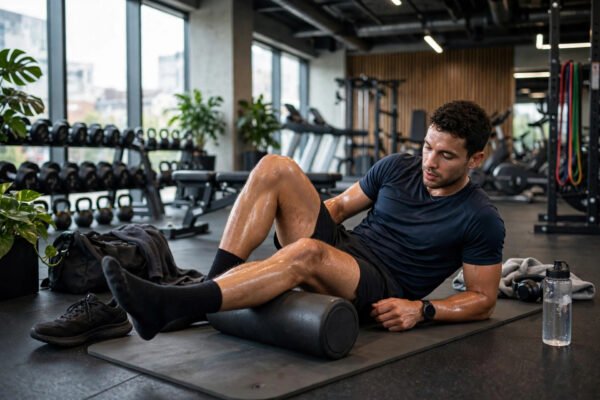
Major areas: Calves (wall stretch, 30s/leg), hip flexors (half-kneeling lunge stretch — the desk-worker’s nemesis), hamstrings (seated or standing, gentle — never bounce), chest/shoulders (doorway stretch — counteracts the hunched posture of modern life), thoracic spine (foam roller extensions — restores the upper-back mobility that decades of sitting steal), neck (gentle side tilts and rotations).
Method: Static stretches held 30–60 seconds per side, 2 rounds, breathing deeply (exhale into the stretch — the nervous system releases on the exhale). Mild tension is correct; pain is not. Flexibility improves through consistent gentle stretching, not occasional aggressive sessions — 15 minutes 4x weekly outperforms one brutal weekly session enormously.
For structured programming around this routine, AI-assisted home workout plans can generate progressive schedules — just ensure any plan respects the gradual progressions here.
The Highest-Evidence Activities
Tai chi: The single best-studied balance intervention for older adults — meta-analyses show it reduces fall risk by ~20–30%. The slow weight-shifting, single-leg stances, and mindful movement directly train every balance system. Community classes are widely available and inexpensive; it’s also the most enjoyable option for many.
Yoga (gentle/Hatha): Excellent for combined balance + flexibility, with the added benefits of strength and body awareness. Choose beginner or gentle classes explicitly — not power vinyasa. And don’t underestimate the social side: making new friends as an adult through class communities is a major adherence booster — the friendships keep people coming back as much as the exercise does.
Standing on one leg while brushing teeth: The habit-stacking champion — two minutes twice daily of balance training disguised as dental hygiene. It sounds silly; the cumulative volume (28 minutes weekly) produces real results. Switch legs halfway through brushing.
Walking on varied terrain: Trails, grass, sand — uneven surfaces train the ankle proprioceptors and stabilizers that flat sidewalks never challenge. It’s balance training disguised as a pleasant walk.
Safety Rules (Non-Negotiable)
Always have support nearby when practicing balance — a wall, counter, or sturdy chair within reach. Training balance means occasionally losing balance; that’s how the system learns. Losing it safely (hand shoots to wall) versus dangerously (fall) is entirely about setup.
Clear the area: No throw rugs, no clutter, no pets underfoot during balance practice. Most home falls involve environmental hazards, not exercise difficulty.
Footwear: Barefoot or flat supportive shoes for balance work — thick cushioned shoes destabilize (ironic but true). For flexibility, comfortable clothes that don’t restrict.
Medical considerations: If you have vertigo, uncontrolled blood pressure, severe osteoporosis, joint replacements, or neuropathy, get medical clearance and consider starting with a physical therapist for 4–6 sessions. These conditions don’t prohibit training — they require professional initial guidance. And check your medications: some blood pressure drugs and sedatives affect balance — worth a pharmacist conversation.
Frequently Asked Questions
How long until my balance improves?
Noticeable improvement in 4–6 weeks of consistent practice; significant, fall-risk-reducing improvement in 8–12 weeks. The single-leg stand test (how long you can stand on one leg eyes open) is a good monthly benchmark — aim to beat your own record.
Is it safe to stretch aggressively after 50?
No — aggressive stretching risks muscle and tendon injury in stiffer older tissues. Gentle, consistent, progressive stretching is both safer and more effective. Never bounce, never force, never stretch through sharp pain.
Can I regain flexibility I’ve lost over decades?
Yes — substantially, though perhaps not completely. Connective tissue remodels in response to consistent stretching at any age. Most 50+ adults regain functional range of motion (the kind daily life needs) within 3–6 months. Gymnast-level flexibility isn’t the goal; independence is.
Should I do balance or flexibility first in a session?
Balance first (when fresh and focused — it demands concentration), flexibility after (muscles are warm, nervous system is calm). Or split them: balance in the morning (toothbrush habit), flexibility in the evening (wind-down routine).
The Bottom Line
Improving balance and flexibility after 50 is one of the highest-leverage health investments available: 15 minutes, 3–4 times weekly, progressing from wall-supported single-leg stands to unstable-surface challenges, plus gentle full-body stretching after a warm-up. Add tai chi or gentle yoga for the evidence-backed boost, follow the safety rules religiously, and track your single-leg stand time monthly. This isn’t about athletic glory — it’s about staying upright, mobile, and independent for decades. The best time to start was ten years ago. The second-best time is today, next to a sturdy wall.