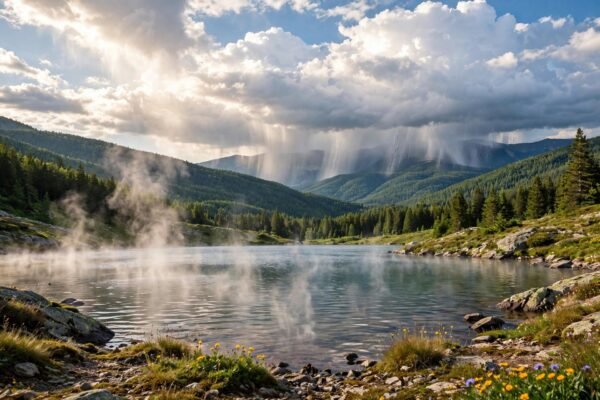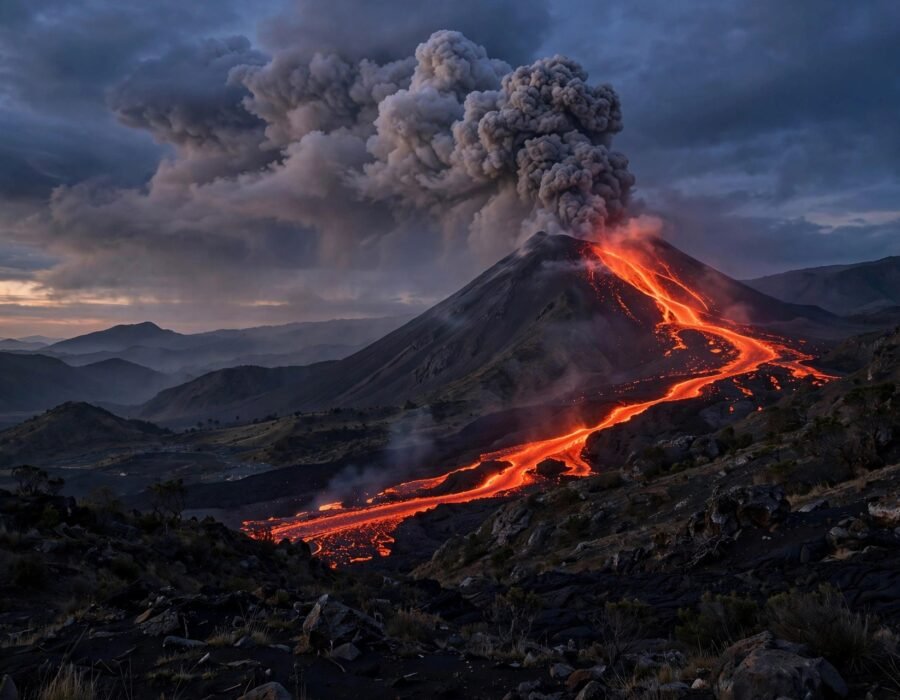
Somewhere on Earth right now, about 20 volcanoes are erupting. Beneath your feet — whether you live in Kansas or California — the planet is a roiling engine of molten rock, and volcanoes are its pressure valves. If you are wondering where can I learn about volcanoes from scratch, you have picked a spectacular subject: volcanology combines chemistry, physics, geology, and genuine danger, and it explains everything from the ground under Hawaii to the air you breathe. This is your complete beginner’s tour, no geology degree required.
A volcano is simply a vent through which molten rock reaches the surface. That molten rock has a journey: it forms deep underground where heat and pressure melt solid rock, rises because it is less dense than its surroundings, collects in magma chambers, and eventually forces its way up. What happens at the surface — gentle lava fountain or civilization-ending explosion — depends on the magma’s chemistry, mainly its silica content and trapped gas. That single variable explains nearly all volcanic diversity.
How Volcanoes Form: Three Recipes
Most volcanoes form at plate boundaries, where Earth’s tectonic plates meet. At divergent boundaries (like Iceland’s rift), plates pull apart and magma wells up to fill the gap — typically runny, basaltic lava that builds broad shield volcanoes. At convergent boundaries (like the Pacific Ring of Fire), one plate dives beneath another; the descending plate releases water, which lowers the melting point of the rock above, generating gas-rich, silica-heavy magma — the recipe for explosive stratovolcanoes like Mount St. Helens and Pinatubo.
The third recipe is the hotspot: a plume of hot mantle rising far from any plate boundary, punching through the crust like a blowtorch. Hawaii is the textbook case — the Pacific plate drifts over a stationary hotspot, creating a chain of volcanoes with the youngest (the Big Island) over the plume today. Yellowstone is a continental hotspot, a supervolcano whose past eruptions were thousands of times larger than anything in recorded history. The US Geological Survey’s volcano hazards program monitors all of America’s volcanic threats, and its public maps are fascinating browsing.
Why Some Erupt Gently and Others Explode
It comes down to viscosity and gas. Low-silica basaltic magma is runny — dissolved gases bubble out easily, like opening a soda slowly. Eruptions are effusive: lava fountains and rivers that destroy property but rarely kill people quickly (Hawaii’s Kilauea is the archetype). High-silica rhyolitic magma is thick as cold honey — gases cannot escape, pressure builds, and the result is explosive: the magma shatters into ash and pumice, launching eruption columns miles high.
The explosive eruptions produce the famous killers: pyroclastic flows (avalanches of superheated gas and rock racing downhill at 400+ mph — nothing outruns them), lahars (volcanic mudflows that bury valleys), and ashfall that collapses roofs, kills crops, and grounds aircraft. The 1980 Mount St. Helens eruption — the lateral blast that flattened 230 square miles of forest — remains America’s defining modern eruption. Understanding the difference matters for the millions of Americans living near Cascade volcanoes today. NOAA tracks volcanic ash for aviation safety, since ash clouds can flame out jet engines hundreds of miles from the eruption.
Reading the Warning Signs
Volcanoes usually telegraph their punches: swarms of small earthquakes as magma moves, ground swelling measurable by GPS, increased gas emissions, and changes in hot springs. Modern monitoring catches most dangerous eruptions in advance — the 1991 Pinatubo evacuation, guided by USGS scientists, saved tens of thousands of lives. The volcanoes that kill are usually the unmonitored ones, or the ones whose warnings were ignored. Prediction is not perfect, but it is enormously better than it was fifty years ago, thanks to the same sensor-and-model revolution behind AI-assisted weather forecasting. Continuous GPS networks can now detect ground swelling of mere millimeters, giving weeks of extra warning.
Volcanoes Shaped Your World
This is the part most beginners miss: volcanoes are not just destructive curiosities; they built the world. The early Earth’s atmosphere and oceans came substantially from volcanic outgassing. Volcanic soils are among the most fertile on Earth — which is why people farm the slopes of Etna and Merapi despite the risk. The 1815 Tambora eruption caused the “Year Without a Summer” in 1816, with snow in July in New England and global famine — a single volcano altered human history.
On geological timescales, the stakes get existential. Supervolcano eruptions and flood-basalt events correlate with several mass extinctions, including the end-Permian “Great Dying” 252 million years ago. The good news: civilization-ending eruptions happen every tens of thousands of years, not on human schedules. The bad news: Yellowstone will erupt again someday. Volcanology’s job is making sure “someday” does not catch us unprepared.
Eruptions That Changed History
A few eruptions deserve special mention. Santorini (~1600 BCE) may have ended Minoan civilization and inspired the Atlantis legend. Vesuvius (79 CE) buried Pompeii, preserving a Roman city in ash — archaeology’s greatest time capsule. Tambora (1815) caused the Year Without a Summer, triggering famines across the Northern Hemisphere. Krakatoa (1883) produced the loudest sound in recorded history, heard 3,000 miles away, and painted the blood-red skies in Edvard Munch’s famous painting. Each one reminds us that volcanoes are not scenery; they are historical actors, capable of redirecting civilizations in a single afternoon.
The Bottom Line
Volcanoes are Earth’s pressure valves: magma rises at plate boundaries and hotspots, and its chemistry decides whether the eruption is a gentle fountain or a civilization-shaking blast. They are monitored, increasingly predictable, and responsible for the air you breathe and the soil that feeds you. If this tour sparked wanderlust, volcano tourism is a real thing — Hawaii, Iceland, Italy — just check activity alerts before booking, and read up on exchanging currency before traveling since the best volcanoes are rarely in your home currency zone.
Frequently Asked Questions
What is the difference between magma and lava?
Location. Magma is molten rock underground; the moment it reaches the surface, it is called lava. Same material, different address. The dissolved gases that escape during the transition are what drive explosive eruptions.
Can scientists predict volcanic eruptions?
Increasingly, yes — for monitored volcanoes. Earthquake swarms, ground deformation, and gas changes typically precede eruptions by days to weeks. The 1991 Pinatubo evacuation saved tens of thousands of lives. Unmonitored volcanoes and the exact timing of eruptions remain uncertain.
What is the most dangerous volcano in the US?
By the USGS threat ranking, Kilauea in Hawaii scores highest due to frequent activity near people, but Mount Rainier near Seattle-Tacoma is often called the most dangerous because of the millions living in lahar paths below it. Rainier has not erupted in 500 years, yet its lahars — volcanic mudflows — could reach populated valleys with little warning, which is why it is one of the most closely monitored volcanoes on Earth. Long Valley Caldera in California is the highest-threat supervolcano system.
Could Yellowstone erupt in our lifetime?
Extremely unlikely. Yellowstone erupts catastrophically roughly every 600,000–800,000 years, and the last was 640,000 years ago — but “overdue” is a myth; volcanoes do not run on schedules. The USGS monitors it continuously with seismometers and GPS, and reports no signs of an impending eruption. Smaller hydrothermal explosions are possible but would be locally contained events.