Every black hole in the universe began as something magnificent: a star, burning bright, holding itself up against its own crushing weight for millions or billions of years — until it could not. What follows is one of the most violent events in nature, a collapse so complete that it punches a hole in reality itself. If you want to understand what is the best way to understand how black holes form in the US — or anywhere — the trick is to follow the life of a star, because black holes are not born. They are what is left when a star dies spectacularly.
The short version: stars are battlegrounds between gravity pulling inward and nuclear fusion pushing outward. For most of a star’s life, the battle is a stalemate. When the fuel runs out, gravity wins — and for the most massive stars, gravity wins so completely that nothing can stop the collapse. Not atoms, not neutrons, nothing. The result is a region where gravity is so intense that not even light escapes: a black hole. Let us walk through how that happens, stage by stage.
Act One: A Star’s Balancing Act
A star is born when a cloud of hydrogen collapses under gravity until its core gets hot and dense enough for nuclear fusion — hydrogen fusing into helium, releasing the energy that makes stars shine. From that moment, two forces oppose each other: gravity crushing inward, radiation pressure from fusion pushing outward. This balance, called hydrostatic equilibrium, can last billions of years. Our Sun is in this stable phase now and will be for another five billion years.
But fusion is a ladder, and stars climb it one element at a time. Hydrogen becomes helium; helium becomes carbon and oxygen; carbon becomes neon, magnesium, silicon — each stage burning hotter and faster than the last, as NASA’s stellar evolution resources describe. A star’s fate is decided by how far up this ladder it can climb, which depends entirely on its mass. Small stars stop at carbon. Only the true giants — stars born with more than about 20 times the Sun’s mass — climb all the way to iron. And iron is where the story turns dark. Modeling these stellar life cycles requires enormous computation; how AI is used in weather forecasting offers a glimpse of the same supercomputing approach applied to Earth’s atmosphere instead of a star’s interior.
Act Two: The Iron Catastrophe
Iron is nuclear ash. Fusing iron consumes energy instead of releasing it — the ladder ends. When a massive star’s core turns to iron, the outward push of fusion vanishes in an instant, and gravity, which has been waiting billions of years, finally wins. What happens next is almost too fast to describe: the iron core, roughly the size of Earth but far denser, collapses in less than a second. The outer layers, suddenly unsupported, come crashing down at a quarter of the speed of light.
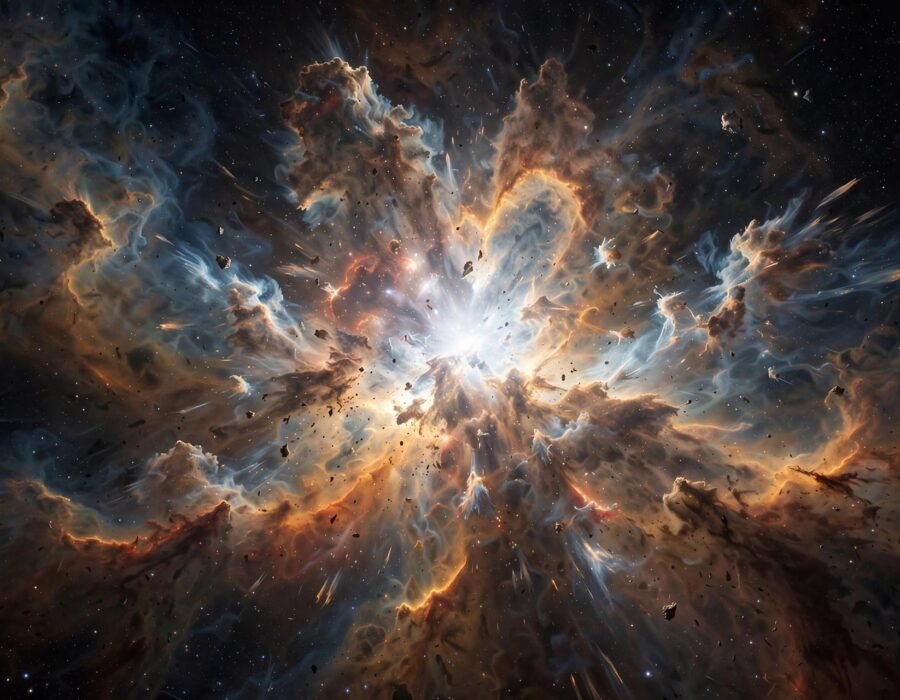
The core compresses until the atoms themselves collapse — electrons forced into protons, creating neutrons and a flood of neutrinos. For a fleeting moment, the core becomes a neutron star: a city-sized ball denser than an atomic nucleus, where a teaspoon would weigh a billion tons. The infalling outer layers hit this unimaginably rigid surface and rebound, driving a shockwave outward. That rebound is the supernova — an explosion that briefly outshines an entire galaxy and forges the heavy elements: the calcium in your bones, the iron in your blood, the gold in your ring. The best documentaries to watch this year include visualizations of this exact moment that no words can match.
Why Iron, Specifically?
Iron-56 sits at the peak of the nuclear binding-energy curve — the most stable nucleus in existence. Fusing lighter elements releases energy because the products are more tightly bound; fusing iron would produce less tightly bound nuclei, costing energy instead. Stars are energy-limited machines: once the core reaches iron, there is no fuel left that pays for itself. The shutdown is total and instantaneous, which is why the collapse is so violent.
Act Three: When Even Neutrons Give Up
Here is the fork in the road. If the collapsing core is below about 2–3 solar masses, neutron degeneracy pressure — the quantum-mechanical refusal of neutrons to occupy the same state — halts the collapse, leaving a neutron star. But if the core is heavier, nothing stops it. Gravity overwhelms even neutron degeneracy. The collapse continues past every known form of matter, past every force physics can describe, toward infinite density: a singularity.
As the collapse passes the critical point, the escape velocity at the surface exceeds the speed of light. Since nothing outruns light, nothing escapes — not matter, not radiation, not information. An event horizon forms: a one-way boundary in spacetime. From outside, the star seems to vanish, leaving only its gravity behind. The black hole is born — not as an object in the normal sense, but as a region of spacetime cut off from the rest of the universe. What happens at the singularity itself is unknown; our physics breaks down, which is the honest way of saying the most interesting part is still a mystery.
Other Ways to Make a Black Hole
Stellar collapse is the classic route, but not the only one. Neutron stars in binary systems can merge — spiraling together over millions of years until they collide, sometimes forming a black hole and broadcasting gravitational waves across the cosmos. Dense star clusters may build intermediate-mass black holes through runaway mergers. And the supermassive black holes at galaxy centers — millions to billions of solar masses — probably grew from smaller seeds through mergers and gas accretion over cosmic time, though their exact origin story is still debated.
Theorists have also proposed primordial black holes, formed from density fluctuations in the first second after the Big Bang. These could be as small as asteroids and might even constitute dark matter — a hypothesis explored in Department of Energy cosmology research — though decades of searches have found no evidence. The universe seems to prefer making its black holes the dramatic way: from the deaths of giant stars.
The Bottom Line
Black holes form when massive stars exhaust their fuel: fusion’s outward push vanishes, the iron core collapses in under a second, the rebounding outer layers explode as a supernova, and if the remaining core is heavy enough, gravity crushes it past the point of no return. What is left is not a thing but a place — a region where spacetime itself is so warped that escape is impossible. Every black hole is a monument to a dead star, and every atom of iron in your blood is a souvenir of a supernova that succeeded where others collapsed completely.
Frequently Asked Questions
Can our Sun become a black hole?
No. The Sun is far too small — it will end as a white dwarf, a cooling ember the size of Earth. Only stars born with roughly 20+ solar masses have cores heavy enough to collapse past neutron-star density into black holes.
What is the singularity?
The point (or region) at a black hole’s center where our current physics predicts infinite density — where general relativity breaks down. It is less a “thing” and more a signpost reading “new physics needed.” A quantum theory of gravity is required to describe it, and we do not have one yet.
How long does it take a black hole to form?
The final collapse takes less than a second. But the lead-up — the star’s entire life of fusion, climbing the elemental ladder to iron — takes millions of years for the most massive stars. The supernova explosion itself unfolds over hours to months of observable fireworks.
Do black holes grow?
Yes, by accreting gas and dust and by merging with other black holes. Each meal increases the event horizon’s size. The supermassive black holes at galaxy centers grew to billions of solar masses this way over cosmic time — though exactly how the first seeds formed remains an open question.