You’re three weeks into a jogging routine along the California coast — feeling stronger, sleeping better, genuinely enjoying it — and then it starts: a dull ache below the kneecap after every run. You ice it, it fades, you run again, it returns. Welcome to the most common dilemma in recreational running: is preventing knee injuries while jogging worth the effort, or is some knee pain just the price of the sport? The evidence is clear — most jogging knee injuries are preventable, and the prevention is simpler than the rehab. This guide gives California joggers the complete prevention playbook.
You’ll learn why joggers’ knees get hurt (the actual mechanisms), the training errors that cause most injuries, the strength and mobility work that protects knees, shoe and surface choices that matter, and when pain means stop versus when it means adapt.
Why Jogging Hurts Knees (The Mechanisms)
The knee is a hinge caught between two highly mobile joints — the hip and the ankle. When either neighbor malfunctions, the knee pays. The most common jogging knee issues: patellofemoral pain syndrome (“runner’s knee”) — aching around or behind the kneecap, caused by the patella tracking poorly in its groove, usually from weak hips/glutes letting the knee collapse inward; IT band syndrome — sharp pain on the outer knee, from the iliotibial band rubbing over the femoral condyle, classic in runners who ramp mileage too fast; patellar tendinopathy (“jumper’s knee”) — pain at the bottom of the kneecap, an overload injury of the tendon from too much too soon.
Notice the pattern: these are overwhelmingly overuse injuries, not impact injuries. The folk belief — “running destroys knees” — is largely myth. Multiple long-term studies show recreational runners have lower rates of knee osteoarthritis than sedentary people; running strengthens the cartilage and supporting structures when dosed properly. Knees aren’t damaged by jogging — they’re damaged by badly managed jogging. The American Academy of Orthopaedic Surgeons publishes detailed runner’s knee treatment guides. The CDC’s physical activity resources note that the health benefits of regular running vastly outweigh injury risks for most adults.
The Training Errors That Cause Most Knee Injuries
Error 1: Too much, too soon. The 10% rule (increase weekly mileage no more than 10%) exists because tendons and bones adapt slower than cardiovascular fitness. Your lungs will happily run 20 miles weeks before your IT band agrees. Every knee injury story starts with a mileage or intensity jump.
Error 2: No strength training. Runners who only run develop the exact imbalances that hurt knees: weak glutes (knee collapses inward), weak hips (poor pelvic control), weak calves (poor shock absorption). Two 20-minute strength sessions weekly — squats, deadlifts, step-ups, clamshells, calf raises — prevent more knee injuries than any shoe, brace, or supplement.
Error 3: Ignoring the warning signs. Pain is data. The traffic-light system: Green — mild stiffness that warms up and disappears within the run: monitor, continue cautiously. Yellow — pain that appears during runs but doesn’t worsen, fading within 24 hours: reduce volume 25–50%, add strength work, reassess in two weeks. Red — sharp pain, pain that worsens during a run, limping, swelling, or pain lasting 48+ hours: stop running, see a professional. Most chronic knee injuries started as yellow lights that were ignored for months.
Error 4: All mileage, no variety. Running the same route, pace, and distance daily hammers identical tissues identically. Vary surfaces, include easy days (80% of mileage should feel easy), and cross-train — cycling and swimming maintain fitness while giving knee structures recovery variety. Even daily walking’s benefits compound when running volume drops during recovery weeks. For structuring balanced training, AI-assisted workout planning helps build programs that respect recovery.
Strength and Mobility: The Knee Protection Program
Twice weekly, 20 minutes. Glute medius (the knee’s guardian): clamshells (2×15/side), lateral band walks (2×12/side) — weak glute meds are the #1 biomechanical cause of runner’s knee. Quads and glute max: Bulgarian split squats (3×8/leg), step-ups (3×10/leg) — single-leg work exposes the imbalances bilateral exercises hide. Calves: straight-knee and bent-knee calf raises (3×15 each) — the calf-Achilles complex absorbs enormous running forces. Hip flexors and ankles: couch stretch for hip flexors (tight hips alter stride mechanics), calf wall stretches and ankle mobility drills (restricted ankles force knees to compensate).
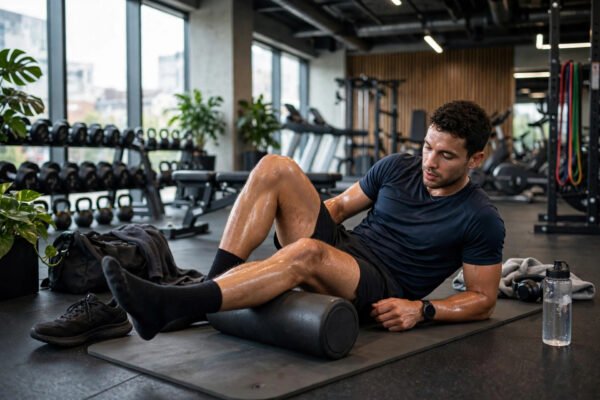
Foam rolling: Quads, IT band (gently — it’s not a muscle, don’t brutalize it), and calves for 5 minutes post-run. The evidence for injury prevention is modest, but for tissue quality and soreness management it’s worthwhile — and the ritual enforces the cooldown most runners skip.
Progress this like running: start with bodyweight, add resistance gradually. The goal isn’t bodybuilder legs — it’s resilient joints. Two months of consistent strength work transforms most runners’ injury risk profile more than any other single intervention.
Shoes, Surfaces, and California Specifics
Shoes: Replace every 300–500 miles (track it — dead shoes are a top injury correlate). Get fitted at a running specialty store with gait analysis, not based on online reviews. The “best” shoe is the one matching your mechanics. Rotate two pairs if you run 4+ times weekly — varying the stress slightly reduces overuse patterns. And ignore the minimalist/maximalist wars: transition gradually if changing shoe types (8–12 weeks), because abrupt changes injure more runners than either shoe type.
Surfaces: Variety protects; monotony injures. Concrete is the harshest (but fine in moderation), asphalt slightly better, dirt trails and tracks kindest. California’s advantage: beach paths, park trails, and crushed-granite park loops are everywhere — use them. Avoid permanently cambered roads (running always on the same road camber stresses one side).
California specifics: Year-round running weather is a blessing and a curse — no off-season means no natural recovery breaks, so schedule deload weeks deliberately. Heat changes mechanics subtly (dehydrated, fatigued runners alter stride) — hydrate aggressively on warm runs. And the hills: San Francisco-style hills build tremendous strength but hammer knees downhill — shorten stride, increase cadence on descents, and build hill volume gradually.
Frequently Asked Questions
Will jogging ruin my knees long-term?
No — recreational jogging is associated with lower osteoarthritis rates than sedentary living. The key word is recreational and well-managed: reasonable mileage, strength training, good shoes, and respecting pain signals.
Should I run through knee pain?
Use the traffic-light system: mild stiffness that resolves = cautiously continue; pain during runs = reduce volume and add strength work; sharp/worsening/swelling pain = stop and get assessed. “Push through” is how 2-week issues become 6-month injuries.
Do knee braces help prevent injuries?
For healthy knees, braces offer minimal prevention benefit — strength training outperforms them enormously. For previously injured knees, a brace can provide proprioceptive confidence during return-to-running, but it’s a bridge, not a solution.
How do I know if I need new running shoes?
Track mileage (300–500 mile lifespan), check tread wear patterns (uneven wear reveals gait issues worth addressing), and notice new aches appearing in previously comfortable runs — often the first sign of dead shoes.
The Bottom Line
Preventing knee injuries while jogging in California is absolutely worth it — and it’s simpler than the running industry’s product catalog suggests: increase mileage gradually (10% rule), strength-train twice weekly (glutes, single-leg work, calves), respect the pain traffic lights, vary surfaces, replace shoes on schedule, and schedule recovery in a state with no off-season. Your knees aren’t fragile — they’re adaptable. Train them like it, and they’ll carry you up those coastal hills for decades.